Metal detectors, social workers and naloxone: how Canadian libraries are responding to communities in crisis
“The public library is the community’s living room.”
Why It Matters
Libraries are increasingly having to deal with complex social issues such as homelessness, poverty and addiction as Canada’s existing safety nets strain under the weight of pandemic fall-out and austerity. However, libraries aren’t prepared to become a catch-all solution for systemic problems.
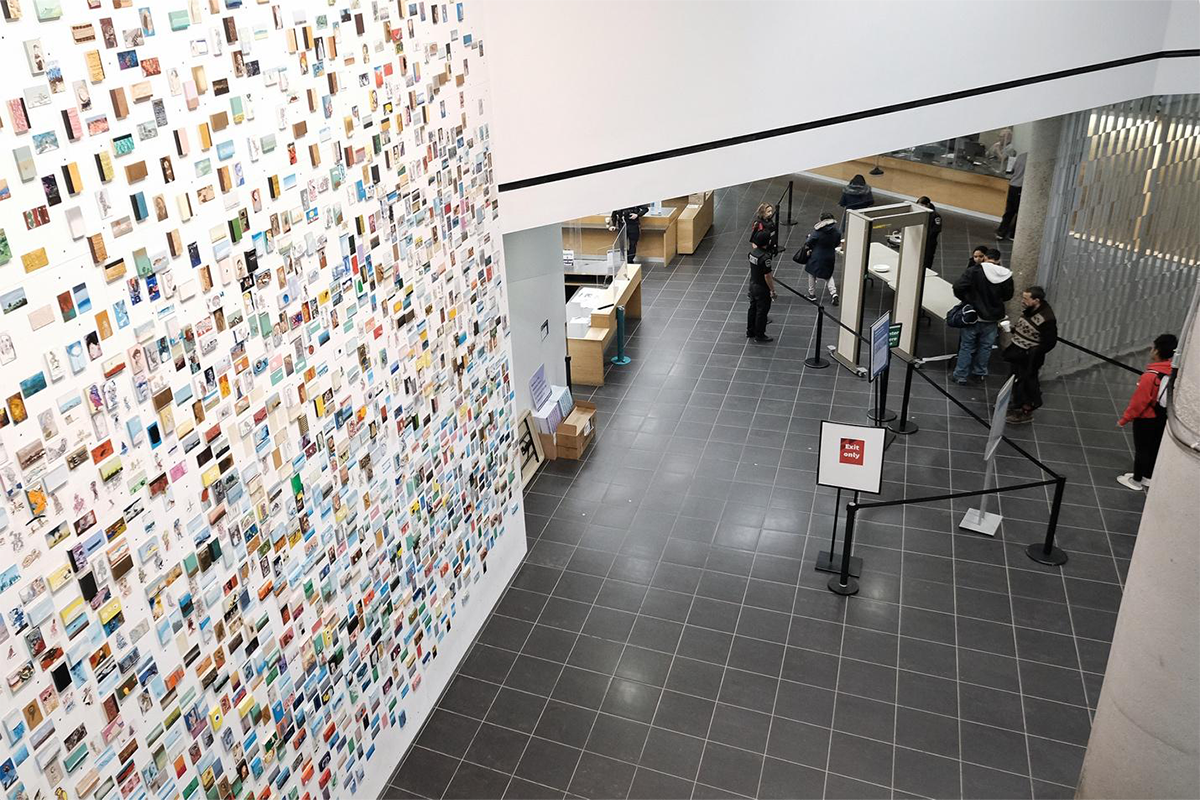
An art installation is juxtaposed against a security queue at the Millennium Library in downtown Winnipeg. Photo: Shannon VanRaes
WINNIPEG/TREATY 1 — Two armed police officers, thumbs jammed under their bulletproof vests, watch people queue at an airport-style metal detector as private security guards poke through bags with yellow sticks; from somewhere above a man yells “fascists” at the scene below.
Welcome to Winnipeg’s Millennium Library.
“I don’t like this at all. I’m only here because my mom asked me to pick something up. I don’t want to come back,” says Susan Plett before joining the line. “It really seems like too much.”
Another man, who doesn’t speak English, stops in front of signs detailing the library’s security procedures, then turns around and leaves. When similar security measures were imposed in 2019, annual visits fell by nearly 30 per cent.
Larry Ducharme comes to the Millennium Library almost every day and while he finds the process stressful, he says the added security measures are unfortunate but necessary.
“You have to take precautions,” says Ducharme. “There was a terrible incident here that was very serious, very bad, so I think they had to do this.”
That incident was the murder of 28-year-old Tyree Cayer, stabbed to death by four teenage boys last December. The library, which is connected to Winnipeg’s police headquarters by a public walkway, remained shuttered for six weeks while additional security measures were established.
While extreme, the incident wasn’t entirely isolated. Public libraries across Canada are seeing increased levels of violence. Seven people were stabbed, one fatally, at the Lynn Valley Library in North Vancouver in 2021 and in 2019 a woman was violently attacked outside Hamilton’s main branch. Last spring, a security guard with the London Public Library was sent to hospital after an assault and earlier this year, a senior citizen was beaten unconscious inside Calgary’s Central Library—the list could go on.
A recent survey of library staff in Saskatchewan, commissioned by the Canadian Union of Public Employees, found 78 per cent had experienced verbal abuse, while 71 per cent reported witnessing violence. A further 50 per cent of those polled said they’ve been the victim of violence themselves.
A 2020 investigation by CBC found violent incidents at the Toronto Public Library had more than doubled over a seven year period. In 2011, there were 103 cases of violence and 262 cases of threatening behaviour — by 2018, those numbers had jumped to 249 and 623 respectively.
Those working in the sector say public libraries have long been at the forefront of complex social issues, rooted in poverty, colonialism, addiction and a healthcare system that fails to meaningfully address mental health, but that the COVID-19 pandemic exacerbated existing challenges.
“Whatever’s happening in our communities, we see that in our public libraries, because the public library is the last space where everybody is welcome and supported,” says Sharon Day, executive director of customer experience at the Edmonton Public Library.
“The public library is the community’s living room.”
Elizabeth Sutter, service manager at the London Public Library, has noticed a pronounced uptick in the number of people experiencing homelessness in recent years, many of whom make use of library resources. “Coming out of the pandemic there’s been a real social shift in terms of people who have been left homeless, as well as people who have addiction issues,” she says.
A new study from the Lawson Health Research Institute backs-up those observations, with some experts predicting the situation will get worse before it gets better as Canada’s cost-of-living crisis continues to deepen. The federal government estimates that 235,000 Canadians experience homelessness in any given year, but experts say the true number could be three times that.
“Our community — across Canada, across North America — is struggling,” says Heather Hill, an associate professor at Western University’s Faculty of Information and Media Studies and graduate chair of the Librarian Information Science Program. “We’re in the middle of an opioid crisis. We’re in the middle of a housing crisis. We’re in the middle of a food pricing crisis. And, we’re three years into a pandemic, so that’s a lot.”
Libraries are not positioned to address the root causes of these issues, but they are nonetheless having to navigate their complex and evolving fallout.
Aly Velji, manager of adult literacy services at the Toronto Public Library, sees the library’s role as helping customers as best as possible — whether they need to find a reference book or a safe injection site.
“A lot of individuals who are experiencing homelessness might just need a welcoming and open space for them to come to,” Velji says. “They might spend the whole day here because they may not have another place to go or maybe they just feel safe here.”
Ducharme, who was unhoused for a number of years, says the library was often the only place he could go to stay warm in winter or cool in summer. He says malls and coffee shops usually kicked him out when he couldn’t purchase anything and most shelters close their doors during the middle of the day — even during Winnipeg’s legendarily cold winters.
While he now lives in a rooming house, Ducharme doesn’t own a phone or computer and visits the library to stay connected with friends and resources. “I’m kind of just living at the very fringe,” he says. “I need the library. It was really hard when it was closed.”
Not a complete picture
Day stresses that while violent incidents may grab headlines, they don’t paint a complete picture of the situation facing libraries. “We had over 3.5 million visits last year and less than 0.1 per cent of those visits escalated into what we would consider an incident,” she says.
But libraries, particularly those located in the core of large urban centres, are seeing more patrons in crisis and face tough decisions about how to handle an influx of people primarily looking for shelter. In 2015, the Edmonton Public Library instituted a “no sleeping policy” at all its branches.
Created in consultation with community partners, it was devised in part to address concerns around opioid poisonings and fears someone in medical distress would be mistaken for a sleeping patron. The EPL recorded 99 opioid poisonings in 2022, most of which occurred at its downtown branch.
But the decision was also about defining the library’s core mandate.
“We were filling a role with the best of intentions to support our community members,” says Day. “But it was actually — within the broader societal landscape of social supports — not the role of the public library to fill the need of a day shelter.”
When someone is found sleeping, Day says staff work with them to find a safe place for them to go to. The library also hired its first social worker in 2015 to assist in the policy’s implementation and better direct people to resources.
“Library staff aren’t trained in social work,” Sutter says. “Yes, we can help find information for people, but we wouldn’t necessarily know what exactly the right thing might be for someone in crisis.”
With that in mind, the London Public Library has also hired a full-time social worker. Initially, the library brought in a wellness worker one day a week, but quickly found need outstripped capacity.
Sutter says the impact of having a social worker based at the library’s main branch has been noticeable. Patrons in need of healthcare, but unsure how to access have been connected with medical assistance, while those that might have used the library as a drug consumption site have been directed to a newly opened space in London’s downtown offering clean drug paraphernalia and supervision.
And, if a person is facing a library ban for something like disruptive behaviour, the social worker acts as a mediator. “She’ll come and say, well, this person’s trying to get clean. If we take away their access to the library, that’s not going to help them,” Stutter explains. “So then we revisit that and she has a conversation with them about, like, you’re being given a second chance here, don’t blow it.”
The Toronto Public Library hired its first full-time social worker in 2018, something Velji says was motivated by a desire to promote inclusion and remove barriers. In the years that followed, the library went even further, going into homeless shelters to connect people with resources through its Community Librarian Initiative.
Community Librarians make library cards on-site, waive fines, give tutorials on computer access and even help shelter clients even set-up book clubs. “We’re meeting customers at their point of need,” says Velji.
While more and more libraries are bringing social workers onboard, the concept is still a relatively new one. The San Francisco Public Library was the first North American library to hire a social worker in 2010.
More security
But municipalities across Canada are also spending more on library security—far more than they are spending on community support programs or social workers. Over the last two years, the Toronto Public Library Board has approved an additional $3 million in annual funding for security measures.
The London Public Library, which occupies a former Hudson’s Bay department store, has also doubled the size of its security detail over the last five years. While the Edmonton Public Library spent about $733,000 on security in 2022.
Even smaller municipalities are installing security guards. Collingwood Public Library brought in full-time security staff in February and Orillia Public Library hired its first security guard at the beginning of the pandemic after repeatedly calling the Ontario Provincial Police for assistance.
However, Winnipeg’s Millennium Library is the only public library in Canada to employ airport-style security measures, searching patrons and their personal effects as they enter the building. It’s a measure many in the community have called extreme, problematic and counter-productive.
Joe Curnow, a member of the grassroots organization Millennium for All, as well as the Millennium Library Community Working Group, says the intensive screening at the library has led to the targeting of Indigenous folks, poor people and individuals who use drugs.
“This happens in a couple of ways,” she says. “One is that people self-select out. We don’t have hard data for this, but it’s pretty consistent with the research of policing across the board. Folks who anticipate that they’re going to get hassled or face humiliation will just stop going to the space.”
In other situations, people are outright denied entrance to the library, Curnow says. Some organizations that previously hosted events and programming at the downtown branch have also moved to other locations so participants don’t have to submit to screening.
The City of Winnipeg’s decision to spend a reported $10,000 per week on additional security measures at the Millennium Library coincides with a reduction in library staff and the closure of its Community Connections space in the building’s lobby, which was operated by Winnipeg Public Library employees and community crisis workers.
According to the city’s website, patrons can still access a crisis worker on the library’s second floor — if they make it through the screening process. Future of Good visited the Millennium Library on two occasions and found the crisis worker’s office closed.
The City of Winnipeg declined to be interviewed for this story.
Ducharme says the closure of the Community Connections space hit him hard. During the seven months it was open, he was able to print forms, get guidance on housing issues and have a coffee or granola bar on days when he was short on money for food.
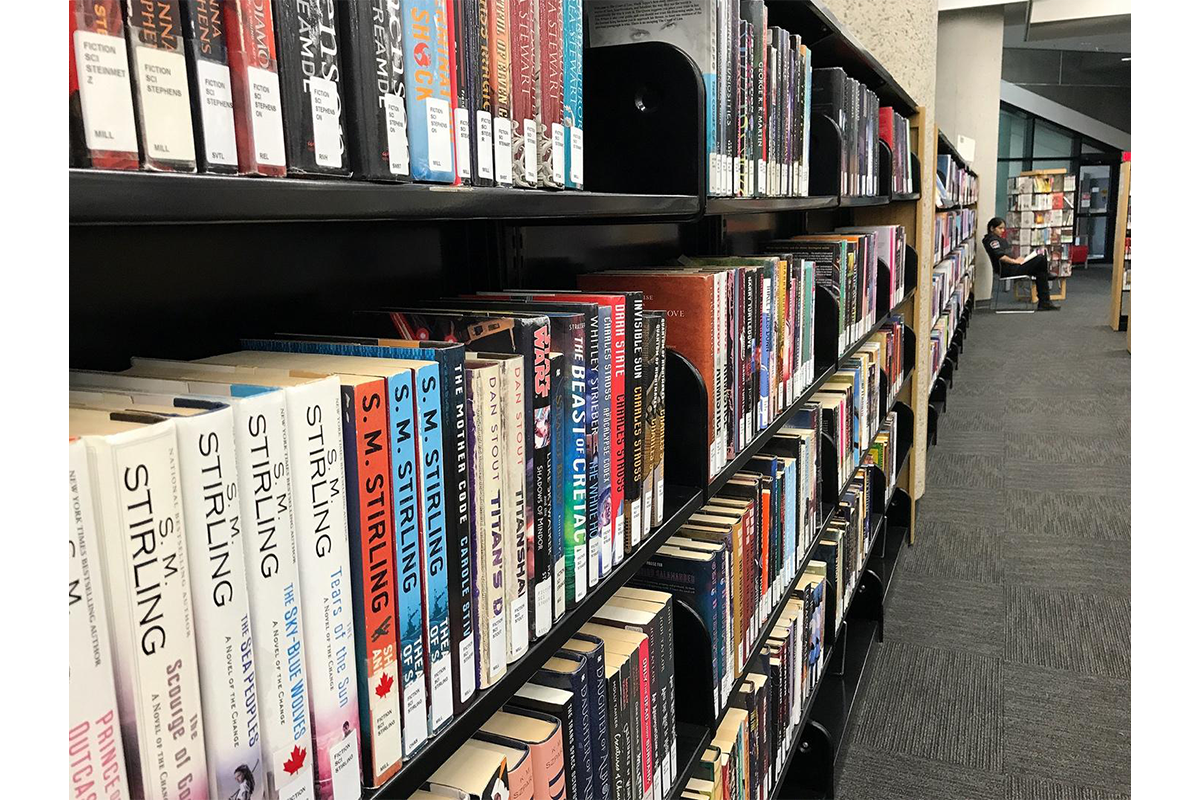
A security guard sits in the stacks at Winnipeg’s Millennium Library. Photo: Shannon VanRaes
Some Winnipeg Public Library staff, who are not permitted to speak publicly, are voicing concerns anonymously through the Winnipeg Library Facts Instagram account.
“I asked for a sharps container for my library’s public washroom and was told there was no funding,” reads one post. “Library staff are first responders, but we have never gotten the support (mental, financial or otherwise) that other first responders have and continue to receive,” reads another.
Curnow says libraries, like the Millennium, need to be adequately funded if they are to effectively assist patrons, including those in crisis or looking to access social supports. “And they just won’t pay for anything except for police, even though we know police won’t solve anything,” she says.
Libraries across the country are facing similar austerity measures, according to Hill. Despite inflation related cost increases, many libraries are seeing budget increases below one per cent, if they are seeing them at all, she says.
“A lot of people think the library is a fun, nice thing to have, but it’s not considered necessary,” Hill says.
“But at the same time, when people need to access resources, they’re told, ‘Well, you can just go to the public library.’”
The combination of dwindling resources and increased demand for complex services has put huge strain on library staff, say those working in the sector. In addition to handling collections and acquisitions, circulation management, cataloging, customer service, budgeting, program creation and delivery, training, event planning and reference services, many librarians are now also called upon to provide crisis intervention and emergency medical assistance.
The Edmonton Public Library has brought in washroom attendants — all with extensive training in opioid poisoning response, as well as lived experience — to take the pressure off library staff at some of its branches, including those in the city’s downtown. About 75 per cent of opioid poisonings occur at the Stanley A. Milner Library.
Day says Naloxone, a medication that rapidly reverses the effects of opioids, is available at all Edmonton Public Library branches. Support staff, including washroom attendants and security guards, administered it in about 70 percent of cases in 2022, while library staff administered it 19 per cent of the time.
“We have included some more intensive training on some of these issues over the last little while,” says Day. “We train in mental health first aid, psychological PPE, management of aggressive behaviours and advanced customer service that includes de-escalation. It’s part of the package we provide to staff to give them the tools and supports for what they might have to deal with in their day-to-day work.”
Twenty years ago, these issues weren’t on anyone’s radar, says Hill. Today, almost all urban libraries are dealing with opioid use and individuals in crisis. “I see some practicing librarians who say, we didn’t learn this in school,” she says. “But the environment is always changing and adapting and we also have to change and adapt.”
However, libraries can’t become a catch-all solution to a weak social safety net. “This becomes a huge amount of stress on public library staff … we can’t do everything,” Hill says. “We can’t, you know, hold up the rain, we can’t keep the net up for everybody that’s falling through the cracks of our social services systems.”
Curnow says it’s hard to be hopeful when looking at Winnipeg’s Millennium Library. While there’s been some bright spots, such as the introduction of well-trained Community Safety Hosts, she notes they aren’t funded by the city.
She describes the issues faced by Winnipeg’s Public Library, but also others, as the result of “austerity and intentional disinvestment” from downtown neighbourhoods and racialized spaces “which the library is then expected to somehow deal with while having no resources.”
Libraries will only continue to grow in importance as more and more of people’s lives enter the digital realm, says Sutter.
“Libraries will be a big piece of creating a more equitable future,” she says. “There’s a lot of important work that libraries can do in their communities to bridge divides, like the digital divide, and make sure people have access to new technology, even if they can’t afford it in their home.”
Many public libraries are also implementing low-cost design features to improve safety. Day says this could include better sightlines, lower shelving and smaller service stations spread throughout a space, rather than one central circulation desk.
Back at the Millennium Library, Ducharme gets ready to leave for the day. He says that while the library has offered him warmth and community over the years, it’s also provided him a window into the wider world. Being “marginal” can be extremely boring and very insular, he says, noting entertainment like TV, internet or reading materials are often out of reach.
Ducharme recently began exploring news stories on Winnipeg’s 1919 general strike using the library’s microfiche collection and says he looks forward to one day sharing his love of the Millennium with his grandchildren.
“It’s a place of learning,” he says. “There are books on neurochemistry all the way down to roses and genetics and artificial selection … it’s all of human knowledge condensed in one location and it’s free of charge.”
Your job. Your mission. Your news.
With your support, the sector you're building gets the journalism it deserves, and you get a tax receipt.

Related Articles
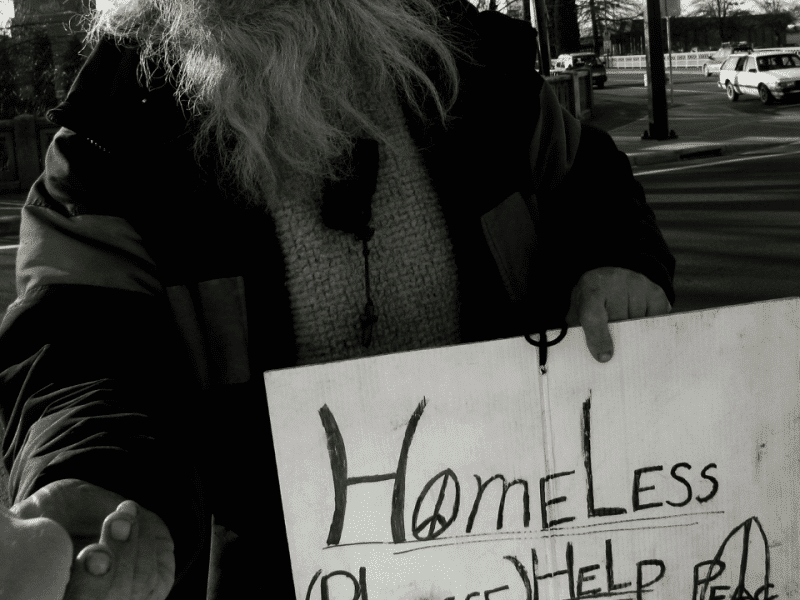
Redesigned Canada Housing Benefit could reduce homelessness by more than half: Report
End Homeless Canada’s new report shows if Canada’s Housing Benefit is redesigned, it could dramatically reduce homelessness in the country.

Partnered Partnered content Mental health support must better reflect how young men seek care: GreenShield report
New data reveals how stigma and traditional expectations of masculinity are shaping young men’s mental health, and why care models need to evolve.

School forest initiative set to expand outdoor learning in Ontario
Many students in Ontario will head outdoors under a new classroom and forest initiative.
