Indigenous-led coalition fighting for consultation on urban development may get injunction instead
Four-day ceremony will be held for every tree felled for elevated transit line
Why It Matters
Canadian law has long enshrined Indigenous peoples’ right to meaningful consultation but has rarely delivered. A new, Indigenous-led coalition hopes to change that regarding one urban infrastructure project.
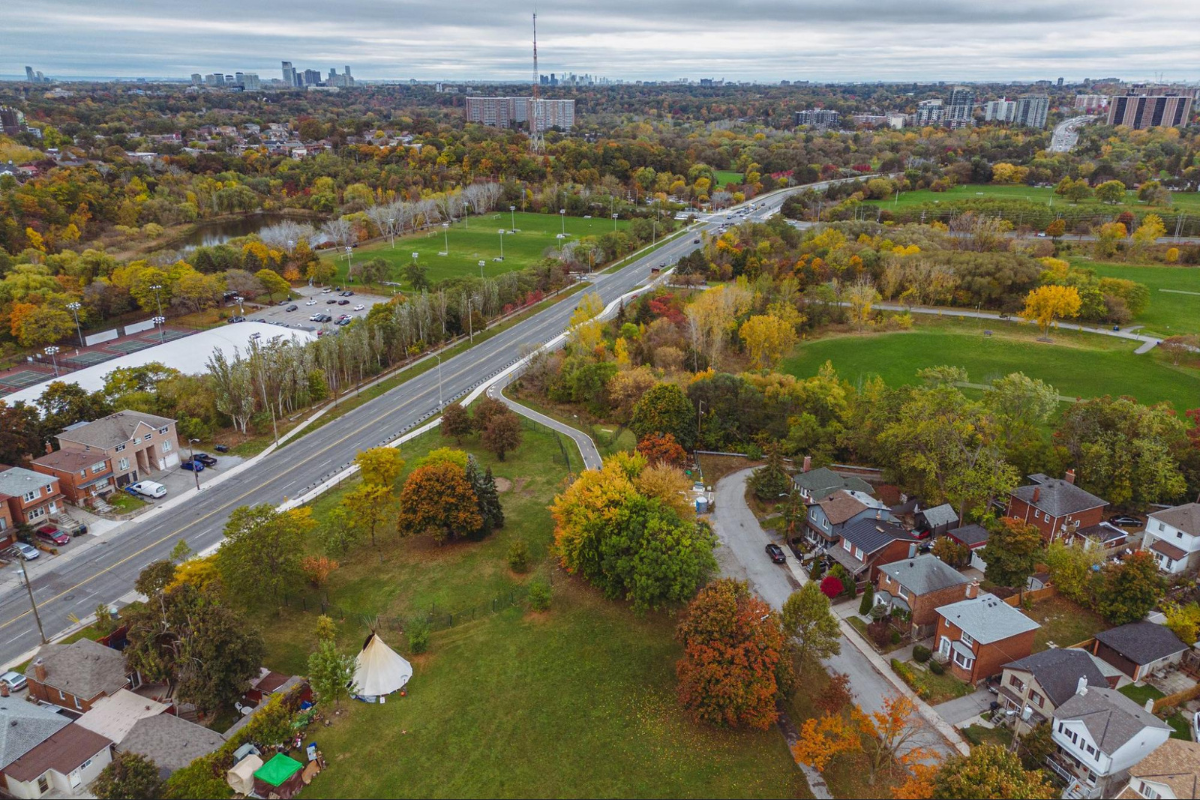
A tipi containing a sacred fire has been erected at Pearen Park near Eglinton Avenue West and Janes Street in Toronto’s west end. An indigenous-led coalition is fighting for meaningful consultation after Metrolinx, a provincial agency overseeing transit in the Greater Toronto Area, expropriated a section of land used for ceremony by First Nations people, as well as recreation and respite by residents of Toronto’s Mount Dennis neighbourhood. Photo: Carlos Osorio
Suzanne Smoke isn’t going to give up one more inch of land without a fight — and she’s not alone.
The acting president of the American Indian Movement’s Ontario chapter is heading an Indigenous-led coalition fighting for meaningful consultation after Metrolinx, a provincial agency overseeing transit in the Greater Toronto Area, expropriated a section of land used for ceremony by First Nations people, as well as recreation and respite by residents of Toronto’s Mount Dennis neighbourhood.
“I’m willing to stand on that front line, and I’ll go to jail,” says Smoke. “I am so done with these developers and politicians that are just lining their own back pockets at the expense of brown people.”
At issue is a 1.5-kilometre stretch of the Eglinton Crosstown West Extension. Unlike other portions of the $4.7 billion light rail line, this soon-to-be-built section is elevated — not buried — cutting through three parks. Indigenous organizations say they were never meaningfully consulted about the project, something they say is all too common in Canada, but particularly so when it comes to urban infrastructure development.
“When it comes to First Nations peoples in urban areas, I think we’re just not seen as much. We’re here, but we’re not seen,” says Michael Peters, chair of the Toronto Indigenous Youth Council.
Many Canadians wrongly assume Indigenous communities only exist in rural locations, he adds, “and because of that, they’re not used to involving us in these conversations, especially when it’s regarding urban development.”
Smoke says one only has to look at the “before the before” to know Indigenous people have always been on the land where Toronto now sits.
“We agreed that we would share the land,” she says. “That doesn’t mean that you get to kick us off it because you’ve deemed that something under the ground or within the ground or above the ground is more valuable.”
A sacred fire has burned in Pearen Park — one of three greenspaces near the Humber River the new line will transect — since January, tended to by volunteers from the Turtle Island Carers of Fire. There’s also a large teepee, an area for firekeepers to rest, sun shades and a small canteen, all maintained by the coalition’s seven member organizations.
Eshkiniigjik Naandwechigegamig Aabiish Gaa Binjibaaying, also known as ENAGB Indigenous Youth Council, is one of those organizations. It licenced a 2.7-acre land parcel just east of the Humber River from the City of Toronto in 2020, using it to grow traditional medicine, hold ceremonies and reconnect with the natural world. Executive director Cynthia Bell says the construction of the elevated rail line would jeopardize those activities and destroy an entire urban forest.
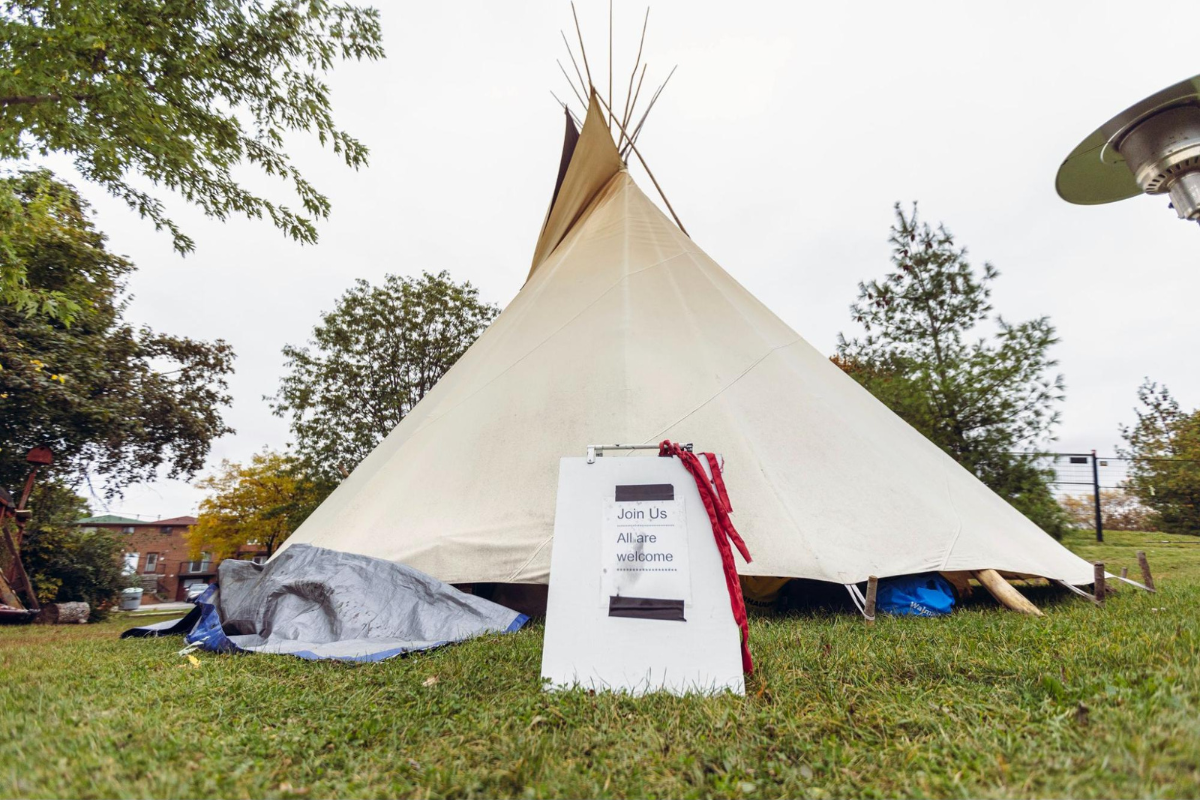
Firekeepers are onsite around the clock at Pearen Park. Photo: Carlos Osorio
“Metrolinx will say they’ve done their due diligence when it comes to consultation because they’ve sent out a bunch of random letters to First Nations that surround Toronto,” Bell says. “But did they ever do one in the city where it is actually going to affect people? Did they ever do it within the city? With Indigenous people who live here? No.”
Metrolinx disputed that characterization by email but did not make a representative available for comment. “We have held more than 120 meetings with community members and First Nations groups, 18 public open houses, and two environmental assessments to share information and gather feedback as the project progresses,” it states.
“In our final environmental assessment, we sought feedback from Indigenous communities and 14,150 neighbourhood residents and business owners.”
But community organizers say meetings with Metrolinx didn’t provide opportunities for meaningful discussion, and those pertaining to the Mount Dennis area were primarily held after the provincial Crown corporation had settled on an elevated design.
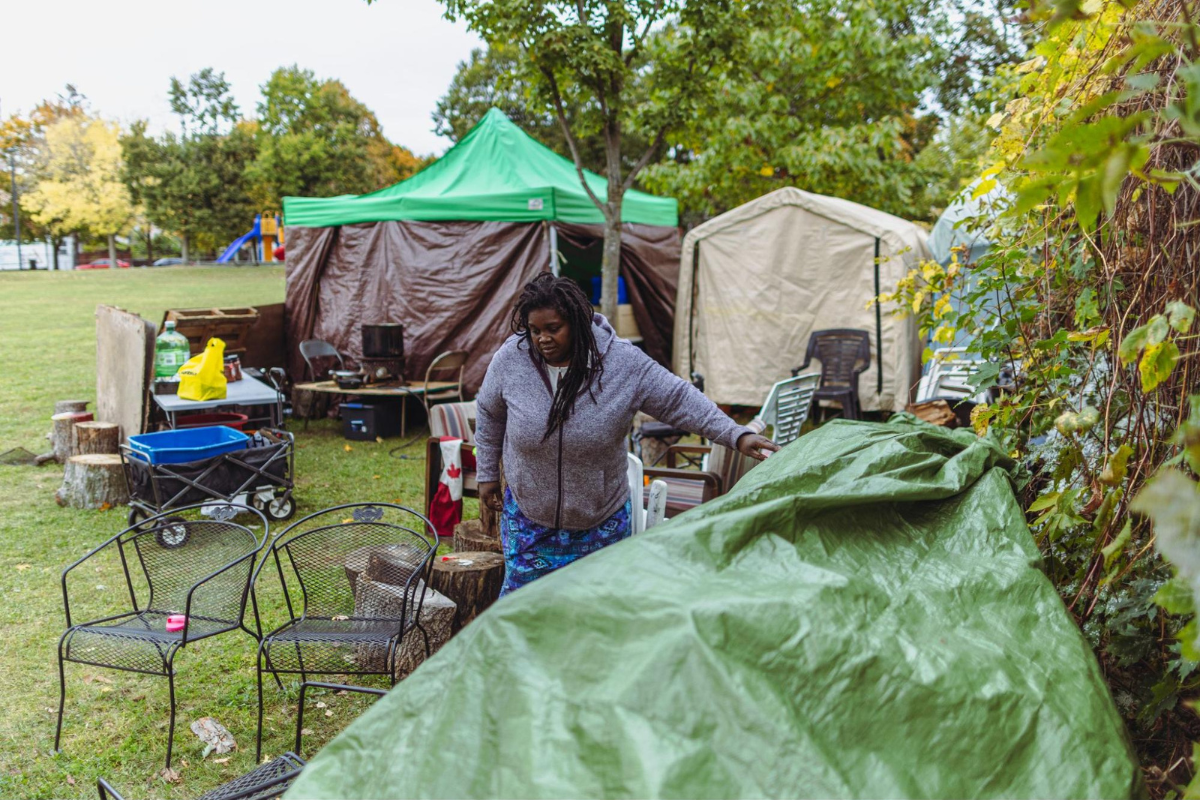
Firekeeper Michele Perpaul covers a stack of fire wood at the camp. Photo: Carlos Osorio
The last straw for both Indigenous and non-Indigenous organizations that were concerned about the environmental and social impacts of the extension’s elevated section came during a meeting late last year. Those in attendance believed they’d be able to give meaningful input on the Metrolinx project. Instead, they learned the design had already been finalized and were asked for their preference on things like lighting options.
Some, including Bell, walked out of the meeting. Not long afterwards, the Indigenous-led coalition took shape.
Bell quickly points out that the Pearen Park encampment isn’t a protest. “We are simply practicing our rights,” she says, adding ENAGB was already in ceremony when Metrolinx expropriated the land for the extension from the city. Now, a four-day ceremony will be held for each of the roughly 1,500 trees cut to make way for the transit project.
Coalition members are calling on Metrolinx to pause construction until an environmental assessment under an Indigenous lens occurs. Canada’s 1982 Constitution Act and subsequent court rulings have enshrined the Crown’s Duty to Consult with Indigenous communities in law, if not in practice; Canadian jurisprudence is littered with decisions detailing repeated failures to meet this obligation.
Not opposed to transit
Neiland Brissenden, a member of Stop the Trains in Our Parks, says Metrolinx was also required to provide stakeholders with “early access to decision makers” and meaningful consultation under the terms of its funding agreement with the federal government –something he says didn’t happen.
The coalition, which includes Stop the Trains in Our Parks, has asked Ottawa to withhold funding until Metrolinx meets this requirement. “Obviously, we don’t want to see the project stopped,” he says. “Our goal right now is to have Metrolink’s return to the table and have a proper consultation.”
Mount Dennis needs better public transportation but doesn’t believe it has to come at the expense of a culturally significant riparian woodland home to endangered species, says Brissenden.
He also notes the 1,500 hundred trees Metrolinx plans to cut down were planted as part of a flood mitigation strategy following Hurricane Hazel, which struck Toronto in 1954, killing 81 people.
Metrolinx says its decision to elevate this section of track on a concrete superstructure is due to the flood-prone nature of the Eglinton Flats. However, detractors of the elevated route note tunnels are routinely built under waterways without incident, including the one that links Toronto’s Billy Bishop Airport to Eireann Quay.
Many community activists have also pointed out that the Eglinton Crosstown West Extension section passing through Premier Doug Ford’s riding of Etobicoke North will be underground. And while much of the public discussion had centred around whether or not the rail line should be buried or elevated, Brissenden says there’s a third, cost-effective option that wouldn’t cut through any parks — building the line at grade along Eglinton Ave.
Built extra-wide to allow the construction of the now-cancelled Richview Expressway — Eglinton Avenue west of the Humber River could accommodate LRT without removing traffic lanes.
“That would be the cheapest and quickest to build, and it would save them $1 billion,” says Brissenden. “And in fact, that’s what the city of Toronto originally wanted. They wanted it at grade for the entirety of the project.”

Left, a section of trees which will be cut down for the Eglinton LRT. Right, Firekeepers mark trees on which ceremonies have been performed with ribbons. Photo: Carlos Osorio
Injunction ahead?
Metrolinx has given no indication it plans to reconsider the elevated design or engage in an Indigenous-led environmental assessment. But, the transit agency did order the City of Toronto to remove a portable toilet being used by coalition members holding ceremonies in Pearen Park. It also asked the city to stop delivering firewood to the site.
Smoke expects the provincial Crown corporation will eventually seek a court injunction to remove coalition members from the park. When asked about this, Metrolinx did not respond.
“It’s always going to be an injunction,” Smoke says.
“Look at any land claim; look at any land back action. They always get an injunction, and they come in force with their armed mercenaries, police and RCMP to remove Indigenous people. We are prepared for it.”
If Metrolinx had come to the table eight months ago, Bell says a comprehensive, Indigenous-led environmental assessment could have already been completed.
“Then we could have had a real discussion about the impact, the options,” she says. “Instead, they’re just trying to exhaust all our resources.”
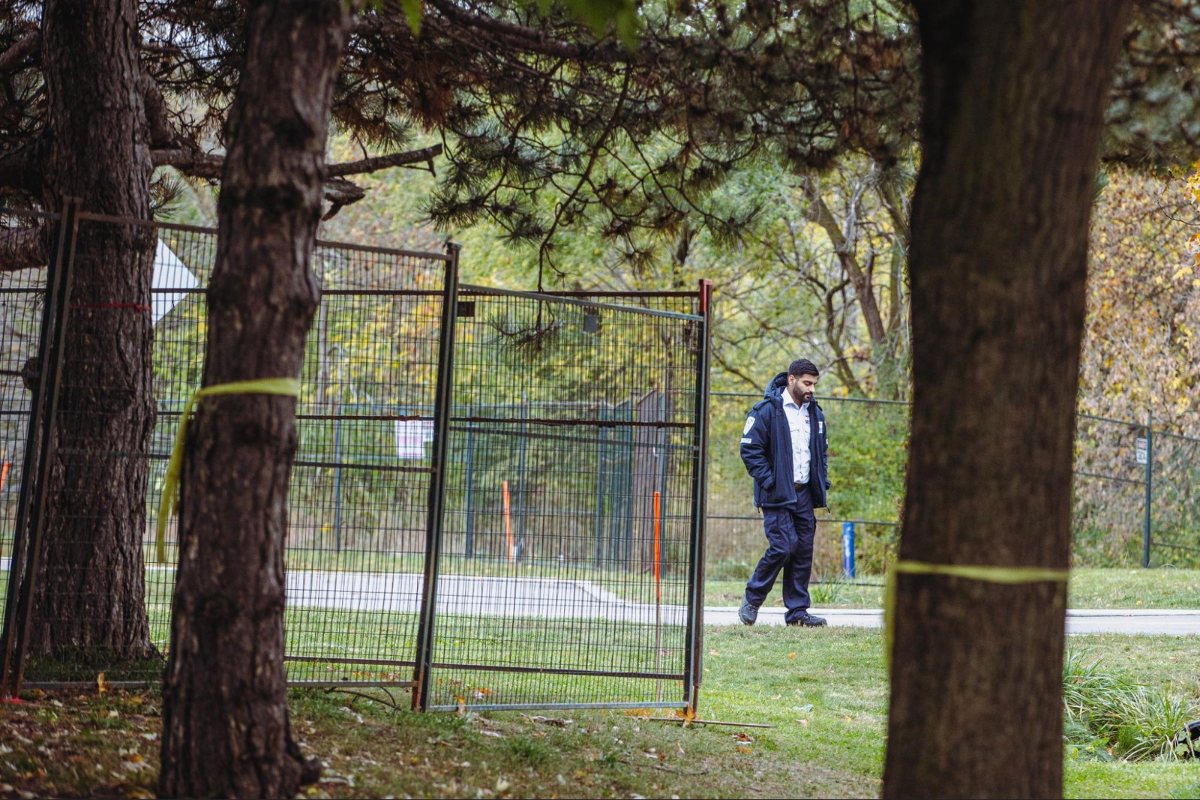
A security guard patrols an area of Pearen Park which has been fenced off by Metrolinx. Photo: Carlos Osorio
The transit authority has offered ENAGB assurances the new rail line won’t directly intrude onto the 2.7-acre parcel it’s currently using, as well as funding for youth programming.
Still, Bell says the organizations will not “sell out.” She believes Metrolinx is fighting hard to avoid setting a precedent around Indigenous consultation that would force them to engage in future collaborative environmental assessments using an Indigenous lens.
Metrolinx’s website has a lengthy land acknowledgment stating it understands “the importance of working towards reconciliation with the original caretakers of this land.” It’s a statement coalition members say rings hollow.
“This is something that we see with a lot of companies and organizations,” Peters says. “They will give a land acknowledgement, but they’re unwilling to commit to concrete steps towards truth and reconciliation. ”
Your job. Your mission. Your news.
With your support, the sector you're building gets the journalism it deserves, and you get a tax receipt.

Related Articles
Partnered Partnered content How construction contracts became the blueprint for social change in Manitoba
Manitoba is a leader in social procurement, with decades of partnerships among government, businesses and social enterprises that have shaped a model other communities can learn from.

‘The need is endless’: Food insecurity highest in Canada’s Black, Arab and Indigenous communities
Food insecurity gaps aren’t closing, so community organizations across Canada are trying new ways to help beyond just providing food.
