Thinking about using AI to fundraise? Here’s what you need to know — including the ethical questions.
Some Canadian charities are using AI to boost donations, helping fundraisers do faster donor prospecting, to better target their donation requests and to create more compelling asks — but there are ethical concerns, too.
Why It Matters
40 percent of charities are still seeing decreased revenue since the start of the pandemic. In this context, fundraisers need all the help they can get. Artificial intelligence tools can help fundraisers to work smarter.

This story is part of the Future of Good editorial fellowship covering the social impact world’s rapidly changing funding models, supported by Community Foundations of Canada and United Way Centraide Canada.
Fundraisers, the robots are not coming for your jobs. But they are smarter than you will ever be at spotting patterns and identifying trends in your data. And the good news is: That’s fine! Artificial intelligence (AI) tools are here to help you do your job better.
That’s the pitch from Canada’s crop of AI technology companies, start-ups like FundMetric, Keela and Wisely — who are keen to offer charities access to tools that are already ubiquitous in the private sector.
For non-profits beleaguered by the pandemic, the help is timely. Imagine Canada’s latest research found that 43 percent of charities are facing lower revenues than pre-pandemic. Those hit hardest are in the arts, culture and recreation sectors (think: day camps, grassroots arts programs and music programs in low-income neighborhoods).
For many of these charities, social distancing requirements have put fundraising events on pause, eliminated in-person shows or recitals and cancelled paid programming. To help bridge the gap, many charities are turning to digital fundraising, and finding, much to their delight, that there are new tools ready to make their jobs easier.
To help you make heads and tails of the new tech, Future of Good took a look at the fundraising products offered by five AI companies, asking them tough questions about AI effectiveness, data privacy and the types of charities their tools are best suited for. To round out our analysis, we spoke to several charities using these tools, and with a data expert for her take on how charities can best position themselves to benefit from the emerging technology.
“We all know how Terminator ends”: What is AI?
The charitable sector isn’t one known for its digital prowess. It should be no surprise then, that most non-profit professionals aren’t well-versed in artificial intelligence — and might even fear the tools.
“When I hear AI, I think, ‘Did you not watch Terminator?’ Like, we know how that ends!” says Molly McHugh, with a laugh. McHugh is the communications manager of No Means No Worldwide (NMNW), a charity that provides training programs and train-the-trainer tools to help end sexual assault and gender-based violence. Last year, while on the hunt for a social media management application, their team adopted Hopeful, a tool that offers the same content-scheduling services as Hootsuite, in addition to whiz-bang predictive AI technology. The tool, McHugh says, isn’t scary — just helpful.
AI leverages the speed and power of much-advanced computers to analyze large data sets in order to generate predictions about future behaviour. In so doing, it mimics the decision-making power of humans — hence, ‘artificial intelligence’.
The technology, which comprises ‘deep learning’ and ‘machine learning’ has applications that many of us use in our day to day lives — speech recognition (which powers Apple’s Siri and Amazon’s Alexa), customer service bots (which many of us hate) and recommendation tools (such as Google Maps or Grammarly).
For a decade or so, these tools have been used to make big companies a lot of money. And now, they might help your charity raise more of it too.
What can AI offer your fundraisers? A look at five tools
In the coming years, your customer management system (CRM), your payment processing tool and your social media management software might all build AI into their standard service offering. But for now, most don’t. This means that if you want to benefit from AI, you’re likely looking to purchase add-on tools or switch out your existing providers
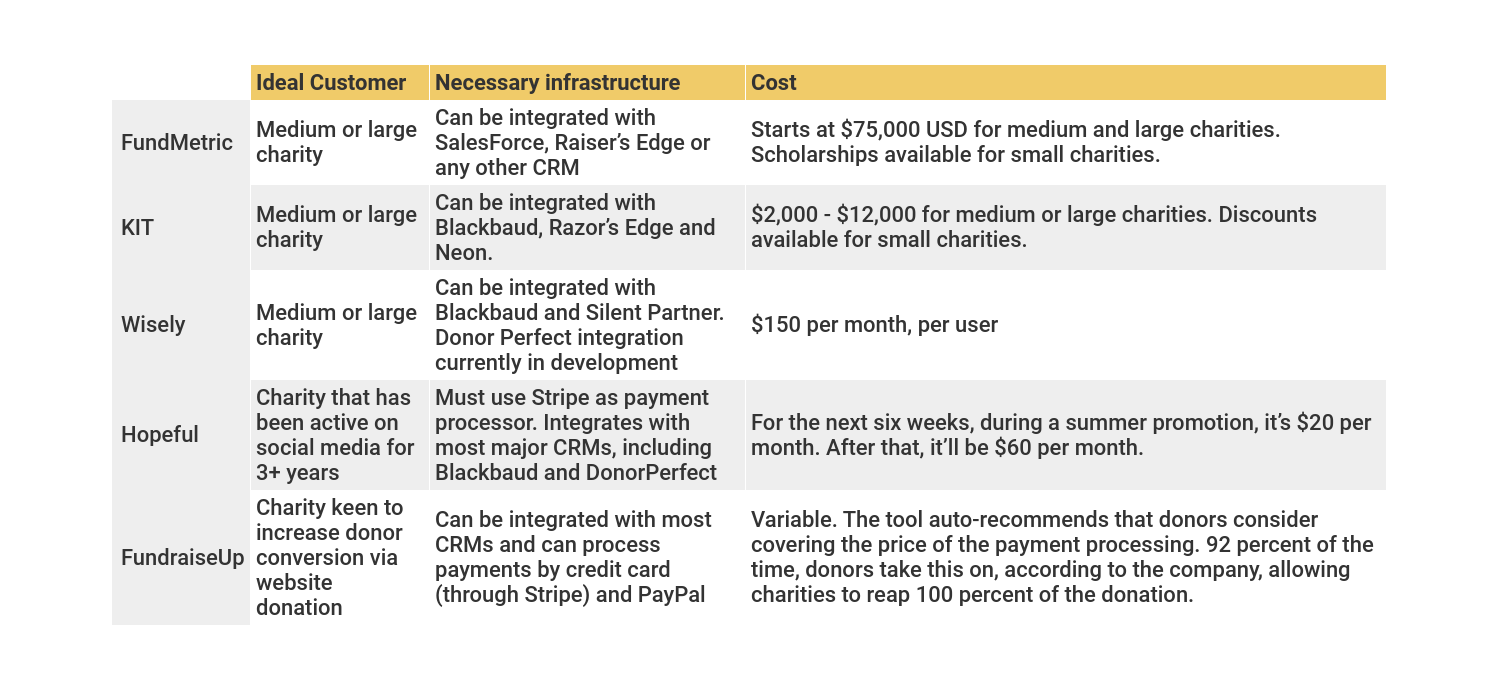
Two of the tools we looked at are keen to be your “full service fundraising platform” — software that either replaces or layers overtop of your existing CRM in order to try to help you raise more money. The first, is a product created by FundMetric, a Halifax-based company, led by founder Mark Hobbs.
“The modern reality is I can’t just send you a generic fundraising letter anymore. I have to get personal and I have to be respectful,” he says.
For Hobbs, being respectful means being attentive to who your donors are and how they want to be engaged — objectives that he believes AI is well-suited to support.
To help your fundraisers’ to best know your donors (and to cut down on the time they spend donor prospecting) both FundMetric, and its Vancouver-based competitor, KIT, will auto-gather all publicly-available information about your donors — their postal code, their photo and even their interests — all information that can inform your ask.
Nourish, a Nova Scotia-based FundMetric customer, has benefited from these tools. For one, says Trina Elliott, the food-focused charity’s office manager, the technology saves their fundraiser time. And two, it helps them better target their donors. Most recently, they’ve considered using the platform’s information-gathering functionality to target their donors who have an interest in running, for instance, for participation in a marathon fundraiser.
“With that AI ability, we’re able to really segment out people that are interested in running…so that we can create targeted campaigns. That’s cool. That is pretty cool,” says Elliot. But despite the appeal of this feature, Elliot notes however, that they’ve yet to use this aspect of the tool. She chalks this up, in part, to limited capacity and resources. The locally-focused charity has just five-and-a-half staff.
To further target donors, both KIT and FundMetric’s platforms are also compatible with the wealth screening tools used by many larger charities, such as Windfall or WealthEngine. These products can provide more granular, real-time information about the financial background of your donors. “You can see when somebody sold a bunch of stocks, if that’s available, or when they registered a new house or a yacht,” says Nejeed Kassam, the co-founder of KIT. These sorts of insights — though perhaps a little invasive — can help fundraisers to prioritize when it might be most appropriate to reach out to donors for a sizable ask.
Another benefit of AI, say both Hobbs and Kassam, is that it can help reduce donor-churn.
If a donor isn’t responding to the charity’s engagement, says Hobbs, “the appropriate response is not just to fire off 16 [emails]. The appropriate response is to ask you why, to leave you alone, or to drop the volume.” Predicting which of these three routes to take is something that AI can help with, by analyzing your charity’s own historical data and predicting future behaviour.
Given the amount of data required to make accurate predictions, both products are best suited for mid-to-large size charities — those with budgets over $1 million. Both founders say, however, that they’re also keen also to support smaller charities to benefit from the tools (and have product discounts to help make it more affordable).
And while similarities abound, there are a couple of main differences in the product offerings. For mid-to-large charities, the base cost of FundMetric’s platform is $75,000 USD. In contrast, KIT retails for between $2,000-12,000 CAD. Built into the cost of FundMetric’s offering however, is considerable one-on-one time with the company’s staff, says Hobbs, which helps to equip charities’ fundraising teams to make the most of the product.
With respect to features, KIT offers several tools to assess the impact of using their platform — KPIs that measure donor retention, lifetime donation value, and more. FundMetric’s platform, on the other hand, offers the possibility to create videos tailored to each of your donors, with auto-populated information about their donations and the impact they’ve helped to create.
A third offering in the market is Wisely, a Toronto-based company that offers a similar tool to those provided by FundMetric and KIT, but for a more focused user: the fundraiser of a mid-to-large-size charity with a portfolio of major giving targets.
“For most charities, 90 percent of their revenue comes from 10 percent of their donors,” says Wes Moon, the company’s founder. That’s why, he says, the company’s focus is on tightly predicting the behaviour of this group of donors. Much like the products offered by KIT and FundMetric, to do so, the tool uses your charity’s own historical data — email opens, prior donations, participation at events — to predict possible future behaviour. This enables your fundraising staff to prioritize the highest gift-value donors in their portfolio.
Fourth up is Hopeful, a Toronto-based company recently purchased by Wisely, which aims to get you off Hootsuite or Buffer and onto its tech. To do so, the platform offers a social media management tool that analyzes all of your prior social media posts (the cringe-worthy tweet you put out when you first set up your account, the engaging, visually-rich instagram story you just posted), and recommends what stories are garnering the most engagement — and pulling in the most donations.
It’ll tell you the time of day your posts do best, recommend the hashtags to go along with your posts, tell you which photos (from your content library) might get the most clicks, and even suggest the verbiage that’s statistically-shown (according to your own historical data) to resonate most with your audience. It also gives you a sense of the emotional impact your posts are having on your audience, helping you to hit the right note.
For McHugh and the team at No Means No Worldwide, Hopeful has been useful for two main reasons: it’s given her time back (saving, on average “a couple of hours a week”), and it’s helped her to make sure her posts emotionally resonate with her audience.
The charity’s mission is to stop gender-based violence — an hot-button issue for many. Analyzing the organization’s historical posts, the technology flagged that posts where they expressed anger tended to result in considerable engagement with their audience, which surprised McHugh. In the process, she learned that “you can use that sentiment in good faith and the people that are engaged with you will understand what you’re talking about.”
While she has decided to mix up the emotion of the charity’s posts to best reflect the organization’s brand, this insight has helped to increase the charity’s confidence in using posts with more emotion. And alongside other tactics this has spurred “significant growth” across for the charity’s accounts on Twitter, Instagram and Facebook, says McHugh.
Hopeful founder Alexander Jivov says this kind of tech can be valuable for all charities, but especially those trying to reach a younger audience.
“Most of the Millennial, Gen Z and Gen X generation are now most inspired to give by what they see on social media — much more than any of the other traditional marketing methods,” he says. To this end, Jivov suggests that his product can simplify social media for charities, helping them to secure a “foundational base of givers who are giving $1, $5, or $10 dollars a month,” so that they’re less reliant on a few major gift donors.
Lastly, we took a look at FundraiseUp, a Brooklyn-based company that’s trying to increase the value of your digital donations. To do so, the firm’s technology analyzes how your prospective donors are engaging with your website, grabs their postal code and other publicly-available information, and then offers them a tailored, auto-suggested donation amount. (If you want to see how much the tool thinks you might donate to several of its client charities, navigate to the “donate” button on the Stand Up to Cancer, Rainforest Trust, or Pathways to Education websites).
Their payment processing tool is also designed so that the donation process feels easy (seven fields to complete, compared to the industry-standard 15, according to the company’s website); and to increase the potential that a donor would upgrade to a monthly donation.
So far, the tool has worked well for Pathways to Education, one of its Canadian clients, which focuses on increasing high school graduation rates for youth in low-income communities. “We’ve seen really, really great results with a platform,” says Jason Shim, the charity’s director of digital strategy and transformation. “We’ve generally seen improved conversion rates and it’s provided for a better overall experience…for [donors].”
Yet, for Shim, despite the ultimate benefits, adopting this (and any other) new piece of technology wasn’t a simple decision. In addition to his work at Pathways to Education, he’s done much digital consulting for non-profits, and is quick to point out the many important considerations that charities should keep in mind before grabbing a cool new tool.
“Data is the new uranium”: Privacy and bias concerns
“AI represents an acceleration of existing decision-making processes,” says Shim. “So I think it’s super important for organizations to be very clear on [their] decision-making criteria…and the organization’s values — and ensuring alignment [between the two].”
For Shim, this means that charities should feel comfortable with the choices their AI can make, before onboarding a new product. For instance, they might ask: Are we comfortable with our AI reading our donor’s postal code and using that information to make predictions about their possible donation amount?
This exact question — of AI predictions based on location and other personal data — has caused a stir in the for-profit world. In financial services sector, using this kind of data has resulted on discrimination toward Black people and other racialized people in recieving mortgages and other loans.
The way that this can happen is that over time, analyzing data, an AI can make predictions based on factors (such as geographic location) that don’t take into account historic biases. For instance, historically speaking, it’s possible that a Black person living in a lower-income community might not have been approved for a loan product. However, this might have no bearing on the individual credit-worthiness today.
The same could be true in the charitable sector. “That bias could show up in the form of this system recommending asking a woman to donate less money than asking a man with a similar salary and credit profile,” says Katie Gibson, vice president of the CIO Council, an organization that has advocated for digital transformation in the non-profit sector. This could occur based on the AI’s pattern-recognition, which could be true for the past, but could not accurately predict the future, given social and economic advancements.
It’s these bias and data privacy concerns that Gibson believes charities considering AI need to approach thoughtfully. “We used to hear that data is the new oil, and now we’re hearing the data is the new uranium. It’s very powerful and it’s also very dangerous if misused,” she says.
In addition to the risks of bias, Gibson says that charities need to also be on the lookout for possible AI-related privacy concerns. “The issue is really the risk of a data breach — and it only takes one data breach for a non-profit to lose the confidence of their donors, and the entire sector is in the blast radius,” she says.
Each of the AI providers we spoke to for this story said that data privacy is “top of mind.” None will sell a charity’s data to third parties — a practice that has come under considerable scrutiny in the for-profit world. And each keeps data for each client separate on the back-end of their platforms. This ensures that it’s not possible to cross-identify a donor who has given to two charities who are using the AI platform — something that might be outside of the scope of what donors are comfortable with.
In addition, the companies are thoughtful about the servers where the data is stored, with KIT, for instance, keeping all data from Canadian charities on Canadian servers. This is important as data stored on servers in another country is subject to the laws of that land. In the U.S., for instance, data is subject to the U.S. Patriot Act, which allows the Federal Bureau of Investigations and other enforcement agencies to seek a court order to access personal data in the case of an anti-terrorism investigation — without the data owner’s prior knowledge. While most donors aren’t likely to be caught up in this kind of snafu, many might not be comfortable with the idea that their data isn’t subject to Canadian privacy laws and protections.
In addition, Gibson cautions that the non-profit sector is “uniquely vulnerable” to data missteps because few have deep in-house technology chops — and that includes few skilled staff capable of properly vetting new tech vendors.
For their part, to help charities navigate this new terrain, the CIO Council is in the midst of developing a new ‘data standard’ with recommendations related to “ethical and privacy-protecting use of donor data.” And, alongside, each of the AI fundraising providers expressed their keenness to support their customers to use AI safely and securely.
For those keen to get started, Gibson and the tech providers encourage charities to begin to strengthen their data governance, through having conversations about how they collect data, how they use it and how it can help drive donations.
In this task — one that combines ethics and practicality — AI will never be able to outsmart their human fundraiser counterparts.
Your job. Your mission. Your news.
With your support, the sector you're building gets the journalism it deserves, and you get a tax receipt.

Related Articles

Explainer: What the social sector should know about Carney’s Spring Economic Update
Measures announced include a permanent employee ownership tax incentive, a simpler application process for the Disability Tax Credit, and a reduction in Canada Pension Plan (CPP) contributions.

Explainer: What Canada’s new national sovereign wealth fund means for the social sector (and why it’s different than the other one)
The new fund could reshape national investment priorities, and the social sector has a stake in how it’s defined

How place-based investing could help finance cities’ climate plan: the LC3 network case
Climate-mitigation funding is drying up like the lakes and rivers it’s trying to save. So how can Canada’s cities and municipalities pay for their plans when funding gaps prevent them? Social finance reporter Diane Berard explores the LC3 network in the case study below.
