Atlantic summit explores solutions to keep social impact groups afloat
“The federal government is a partner in developing good policy, but we need to co-design the solutions and the policies that will make a difference”
Why It Matters
Attendees at a social impact summit recently held in Canada's easternmost city walked away with a clear message: Communities have solutions to social challenges, but what's needed is clear facilitation, cooperation and guaranteed funding.

[GREETINGS BY DIGNITARIES, The Rooms, Sept. 25, 2023] Left to right: Mayor Danny Breen, City of St. John’s; Sheldon Pollett, Executive Director, Choices for Youth; Ryan Turnbull, Parliamentary Secretary to the Minister of Innovation, Science and Technology and Member of Parliament for Whitby; Mike Toye, Executive Director, Canadian Community Economic Development Network; Chelsey MacNeil, President, Common Good Solutions; Paul Pike, Minister of Children, Seniors and Social Development, Government of Newfoundland and Labrador
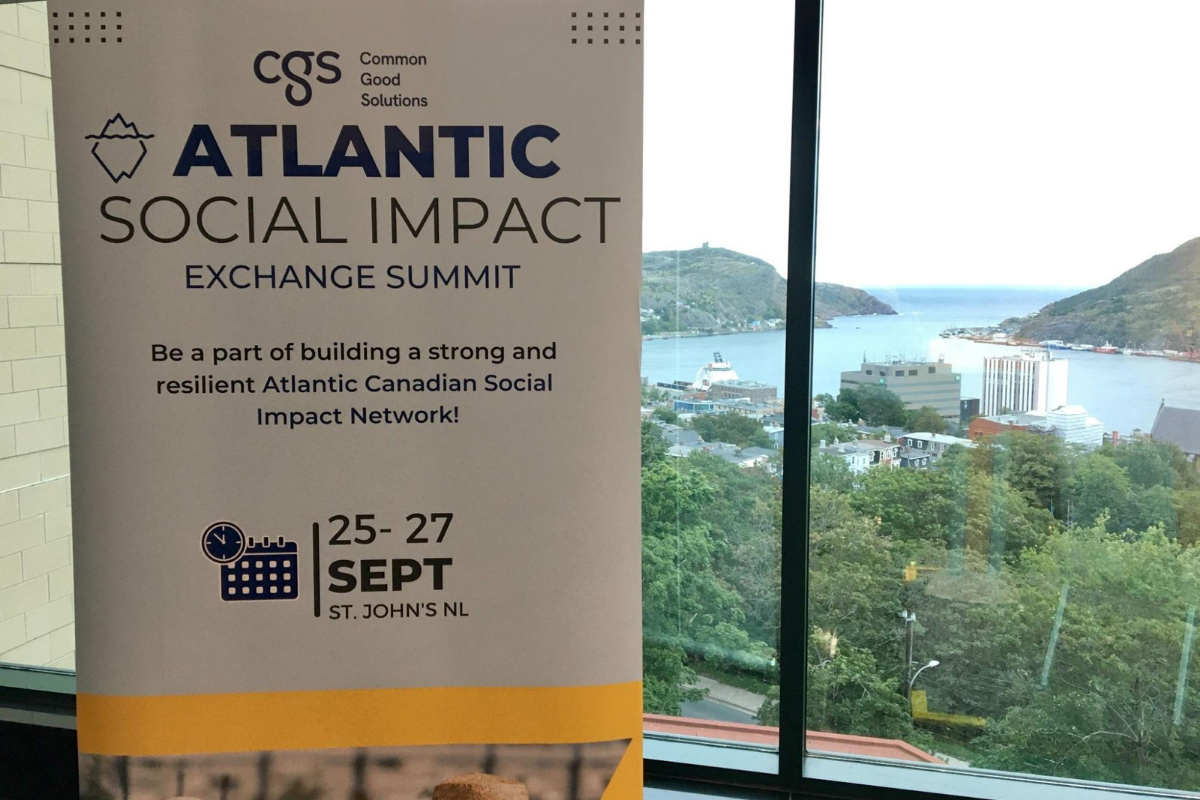
St. JOHN’S, Nfld. & Lab. — The inaugural Atlantic Social Impact Exchange Summit held from Sept. 25 through 27 was an opportunity for social purpose organizations and changemakers to share their experiences and showcase how they work together to build a better society.
Ryan Turnbull — a leader in the social innovation field for the past 15 years, the Member of Parliament for Whitby since 2019 and the recently appointed Parliamentary Secretary to the Minister of Innovation, Science and Industry — has been instrumental in increasing federal funding in social finance. His visit to Newfoundland was premised on delivering one key message, he said: policy matters.
“The federal government is a partner in developing good policy, but we need to co-design the solutions and the policies that will make a difference,” Turnbull said.
“I started getting hired by government to give them advice on collective impact and how we can make systems change, and you know what struck me was that every one of these major systems change projects came down to government policy — it really did — because policy could either enable progress or inhibit it.”
During his opening night address, the Ontario native hailed the federal government’s recently minted Social Finance Fund as an investment in the success of social changemakers. The fund, which is designed to support charities, non-profits, social enterprises, co-operatives and other social purpose organizations in accessing flexible financing opportunities, has the potential to help these groups grow, innovate and enhance their social and environmental impacts, said Turnbull.
“Communities have the solutions,” Turnbull said.
“I really think the communities already have that wisdom, they already have that potential, and when they work together, they can find the resources, but often the policy gets in the way.”
While there is much to be optimistic about concerning the federal government’s influx of capital into social finance, it will take time — and fulsome data — to truly determine how successful this fund is in meeting its mandate, meeting the moment and maintaining momentum.
There are also questions about who the Social Finance Fund’s investment managers will be, whether regions like Atlantic Canada will be well-served by the fund and how many social purposes organizations will be in a position to take the risk on the fund’s repayable capital.
Impact is a key element when discussing the meaning and utility of social finance, according to speaker Katie Davey, executive director of the Pond-Deshpande Centre at the University of New Brunswick.
“I think we need to broaden our definition to understand . . . it’s not for one type of organization or one type of funding or one type of model, but really having an impact at the root so that all of the elements that we’re thinking about when we’re thinking about social finance really come back to that idea of systems change, community impact and really solving our community problems,” Davey said.
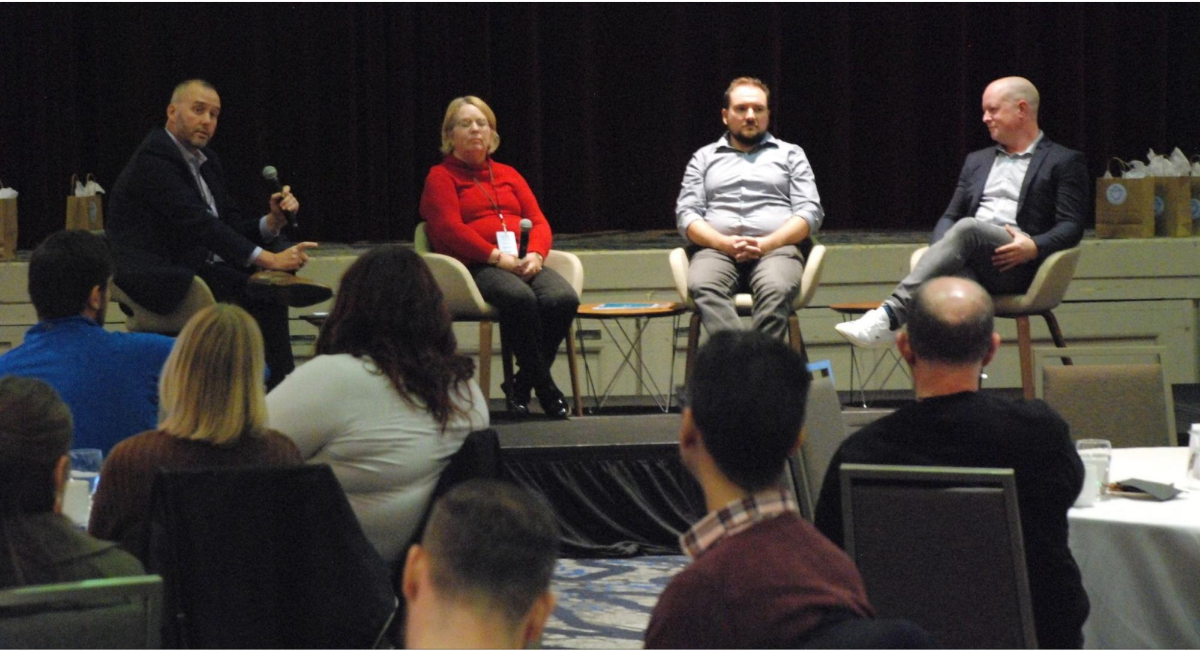
[NAVIGATING THROUGH INVESTMENT FOR SOCIAL IMPACT, Delta Hotels by Marriott St. John’s Conference Centre, Sept. 27, 2023] Left to right: Mark Lane, Northpine Foundation; Christine Snow, Community Sector Council NL; Darrell Jackman, Smallwood Crescent Community Centre; Bradley Russell, Big Feed Club Grocery Delivery
Mike Toye, executive director of the Canadian Community Economic Development Network and chair of the federal government’s Social Innovation Advisory Council, dedicates his life to making the economy more democratic, just, inclusive and sustainable.
The origins of the 34-year-old community economic development network Toye directs stem from two primary functions: support peer learning and become an effective policy voice. In 2021, the network produced its theory of change framework, founded on a vision of communities directing their future.
“Daniel Ben-Horin, founder of TechSoup Global, said in the Stanford Social Innovation Review many years ago that it’s not innovation that’s the problem, it’s propagation — sharing, adapting, scaling, transferring,” he said. “We don’t need to reinvent the wheel.”
Like Turnbull, Toye also sees the policy side of the equation as critically important.
“Moving from the fragmented, extractive economic models to ones that foster healing, regenerative practices and allowing us to survive in this 21st century is largely a policy challenge,” he said.
“We’re stuck in some old models and regulations.”
The social finance and social innovation file has been a focus of the Canadian Community Economic Development Network since 2015. Though slow-moving, Toye shared that the Organisation for Economic Co-operation and Development recently confirmed the value of the roadmap and key themes of a 2018 inclusive innovation report published by Employment and Social Development Canada’s Social Innovation and Social Finance Strategy Co-Creation Steering Group.
However, Toye also clarified that social finance and social enterprise are not a panacea.
“It’s not going to solve all of our problems; it’s not for everyone,” he said. “It can’t replace the need for the proper funding of essential community, public and social services, but it does offer new ways of undertaking economic activities that address the social and environmental issues that need fixing by, most importantly, not creating them in the first place.”
With cohesive, coordinated action, dated frameworks rooted in colonial, patriarchal and racist systems will continue to evolve, Toye said.
“The economy creates lots of wealth for a shrinking number of people, but it also creates poverty and environmental destruction, and it doesn’t have to be that way,” he said.
Matt Pfahlert, co-founder and chief executive officer of the Australian Centre for Rural Entrepreneurship, prefaced his keynote address on day two of the summit by stating that Australia has some catching up.
“It just warms my heart to come here and have my cup filled that what you have in terms of the engagement with government is possible for us too,” he said.
“We’re here to talk about community-led rejuvenation, and really it’s a concept still in our country, and what we’re doing is just building out proof points for it because it’s a bit scary for people, particularly government, needing to let go.”
“We know that our institutions, our governments and our well-meaning corporations have been good at solving complicated problems when there is one solution that is known, but what do we do when there are five or ten levers that we need to activate simultaneously?” he said.
Building trusting relationships grounded in the local context is vital to the future well-being of communities, particularly in rural settings far from the halls of power, Pfahlert explained.
“What this is all about — community-led — is all about going, ‘Well, let’s just stop this dependency mindset,’” he said.
“How do we make it easy for government to deal with us, how do we de-risk it, and how do we just crack on — we find ourselves on the receiving end of having to compete for scraps, and it’s exhausting and fatiguing, and it’s traumatizing.”
He said Pfahlert’s Shangri-La exists where social enterprise is entirely unremarkable because everyone is doing it.
“That’s the model that puts people and the planet in front of person and profits.”
Beatrice Alain, executive director of Chantier de l’Économie Sociale, beamed into the summit via video conference on the third day and spoke candidly about Quebec’s experience building the social impact ecosystem.
Alain described how collective enterprises — enterprising non-profits and co-operatives — have been an important part of Quebec’s economic, social and territorial development history.
“Often, the community would come together to do things that the state or the market is not serving — to maintain pertinent services or redevelop certain areas,” she said. “I think that’s the case in many different parts of Canada, particularly rural development.”
The executive director pointed out the social economy involves very different people in managing enterprises than private enterprises, so different outcomes result.
“They make more innovative choices, which makes them both more resilient and have more impact in the community,” Alain said. “But also sometimes [they are] more complicated to fit within government policy or financing available at the corner bank.”
A hypothetical example of a food bank that also operates a restaurant and a catering service whose profits are reinvested back into the food bank highlights the difficulty some enterprises face when trying to fit into existing programs or financing schemes, she said.
“These enterprises have a higher survival rate than private enterprises,” Alain said. “We’ve talked sometimes about ‘too big to fail’; these are ‘too important to fail’ — when you meet defined needs by the community and when you’re supported by community, that community oftentimes finds ways for you to survive through thick and thin.”
This independent journalism is in partnership with Common Good Solutions. Read our editorial ethics and standards here.
Your job. Your mission. Your news.
With your support, the sector you're building gets the journalism it deserves, and you get a tax receipt.

Related Articles

‘Astounding’: New report highlights exponential increase in care community job vacancy rates
Combining more than a dozen datasets is the first step in creating a labour force strategy, says United Way Centraide Canada

Redesigned Canada Housing Benefit could reduce homelessness by more than half: Report
End Homeless Canada’s new report shows if Canada’s Housing Benefit is redesigned, it could dramatically reduce homelessness in the country.

Partnered Partnered content Mental health support must better reflect how young men seek care: GreenShield report
New data reveals how stigma and traditional expectations of masculinity are shaping young men’s mental health, and why care models need to evolve.
