Data story: Only 10 per cent of Canada’s Universal Broadband Fund for high-speed internet was awarded to non-profits and cooperatives. Where did the rest go?
Future of Good digs into some of the numbers behind the Universal Broadband Fund, and who will be building broadband infrastructure to connect all Canadians to high-speed internet.
Why It Matters
Funding cooperatively-owned or non-profit telecommunications providers not only brings more competition into the Canadian telecoms industry, but also contributes to community resilience, by allowing communities themselves to make decisions about critical infrastructure that they own.
This independent journalism on data, digital transformation and technology for social impact is made possible by the Future of Good editorial fellowship on digital transformation, supported by Mastercard Changeworks™. Read our editorial ethics and standards here.
Back in 2020, the federal government announced $3.225 billion in funding to connect all Canadians to high-speed internet by the year 2030. The Universal Broadband Fund (UBF) – which later received a $475 million top-up in 2022 – aims to connect everybody in the country to 50/10 Mbps speeds.
Earlier this year, the government reported on progress that has been made since the Fund was announced in 2020, also publishing an interactive dashboard that shows province-by-province progress to achieving 100 per cent internet connectivity by 2030.
Perhaps unsurprisingly, Quebec, Ontario and British Columbia are leading the charge according to the government’s figures, while Northern provinces are significantly further behind in their journey to 100 per cent connectivity to high-speed internet. Nunavut currently stands at 0 per cent, with work appearing to begin in 2025.
At Future of Good, we dug deeper into a database of 262 projects that have been selected as part of the UBF since 2020.
A range of organizations have received funding, from telecommunications companies and locally-owned cooperatives, to Indigenous governments and municipalities. The largest single contract of $70 million went to Xplore, to fund infrastructure for nearly 30,000 households in Newfoundland and Labrador, while the smallest award went to the Chapleau Ojibwe First Nation in Ontario, to bring connection to 13 households with just under $15,000 in funding.
The Auditor General’s report on connectivity in rural and remote areas also suggests that there has been an underspend: of $1.3 billion that was available to spend as part of the Fund in the 2022 to 2023 fiscal year, ending in March 2023, only $324 million had been spent as of January 2023. That’s roughly a quarter of the total allocation for the fiscal year.
In the database Future of Good analyzed, the selected projects only added up to around $892 million, which the ISED media team later added does not include federal-provincial funding partnerships announced under the UBF, which takes the funding amount up to $2.2 billion. “The $2.2 billion in UBF funding announced to date represents a reconciliation between the funding partnerships announced to date and projects announced in detail,” said the ISED media team.
“There are a few apparent reasons that this money seems to have gone unallocated,” says Dr Helen Hambly Odame, who runs the Regional and Rural Broadband Project, which is based out of the University of Guelph and researches equitable access to the internet in rural Canada. “Every expert indicated that the call [to apply for UBF funding] was oversubscribed – there wasn’t a lack of demand. But there may have been an issue with the quality or integrity of applications. Many smaller municipalities who have bid have struggled. First Nations-owned [broadband] initiatives and companies, non-profits and municipalities have seen underwhelming access to the fund.”
By analyzing the 262 projects that have received funding under the UBF, Future of Good looked to understand more about where exactly this momentous pot of funding had flowed to since 2020. The database published by Innovation, Science and Economic Development (ISED) covered the following information about each project: the province, specific locations to be connected, number of households to be served, the funding recipient, and the amount they had been awarded. To that, we added two variables: the type of funding recipient (for example, a private company, a non-profit, or a government body), and the size of the organization (do they operate nationally, provincially, regionally or locally?).
Two of the projects are marked as ‘withdrawn’, and it is unclear if that means that the project itself is not going ahead, or whether the selected funding recipient has withdrawn and will be replaced. Three of the funding recipients also did not have their own websites at the time of pulling together this data story, suggesting that they have either been acquired by other organizations, or that they are no longer in operation. All of these remained part of the dataset, as supplementary information was available online.
From the database, Future of Good picked out three key findings:
- Only around 10 per cent of money from the UBF has flowed to cooperatives and non-profits in the telecommunications industry;
- The collective contracts awarded to Bell make up over a quarter of all of the funding, and finally;
- There is a huge geographical split in terms of where funding has been allocated, with 6 in 10 projects being Ontario-based.
“This is going to be a huge election issue going forward,” Dr Hambly adds. “This is not disassociated from the fact that federal workers’ lives are increasingly mediated through the internet, and they need secure, high-speed internet access to work remotely. This is not disassociated from problems in other sectors: the service, manufacturing and agrifood industries all have a strong digital backbone to them. They’re counting on that high-speed access.”
Finding: Around one-tenth of funding flowed to cooperatively-owned and non-profit telecommunications providers
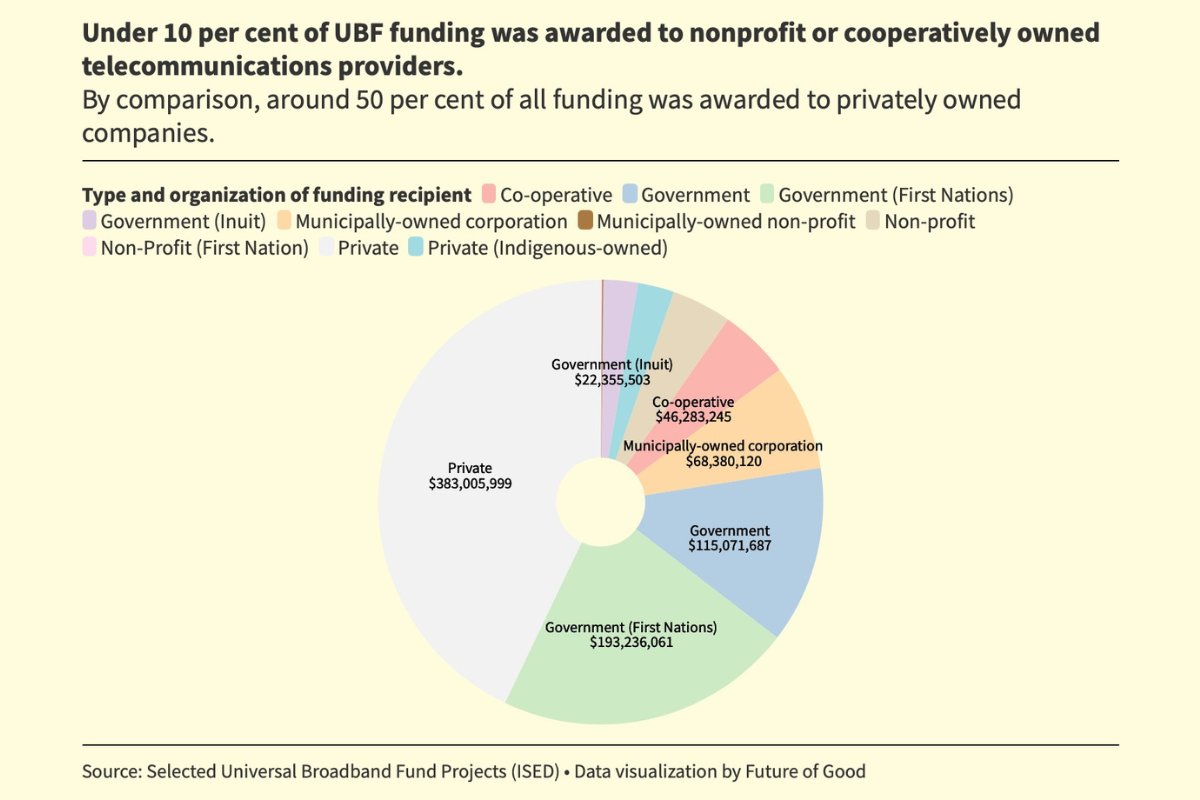
Of the 262 projects that received funding according to the Selected Universal Broadband Fund Projects database, only around 5 per cent were cooperatively owned. That includes Huron Telecommunications Co-operative in Ontario, and Access Communications in Saskatchewan. Just under 5 per cent were non-profits, including non-profits that are municipally-owned or run by First Nations. By comparison, just shy of 50 per cent of all of the funding was allocated to private telecommunications providers, including Indigenous-owned companies. 37 per cent flowed to governments, including Indigenous governments, who received approximately 24 per cent of the overall pot.
For Dr Hambly, the positioning of the UBF as an accelerated program – one which would favour “shovel-ready” projects – meant that national or more established telecommunications companies were likely to walk away with the most funding. The paradox, however, is that smaller telecommunications organizations aren’t able to get to a stage of building shovel-ready projects without the funding in the first place.
“Acceleration that puts new obstacles in the road for [smaller providers] is not proper acceleration,” Dr Hambly says. Instead, she suggests, there needs to be dedicated funding to increase technical capacity among municipalities, cooperatives and non-profits, rather than rolling them into the same funding initiatives as the big three telecommunications companies. “There needs to be some criteria to push forward projects that aren’t shovel-ready, but critical to fund. This should be brought forward to the Canadian Radio-television and Telecommunications Commission (CRTC) and ISED.”
“Non-profit telecommunications organizations, and Indigenous-owned and operated companies, are initiatives that are there because [some areas] have been bypassed by providers,” she adds. “It’s where big business or the market has failed. Cooperatives have also had a hard time surviving in a 21st-century context. Bigger companies have gobbled up the smaller providers, and there are so few of them left.”
Historically, many rural and remote communities have been ignored by larger telecommunications companies because it’s not economical or profitable for companies to lay cable and build broadband infrastructure for a handful of households. For Mark Buell, director of Indigenous programs development at Connect Humanity, that’s even more of a case for handing funding directly to those communities, to build and maintain their own infrastructure.
“If you’re not generating a profit, delivering services [to a community] is cost prohibitive [for a service provider],” Buell says. “For remote services, if the network goes down, the service provider would have to fly a technician out. Travel in the North is not only incredibly expensive, but sometimes not possible due to weather conditions. We saw a small community in the Northwest Territories where the internet was down for ten days, because a technician couldn’t be flown out. That was ten days of them not being able to access funds from a bank.”
Dr Hambly adds that receiving some money from the UBF does indicate that there was some awareness of the importance of cooperatives and non-profits within the assessment criteria. However, the relative lack of funding that has gone to them not only strengthens the oligopoly of telecommunications providers in Canada at the moment, but also denies communities the opportunity to be in control of building and governing their own critical infrastructure.
The application process itself is also a burdensome one, adds Buell. “The amount of effort that needs to go into the proposal, just to be assessed, is tremendous.” Indigenous and Northern communities, as well as local cooperatives and non-profits simply don’t have the capacity to put that much energy into an application, he adds. “The government could start by providing funding for communities to apply and bring on other organizations to help them develop their applications.”
In a follow-up with ISED’s media team, Future of Good was informed that “a Pathfinder service [an assistance helpline for those who need additional support in completing the application] was available to all applicants, particularly for smaller Internet Service Providers (ISPs), municipalities, and Indigenous applicants, to assist them in submitting quality applications. […] In addition, webinars were available on a variety of topics to ensure smaller applicants had the necessary tools to build partnerships, find sources of funding, and navigate the application process.”
However, the support was relatively short-lived and didn’t extend to after an application had been submitted: the Auditor General’s report “found that when applications to CRTC’s Broadband Fund were on hold, not selected, or deemed ineligible, the CRTC did not notify applicants of the status of their applications. In our view, it was not a good management practice to make applicants wait for 2 or more years for a decision.”
There is also an assumption made by the government that all applicants to the UBF and other similar funding programs already have a working source of capital to build and deploy networks, adds Buell. Providers are expected to pay for the cost of equipment, infrastructure, labour and consultancy, and then get reimbursed later on. ISED’s media team itself said, “UBF recipients are required to provide quarterly reports describing the progress of their project and a final performance report at the end of the project. Recipients are paid throughout the lifecycle of their project following program officials review and approval of these progress reports to ensure they are meeting desired objectives and to ensure the appropriate use of public funds.”
That program structure could exclude or discourage smaller providers or municipalities from applying for funding in the first place: “For small communities who have just a few million dollars to put towards a network, they might not be sure when they’ll get that money back,” Buell says.
The solutions to diversifying the telecommunications industry and giving space to cooperatives and non-profits are relatively simple, according to Dr Hambly. “Getting [timely] feedback on applications before deadlines can tear down those barriers, particularly for organizations who have staffing challenges,” she says.
Finding: 66 of the 262 contracts listed in the Selected UBF Projects database were awarded to Bell
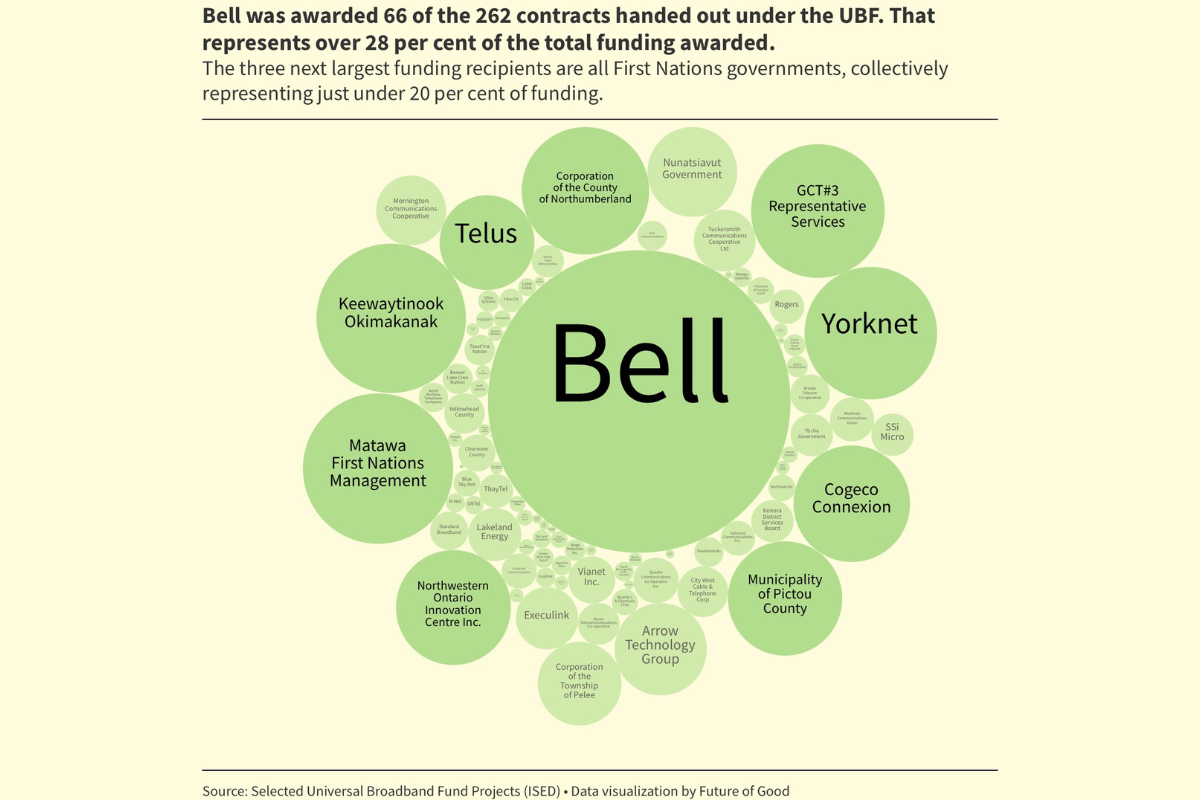
Buell believes that the government is still caught in the mindset of believing that big telecommunications companies are the only ones that can do the work, which means that funding and contracts continue to be awarded to them. When asked the question of why Bell had been handed about a quarter of all of the contracts awarded by the UBF – which collectively represent just over 28 per cent of the total funding pool – ISED said the following: “The program’s assessment is designed to deliver projects offering the greatest value for Canadians in terms of extending robust, affordable broadband service to underserved households. The comparative criteria ensure that projects from a wide variety of applicants across Canada are considered. To date, 113 announced projects have been awarded to larger ISPs, while 146 announced projects have been awarded to small ISPs, municipalities or Indigenous entities.”
Following Bell, the next three largest funding recipients were all Indigenous governments: Matawa First Nations Management received one contract with a value of $62.7 million; Keewaytiknook Okimakanak received three contracts, collectively worth $61.9 million, and Grand Council Treaty (GCT) #3 Representative Services was awarded one contract of $49.5 million. By comparison, Telus was awarded 18 contracts, with a collective value of nearly $25 million, and Rogers’ five contracts totalled $3.3 million.
Bell is in a unique position, even among the big three providers, says Dr Hambly. “In many rural and remote parts of Canada, Bell is the sole provider. There is no other choice, so there is a monopoly in the oligopoly.” It makes sense that so much federal funding has gone to large providers because “governments are inherently risk mitigators,” and going with an established provider removes the “risk that something embarrassing may happen,” Buell adds.
Having a sole provider in rural areas can also contribute to affordability challenges, which is a primary concern for consumers in Canada, a country with some of the highest broadband rates in the world.
The Auditor’s General report, however, found that the connectivity strategy “did not include any national indicators or targets to evaluate whether its affordability outcomes were being achieved,” and recommended that ISED “should identify, collect and analyze data, including consideration of household income, to measure progress against the affordability objective of Canada’s connectivity strategy to support improved Internet and mobile cellular connectivity in rural and remote areas, including in Indigenous communities.”
It’s also likely that Bell is making more money than has been outlined explicitly by the funding announcements in this database, Dr Hambly says. “Bell owns a huge share of the [broadband infrastructure] backbone, and so other providers buy access to Bell’s backbone. They’re benefiting even more than what we can see now.”
Additionally, the amount that is currently listed as being awarded to Bell doesn’t include any wholly-owned subsidiaries: for instance, Northwestel has been awarded just under $2 million to connect 5667 households in Nunavut, and has been owned by Bell since 1989 – but is listed as a separate provider in the database.
On top of that, for municipalities or Indigenous governments that have been awarded funding, they may not have the technical expertise to stand up and maintain networks themselves, and may end up using the work to subcontract out to private providers. For instance, the Rural Municipality of St Laurent in Manitoba was awarded $1.05 million to connect 1162 households, and has selected Starlink as its provider. Starlink is operated by SpaceX, and privately owned by Elon Musk.
ISED told Future of Good that it “received over 2000 applications, far more than anticipated, resulting in a large overlap of competing applications, and it has taken time to determine what could be funded and in what order.” Buell believes that there’s a critical piece of data missing here in terms of the information that has been made publicly available: “I’d love to see statistics on who applied in comparison to who got funding.”
Finding: Over 60 per cent of UBF funding was allocated to organizations and communities in Ontario
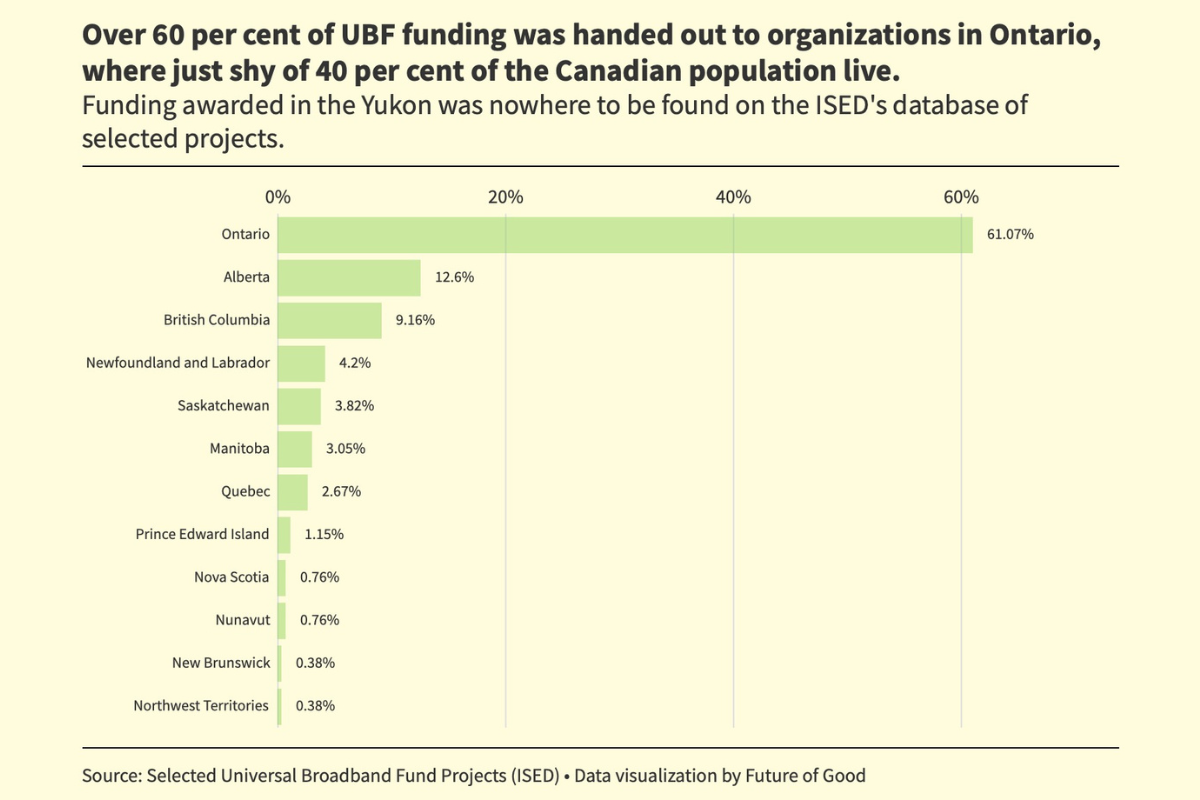
The 61 per cent of UBF funding that has been awarded to organizations working on projects in Ontario reflects the fact that 38.5 per cent of the Canadian population live in the province, according to the 2021 census. However, there has been clear geographic discrimination, Dr Hambly says, which has prevented provinces with larger rural populations accessing funding for projects that perhaps aren’t shovel-ready just yet, and require more infrastructural investment.
Nova Scotia, Nunavut, New Brunswick and the Northwest Territories all received less than 1 per cent of the total funding amount, which largely reflects how sparsely populated those provinces are. In fact, Nunavut is one of the provinces that has seen the most growth in its rural population between 2016 and 2021. And curiously, UBF funding awarded in the Yukon doesn’t appear on the database, suggesting that there hasn’t been any yet – according to the government’s progress dashboard, it looks as though work to connect the remaining households will begin in 2023.
“Geographic discrimination in the Maritimes, Northern communities and parts of rural Quebec is forcing people to move,” Dr Hambly says. “There is no consistency with the objectives of the UBF in terms of geographic distribution or equity. If you don’t invest in this equitably, you end up growing the digital divide, and relying on legacy technology which is even more costly to update or replace.”
Your job. Your mission. Your news.
With your support, the sector you're building gets the journalism it deserves, and you get a tax receipt.

Author

Related Articles
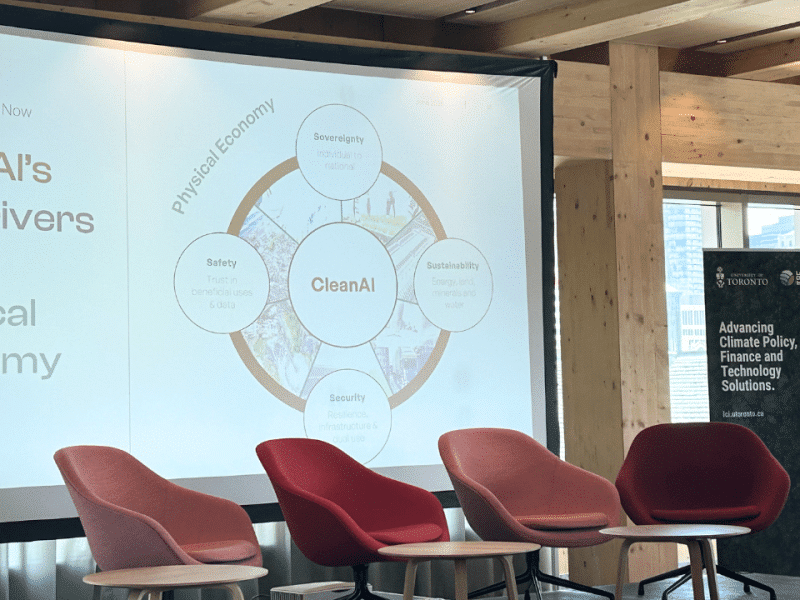
Quarter of all Canadian AI ventures could be categorized as ‘clean AI’: new research
At Toronto Climate Week, the global CleanAI Initiative shared research on the Canadian ecosystem, finding growing investment hubs in Vancouver, the GTA, and Kitchener-Waterloo.

Partnered Partnered content Non-profits are increasingly being targeted for cybercrime. Here’s how your organization can help protect itself
Being cybersecure doesn’t have to be daunting or expensive. A panel of experts discuss ways the non-profit and charitable sector can help protect itself in a constantly changing AI landscape.

Canadian astronaut, entrepreneur donates $15M to Concordia to launch new space school
Montreal’s Concordia University will be the home of the Mark Pathy Space Institute.
