Canada’s social finance history offers a path forward for non-profit digital transformation
Katie Gibson, vice president of strategy and partnerships at CIO Council, on a systems approach to helping non-profits transition to digital
Why It Matters
In a post-pandemic reality, non-profits will need to digitize — in one way or another — most of their processes, services, and activities. But for many, the capacity to embark on digital transformation just doesn’t exist. Gibson says a cross-sector, systems-level approach is necessary.

I am fired up about digital transformation in the social sector.
Canada’s non-profits provide vital services, often to our most marginalized communities. Yet many lack the digital and data infrastructure needed to maximize their impact. Ever resilient, nonprofits adopted new technologies to serve clients under pandemic restrictions. Now, Canada’s Budget 2021 has committed to a $400M Community Services Recovery Fund helping charities and non-profits “adapt and modernize.” We can build on this momentum to broaden access to services, create digital-first programming, and use data to drive outcomes.
My career has focused on social impact, and nothing excites me more than innovations that improve how social value is created. This drew me to social finance almost a decade ago and now to digital transformation in the social sector.
What lessons can we apply from one of the most powerful social innovations of the past decade – the explosive growth of social finance – to accelerate the badly needed digital transformation of the social sector? I see parallels between the maturity of digital transformation in the non-profit sector today and social finance when I got involved in 2013:
- A nascent ecosystem with limited coordination;
- a lack of consensus on the problem to be solved;
- much legitimate skepticism about using capitalist tools (of shareholder capitalism, now surveillance capitalism) for positive social impact;
- required expertise outside the core competencies of most non-profits; and
- a transformative potential for social value creation.
Digital transformation goes beyond using technology to optimize existing business models or create operational efficiencies. It’s about becoming a digital organization – integrating digital technology into all areas of the organization, fundamentally changing how you deliver value to clients and fulfil your social mission. It can involve online service delivery, mobile applications, cloud-based infrastructure, data analytics, automation, artificial intelligence/machine learning, internet of things, blockchain etc. It incorporates cybersecurity and data governance.
I will not detail the growth of social finance– although a $755M commitment from the Federal government for a Social Finance Fund and an 81 percent growth rate of assets under management over two years are good data points – or dissect the missteps.
But I do believe three insights from building a social finance ecosystem can chart a path for digital transformation:
- Build consensus on the problem;
- Identify high-impact solutions; and
- Retool existing supports.
I invite those who are as fired up as I am – whether non-profit leaders, policy-makers, funders, or enablers – to come together and address digital transformation not as an organizational choice but as a sector imperative.
Build a sector-wide consensus on the problem
One barrier to a sector-wide embracing of social finance is disagreement about the problem to be solved. The problem statement – usually implicit – ranged from “lack of capital” to “lack of innovation” to “poor outcomes measurement.” But innovation for innovation’s sake is not compelling, and nobody responds to lectures about their inadequacies. Like social finance, digital transformation is a tool. Why should non-profits equip themselves with this tool? The first rule of change management is that stakeholders will not buy into a solution without aligning on a problem.
Funders should support research to substantiate the shortcomings of the current state of the sector’s digital transition, illustrate the ideal future state, and inform a strategy for bridging the gap. Much relevant data exists or can be gathered easily, so this step can be expedited with the right partners. Some key research projects:
- Establish a baseline: What is the current state of Canadian non-profits’ digital transformation? US research characterized only 21 percent of non-profits as “future ready” — the most mature level of digital transformation — versus 47 percent that were in the least developed category.
- Build the case: Does digital transformation enable non-profits to operate more efficiently, expand access, and improve social outcomes? The rationale is more complex than the competitive advantage conferred by private sector digital transformation.
- Identify key barriers: What unique barriers do non-profits face? Do they differ from barriers identified by small and medium enterprises such as limited capital, hesitancy to invest in technology instead of other activities, fear of not seeing a return on investment, and lack of understanding of the potential benefits?
But research should not delay action. In parallel, sector leaders should build support and momentum for addressing the problem as a sector. Case studies illustrating what is possible can be particularly persuasive. COVID-19 has acted as an accelerant, and we have amassed anecdotal evidence about the benefits of digital transformation. More is required.
Finally, when aligning on the problem, funders, policy-makers, and sector leaders must bring a sophisticated equity analysis. A legitimate critique of social finance is that it is driven by elites enamoured with technocratic solutions to what are at heart issues of power and inequality. This critique must inform a digital transformation strategy. Technology should reduce inequality, not exacerbate it.
Identify high-impact solutions
Identifying the highest-impact solutions for accelerating digital transformation requires a whole-of-sector effort. Convening a Task Force on Digital Transformation in the Nonprofit Sector is a critical step to identifying solutions and coalescing an ecosystem.
The Task Force on Social Finance was catalytic, bringing together business, policy, and philanthropic leaders to address the lack of capital to tackle social needs. It produced the foundational 2010 report, Mobilizing Capital for Public Good with recommendations for government, funders, and investors. This gave social finance supporters a touchstone and a playbook to drive progress
A Task Force on Digital Transformation in the Nonprofit Sector should be mandated to identify priority interventions at the organizational and sector level to accelerate digital transformation.
The Task Force should adopt an inclusive, transparent, open methodology, taking submissions and research from all corners of the sector without barriers. This is critical for ensuring that the Task Force considers the diversity of the sector and preventing it from becoming an elite exercise, which has bedevilled previous task forces.
The Task Force could be comprised of early implementers of non-profit digital transformation (e.g. Kids Help Phone, Furniture Bank, CanadaHelps), private and public sector digital transformation enablers (e.g. the Technovate consortium, technology executives from the CIO Strategy Council, Code for Canada), nonprofit digital transformation consultants(e.g. Ajah, Open North, Answer.it, TechSoup Canada), sector funders, academics (e.g. MIT’s CISR), international experts (e.g. The Center for the Digital Nonprofit, Technology Association of Grantmakers, NTEN, and Avanade), sector networks and platforms for thought leadership (e.g. Imagine Canada, Ontario Nonprofit Network, The Philanthropist), and executive recruiters with nonprofit practices (e.g. KCI, Boyden).
While the Task Force is temporary, it could recommend a permanent coordinating body: a National Advisory Board and/or communities of practice for non-profit leaders, funders, and others, perhaps modeled on the Table of Impact Investment Practitioners.
A Task Force concentrates efforts and surfaces solutions. We also need a vision. In the social finance context, I have often quoted Judith Rodin, former President of the Rockefeller Foundation, who succinctly described the opportunity: “while there is not enough money in foundation and government coffers to meet the defining tests of our time, there is enough money. It’s just locked up in private investments.” Digital transformation too needs a bold vision.
Retool or scale up existing supports
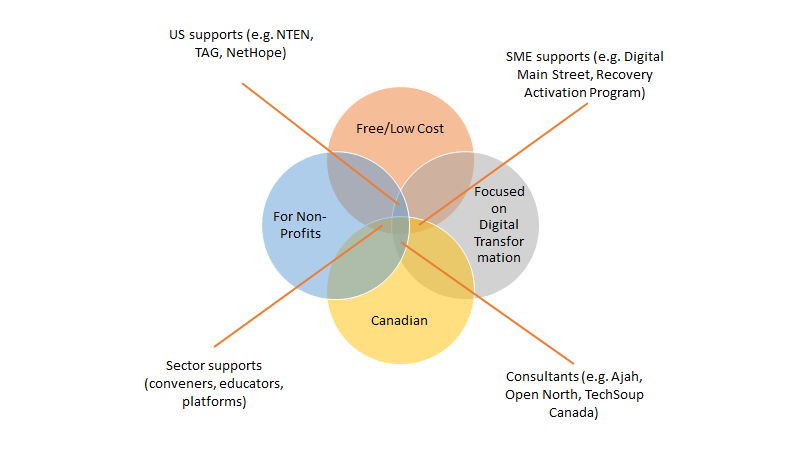
We can agree that digital transformation is not cheap, and resources in the sector are always stretched. The sector needs supports that are free or low-cost for the user, focused on digital transformation, and available to non-profits in Canada. A vanishingly small number of such supports exist, but adjacent ones are available – such as free digital transformation assistance for Small-Medium Enterprises or digital transformation tools focused on US non-profits. The systems-level play is to retool, scale up, and streamline existing supports so they hit, and expand, the bullseye of the Venn diagram.
It would not be complicated, for instance, to adapt digital transformation supports designed for Small-Medium Enterprises to meet the needs of non-profits. These programs have sprung up in response to COVID, including Digital Main Street and the Recovery Activation Program in Ontario and the Digital Boost Program in New Brunswick. TECHNATION has also convened stakeholders to accelerate SME digital transformation, and we can expect more to come – playbooks, coaching and mentorship, and upskilling and micro-credentialing initiatives.
Digital leadership on non-profit boards, too, could be catalytic. Let’s set a goal of electing at least one digital transformation expert to every non-profit board. The sector already benefits from several non-profit board matching services. These services could partner with the private sector to place digital transformation experts in organizations.
Organizations could also partner with recruiters. Digital transformation requires talent as much as technology, and strong leadership is essential. Executive recruiters often shape the skillset for senior roles. What about building a partnership with recruitment firms specializing in nonprofit leadership?
Engaging and upskilling non-profit staff is critical. What do programs like Carleton’s Graduate Program in Philanthropy and Nonprofit Leadership teach about digital transformation? What supports can important sector convenors like the Ontario Nonprofit Network offer? How can McConnell Foundation’s Innoweave platform be leveraged? Perhaps these offerings could incorporate new trainings and mentorship.
Canadians must also look beyond our own borders and be “fast followers.” While Quebec is a leader in the social economy, no Canadian jurisdiction led the pack in social finance. Formalizing relationships with the U.S. and the U.K. accelerated our progress.
Canadian funders should tap into the Task Force on Digital Infrastructure, led by the Technology Association of Grantmakers in the US. It has recently launched “prioritized projects” including a cloud technology starter pack for non-profits, a map of capacity-building efforts, and a campaign to address the “tech as overhead” myth. Non-profits can consult NetHope and Techsoup‘s assessment tools and NTEN‘s education program.
Crucial to the growth of social finance are standards like the Global Impact Investing Network’s IRIS+ impact accounting system. As Director of the Social Enterprise Branch for the Ontario government, I convened the Ontario Social Enterprise Impact Measurement Task Force, which spawned the Common Approach to Impact Measurement. It has now developed a Common Impact Data Standard.
Similarly, digital transformation tools and playbooks can be developed. When methodologies and technologies are standardized, it compresses subsequent transformation cycles. For example, could Imagine Canada’s charity accreditation better recognize technology excellence? An organization like the CIO Strategy Council, where I work, is expert in standards-setting for technology innovations with a social purpose.
The path forward
Applying the lessons of the development of the social finance’s ecosystem, I have described a path toward the digital transformation of our nonprofit sector. Canada’s non-profits change lives, and we all have a stake in their success. Let’s work together to give them the best tools for the job.
Your job. Your mission. Your news.
With your support, the sector you're building gets the journalism it deserves, and you get a tax receipt.

Related Articles
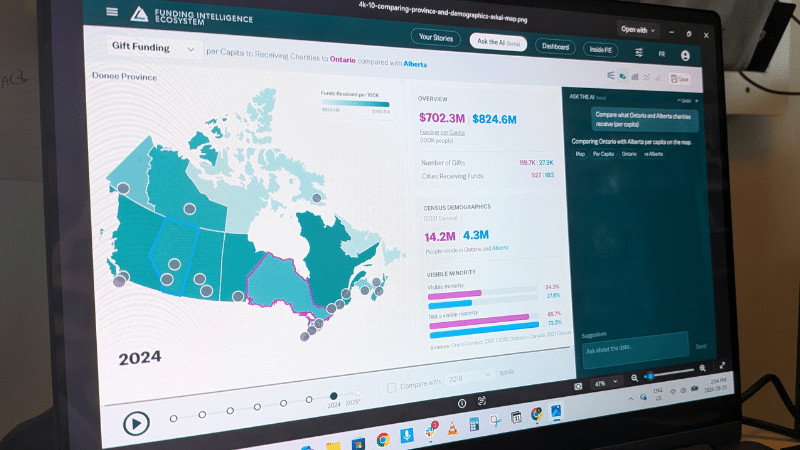
Imagine Canada launches visual tool to ‘see’ non-profit funding landscape
A new data visualization tool designed to let funders, non-profits and researchers understand the entire non-profit funding ecosystem

Ottawa chooses Canadian Housing Acquisition Fund to manage $1.5 billion affordable housing money
The massive new fund will help grant Indigenous, cooperative and non-profit housing providers easier access to capital to help buy and develop homes for lower-income Canadians.

New donation platform to help communities directly pay down mosque debt
Own Your Masjid is a project of boutique marketing agency Process Plus Marketing
