Does shareholder climate activism complement grassroots activism?
“We built on the work of advocacy and grassroots activism to get investors to realize that climate change is a collective problem.”
Why It Matters
Transitioning to a low-carbon economy and society requires buy-in and intentional actions from publicly traded corporations, not just social purpose companies. Shareholders can push for climate action should they choose to exercise their power. Will they?

Matt Price speaks at the 2023 annual meeting for TD shareholders. Photo: courtesy of Matt Price
This independent journalism is made possible by the Future of Good editorial fellowship covering social finance, supported by the Suncor Energy Foundation. See our editorial ethics and standards here.
Canada has been warming twice as fast as the global average. Among the many consequences of climate change are physical damages, like loss of biodiversity, sea-level rise, infrastructure damage due to fires and floods.
A 2022 report from the Institute for Sustainable Finance Climate evaluates that these physical damages could result in $2.8 trillion in losses for the Canadian economy until 2100 if global temperatures rise by 2 C. These losses have already started dating back to 2015.
This data raises concerns among Canadian investors. They risk losing their money if the companies they invested in do not clean up their act soon.
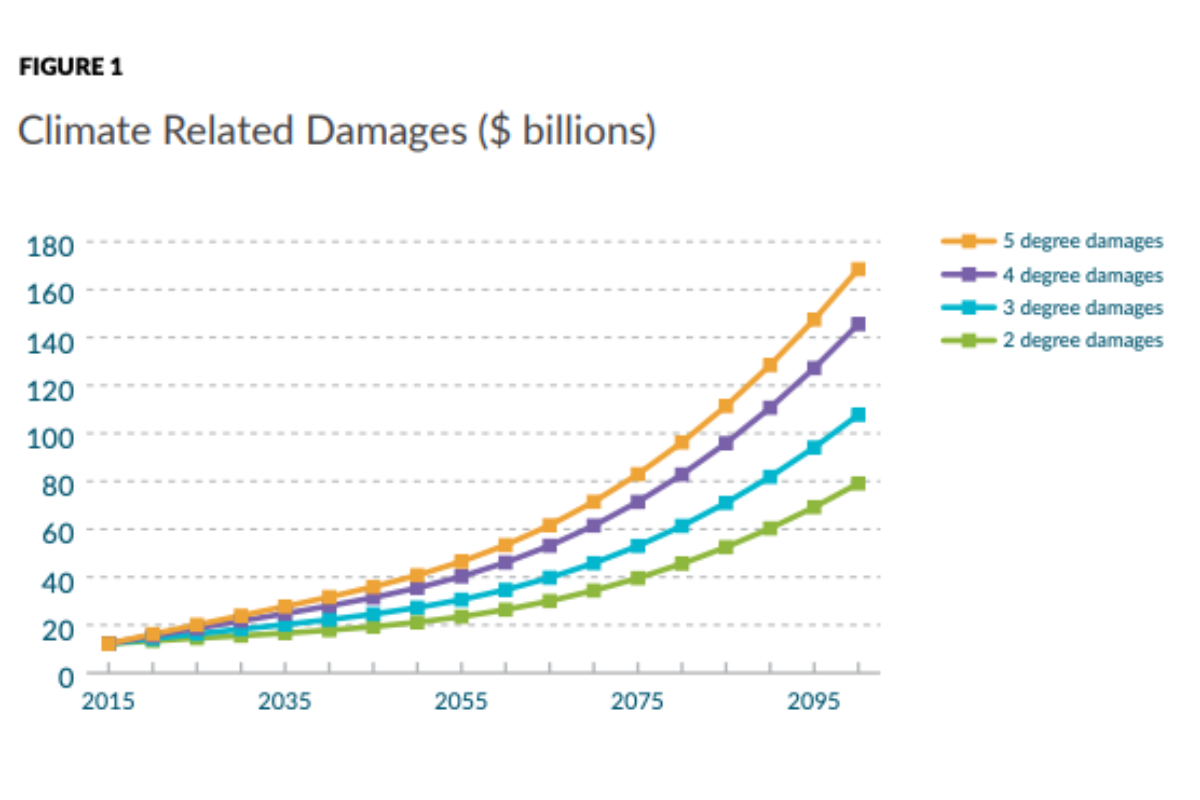
The Physical Costs of Climate Change: A Canadian Perspective report, April 2022.
Since June 2022, 34 finance organizations (banks, asset managers, institutional investors, insurance companies, pension plans, and family offices) with a combined $4.6 trillion in assets have been engaging in dialogue with the 41 biggest Canadian GHG emitters. The initiative is called Climate Engagement Canada (CEC). The members want those 41 companies to adapt their activities to reach a net-zero economy.
These finance organizations have different investment targets. Some of them want fast returns. Others have long-term obligations, like pension funds which need to support new retirees each year.
Most do not identify as impact investors or responsible investors. They would not fit in the social finance universe; however, their investment decisions have social impact. Investors play a crucial role in determining how society fares in the face of climate change. As owners, investors can use shareholder climate activism to ask companies to lower their carbon footprint.
Does shareholders climate activism complement grassroots and NGO activism? Can it amplify it?
Future of Good met with the pioneers of shareholder engagement and new actors in the sector for a frank talk about finance and climate change.
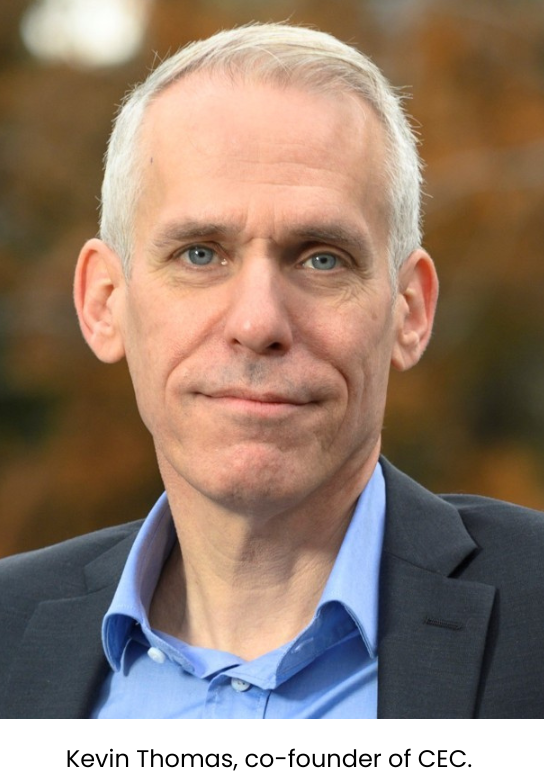
“CEC participants all have different motivations for wanting businesses to act about climate change,” says Kevin Thomas, co-founder of CEC. Before CEC, Thomas was a workers’ rights advocate and an Alberta Lubicon Lake First Nation treaty negotiation advisor.
“Whether you come as a conscious human being or from a very strict financial angle, saying we can’t afford to keep doing business as usual makes no difference. What brings investors to CEC matters less to me than what they do once they join. Our job is to make sure change happens.”
Shareholder activism 101
“Shareholder engagement is a constructive process of dialogue between shareholders, or their representative, and the companies around how management can improve the policies and the practices related to a specific environmental, social or governance (ESG) risk,” says Anthony Schein, director of shareholder advocacy at SHARE, in Vancouver. Schein spent a decade with AMAPCEO, an Ontario public sector union, and has a background in civic engagement, community engagement and trade unionism.
Investors hire the SHARE team to represent their interests and make sure companies do not put their investments at risk. Most of their clients are long-term institutional investors. Pension funds, university endowments, Indigenous funds, religious institutions and philanthropic foundations keep their investments longer than speculative investors because they have long-term responsibilities toward their beneficiaries.
“Our clients have numerous expectations to fulfill,” says Schein. “Take pension funds; you and I want the money deposited in our bank account when we retire. But we also want a healthy community to live and thrive. We expect our pension fund to address climate risk in their investments, so we have a future to look forward to.”
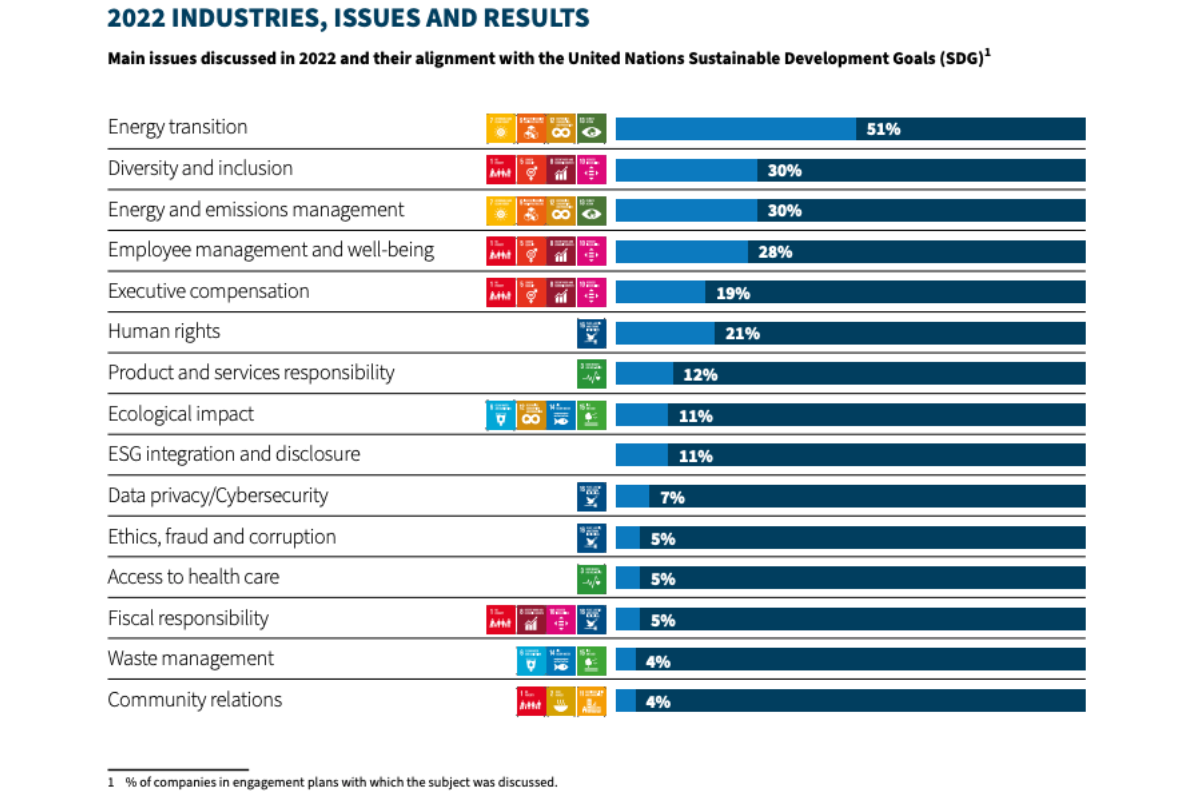
From Aequo Activity Report 2022-2023.
The three expectations of shareholder climate activists
Regarding climate, all investors expect three sets of actions from businesses to ensure their money is not at risk, says François Meloche, director of engagement at Montreal Aequo.
Like SHARE, Aequo represents investors’ interests. Meloche, for instance, primarily works with the oil and gas sector. Before joining Aequo, Meloche worked in sustainable finance for many years.
Firstly, investors expect companies to set and disclose emissions targets compliant with the Paris Agreement, says Meloche. That legally binding international treaty states that greenhouse gas emissions should decline 43 per cent by 2030.
“Everybody talks about zero emissions by 2050, but the key date is 2030. Aequo, like all shareholder activists, expects short and mid-term targets,” says Meloche.
Some targets weigh more than others, like Scope 3 emissions. According to a report from Deloitte, Scope 3 emissions account for 70 percent of most businesses’ carbon footprint. Those are indirect emissions; for example, they result from the use of a product, not from manufacturing. Building a car causes GHG emissions, but driving it pollutes way more. In Europe, Scope 3 disclosure is mandatory, but not yet in Canada.
“But Canadian investors know that it is the real game changer to protect their investment,” says Meloche.
“To reduce Scope 3 emissions, a company will have to change its product. Changing your product means changing your business. And the transition will only happen if companies change their business models.”
The second demand from shareholder climate activists is the disclosure of capital expenditure. Shareholders want to know where companies allocate their money, now and until 2030, a milestone set by the Canadian government to reduce carbon emissions of 40 to 45 percent below the 2005 level.
“I compare reaching the 2030 Paris Agreement targets to New Year’s resolution to go to the gym,” says Schein. “Suppose you pledge to go to the gym 150 times yearly. It means three times a week, which is feasible in January. Come June, you have not been to the gym once; to reach your goal, you have to double your weekly sessions. Come October, if you have done nothing, your goal is unreachable. Companies who are serious about reaching Paris 2030 targets show it in their financial statements now.”
Thirdly, investors want full disclosure of lobby activity, that is, any meeting with a government official to influence climate action.
“There is no point in a company setting emission reduction targets while lobbying the government to make sure no regulation forces them to comply with these targets,” says Meloche.
The report Pulling back the curtain by Share states: “While companies have made progress to address some disclosure gaps by providing often high-level information on their lobbying priorities and strategies, all companies fail to demonstrate how their association memberships align with Paris Agreement goals.”
Science-based emission reduction targets: Will it change anything?
All shareholders climate activists interviewed for this article commented on the lack of ambition and credibility and the pace of businesses’ GHG emission reduction targets. But the Science Based Targets initiative (SBTi) might shed new light on relevant climate action for investors.
SBTi is a partnership between the United Global Compact and NGOs. Its mission: “to show companies and financial institutions how much and how quickly they must decarbonize to prevent the worst impacts of climate change.”
Thus, a company can submit its emission reduction targets to SBTi for accreditation. This validates that a company’s targets are relevant and achievable according to science-based criteria. As of December 2022, 67 Canadian companies had their emission reduction targets validated by SBTi. The list includes shoe retailer Aldo. Their science-based accredited target is the following: by 2030, to cut carbon emissions across their operations by 60 per cent and down per pair of shoes by 30 per cent, compared to 2016 levels. Another example is telecom provider BCE, whose science-based approved emission reduction targets include end-of-life treatment of sold products, business travel and employees’ commuting.
“It means that according to science, these companies set targets that will get where they should go,” says Meloche. “Then, we have to make sure they act.”
“When it comes to climate, investors’ main role, and challenge, is to unlock management thinking,” says Schein.
Companies are obsessed with the first actor role, says Schein. “Nobody wants to be the first to move, to take risks. Shareholder engagement needs to transform this passive posture into a FOMO obsession. I want CEOs to lose sleep over not moving fast enough and missing the net-zero economy opportunities. They all think they can be the last ones in the room when the lights turn off on the carbon economy. The more you think like that, the less likely you will be that one.”
All the interviewees met for this story rely on the same three tactics to get companies to manage climate risk and adapt their practices: engaging in dialogue, presenting propositions at annual assemblies, and, if nothing works, selling their shares.
Investors meet with management or hire firms like Aequo and Share to do this.
There have been some harsh critics of those meetings. “In the UK, they are called “tea and biscuits,” says Price.
As this expression suggests, many impact investing stakeholders frown upon shareholder climate activism. Julie Segal is one of them. She is the senior manager of climate finance for Environmental Defence Canada. Prior, Segal was a senior analyst in impact investing at the McConnell Foundation.
“There have not been any significant changes on how companies operate,” says Segal,
“Most investors are still concerned that the positive social and environmental thing to do might affect their returns negatively. And most companies act to maximize profit, even when it maximized nature destruction for communities,” says Segal.
Is shareholder climate activism too polite?
“The companies we engage with are not our friends,” says Schein. “I keep reminding my team that they are not in this business to make friends. We talk frankly about the goals and the targets that need to be met.”
“Shareholders have a unique responsibility and opportunity to influence businesses in a positive way,” says Thomas. “And to achieve positive outcomes, shareholder engagement can’t be negative. I want companies to see us as trusted partners to assist them toward the complicated challenge of transition.”
Segal is critical of shareholder engagement and skeptical about the outcomes.
“Shareholder advocacy won’t get us where we need to go,” she says. “But companies realize that having no transition plan to a low-carbon business model is not acceptable. It is not good for their reputation. Thus, attracting public attention is probably how shareholder climate engagement can be most useful.”
Shareholders attract public attention when they submit propositions at a company’s annual assembly. At those events, management reviews highlights of the year and takes questions. Shareholders vote for board members and on any submitted propositions.
In Canada, you must own a minimum of $2,000 in shares for six months before the assembly to submit a proposition. The media often cover these assemblies. Companies and their CEOs can hit or miss with the public, depending on the impression left by their statements at their annual meeting.
Some companies come out as arrogant and out of touch with the impact of their activities on the community. Others appear more concerned and connected with balancing profits and sustainability.
In 2023, Canadian investors submitted 16 climate resolutions at various annual assemblies, three more than the previous year. Average support for those resolutions was also up from last year at 15.6 per cent.
But a report issued by the investment company BlackRock last year proves that this positive data hides a flaw: the less prescriptive propositions are, the more shareholders support the rally. the less prescriptive propositions are, the more shareholders support the rally.
“We are not likely to support those (climate-related shareholder proposals) that, in our assessment, implicitly are intended to micromanage companies,” the report states. “This includes those that are unduly prescriptive and constraining on the decision-making of the board or management, call for changes to a company’s strategy or business model, or address matters that are not material to how a company delivers long-term shareholder value.”
Designing an impactful proposition is an art. There is a sweet spot between a wishy-washy proposition getting a high level of approval but no concrete change and one that could induce change but is too binding to get approval, says Meloche.
Shareholder propositions get media attention. “But dialogue is where the real action is,” says Meloche. “All year-round, we meet stakeholders of the companies we engage with. We have conversations with the CEO, the VP of finance, and the sustainability team. If dialogue does not generate results, we present a shareholder proposition,” says Meloche.
“Our teams are getting constant training on how to engage well with companies, learning from each other’s success stories,” says Thomas. “We make sure our people know how to evaluate a company’s response. And if the engagement process isn’t achieving the results we want, we have to find some other way to move it forward.”
 New kids on the block
There’s a new player in the shareholder climate activism universe, Investors for Paris Compliance (I4PCC), a hybrid between an advocacy group and a shareholder engagement initiative.
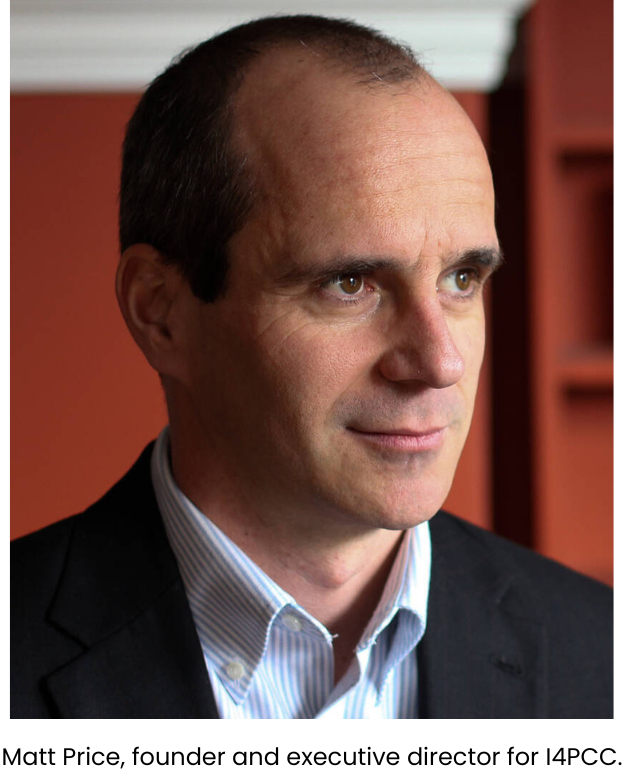
“We bring a bit more forcefulness to the table,” says Matt Price, founder and executive director for I4PCC.
Price was campaign director for Environmental Defence, a Canadian advocacy group defending clean water, a safe climate, and healthy communities. The director of corporate engagement, Duncan Kenyon, worked for Pembina Institute, an Alberta think tank advocating for the clean energy transition.
“Sometimes, I wake up in the middle of the night in a cold sweat thinking about climate change,” says Kenyon. “You do want to scream at people to take climate action now. But nobody will change because you had an aggressive discussion with them. So we learn to speak the company’s language. It is a steep learning curve, but we entered the shareholder engagement space to try something different.”
I4PCC’s mission is two-fold: producing reports ranking companies’ climate action and buying shares in companies that are big emitters to make climate propositions at their annual assembly.
Investors for Paris Compliance targets the banking industry. “Banks are putting the gas in the companies’ gas tanks,” says Price. “Without capital, you’re not going anywhere.”
“I would love to fix the financial system, but we do not have time,” says Kenyon. “So we work within the flawed system, trying to make banks accountable for their investment decisions.”
So, does shareholder climate activism complement the work of advocacy and grassroots activism?
“I would say we need each other,” says Meloche. “We built on the work of advocacy and grassroots activism to get investors to realize that climate change is a collective problem. And demand for action.”
Your job. Your mission. Your news.
With your support, the sector you're building gets the journalism it deserves, and you get a tax receipt.

Author

Related Articles

Indigenous people bear brunt of climate change disasters: StatCan
New data from Statistics Canada shows that, despite only representing five per cent of the population, just under half of wildfire evacuations in 2023 were from communities where more than half the population was Indigenous.

Fires and floods: How Canada’s non-profits are responding to summer disasters
Several organizations have set up ways Canadians can help as more than 900 wildfires burn across the country

Nova Scotia approves Indigenous-owned, largest-ever wind farm to power hydrogen production
The massive 1.2‑GW wind farm locks in Indigenous-led ownership and will power Canada’s biggest proposed green hydrogen export hub.
