Government of Canada announces three Social Finance Fund wholesalers
Realize Capital Partners, Boann Social Impact, and CAP Finance will administer the long-awaited fund
Why It Matters
The federal government says its plan is to catalyze $2 in private social investment for every $1 spent throughout the $755 million Social Finance Fund’s administration. That’s a huge amount of money for social purpose intermediaries.
This independent journalism is made possible by the Future of Good editorial fellowship on social finance and impact investing for an equitable future, funded by Suncor Energy Foundation.
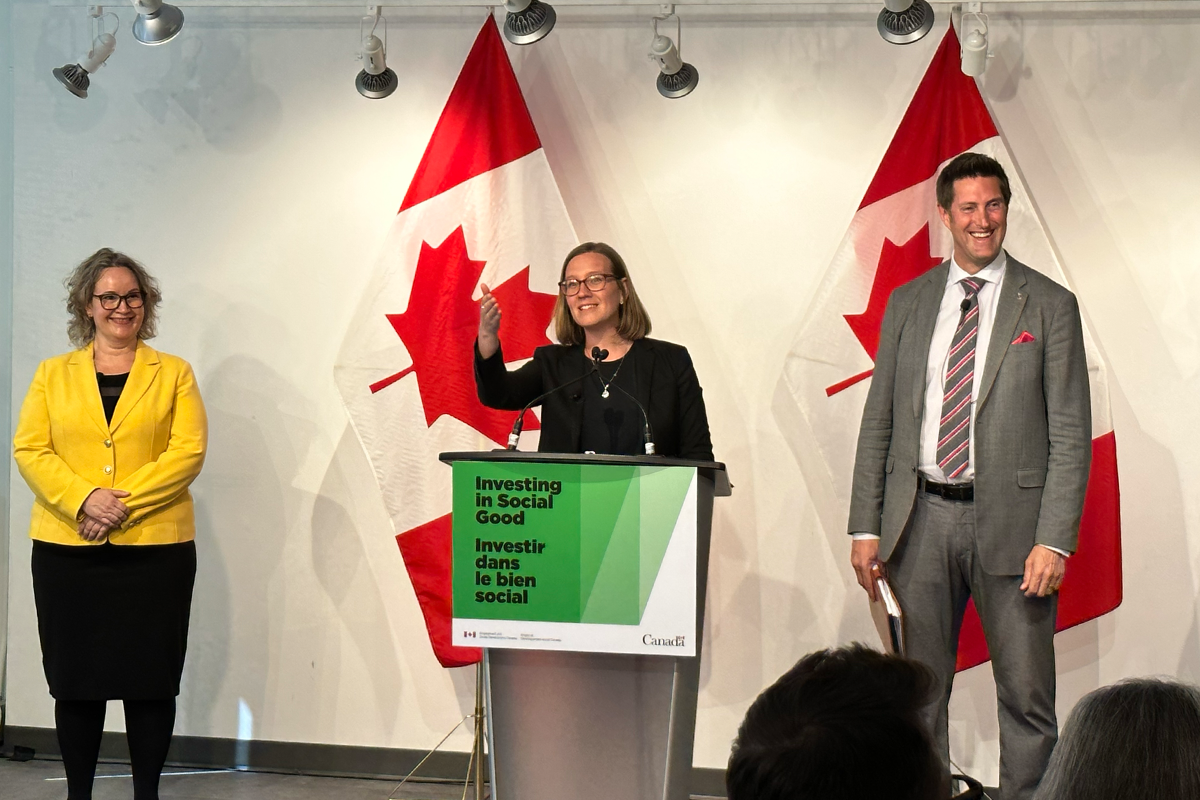
On May 29, Minister for Families, Children, and Social Development Karina Gould launched a long-awaited $755 million Social Finance Fund. It has been a six-year journey since the first announcement of the fund as part of the Ottawa 2018 Fall Economic Statement.
“It was a tough process,” the Minister said at the launch event in Ottawa. “We have never done this before. We had to build something new and find a way government can work with non-profits, social innovators, and the financial sector. But, in the grand scheme, six years is not that long.”
The fund, a long-term program, will run until 2039. It includes conditionally repayable contributions to invest in social finance intermediaries, like credit unions and private equity firms, and in rare cases, directly into social purpose organizations. Up to 10 per cent of total funding will be non-repayable contributions to cover administrative costs, blended finance, and ecosystem-building activities.
Three fund managers
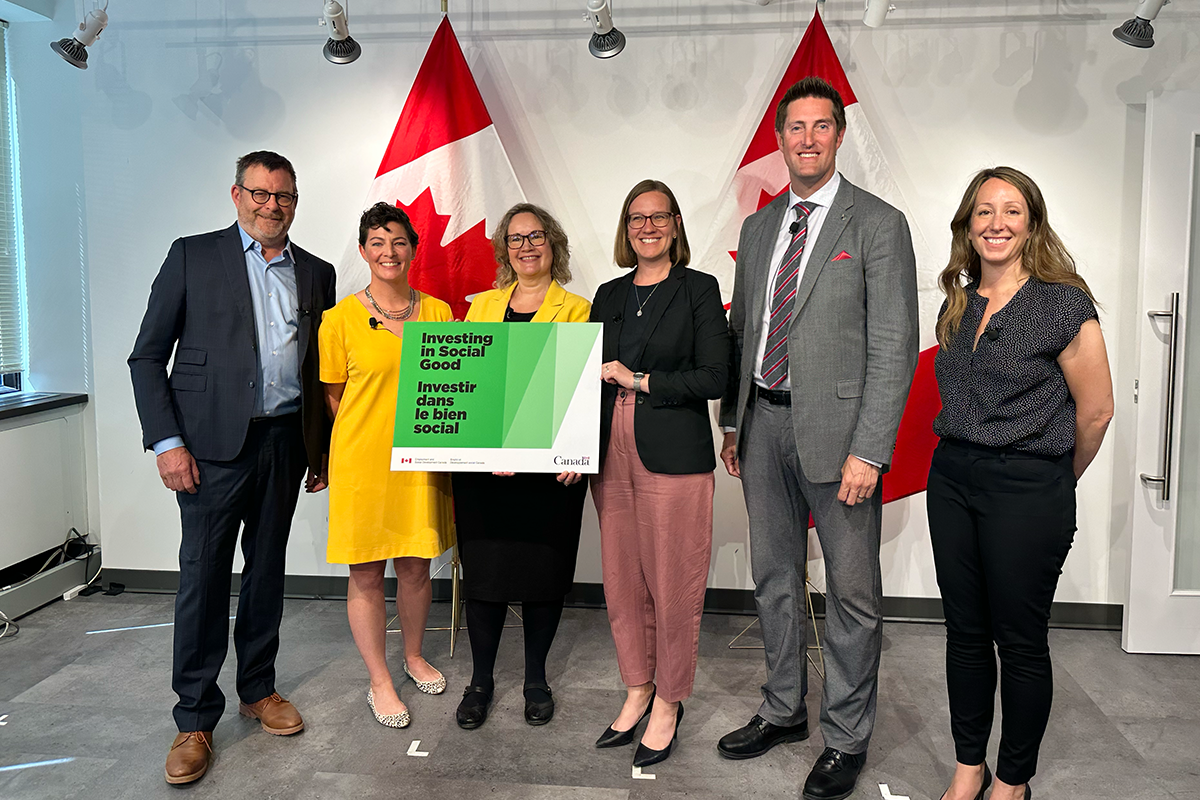
The May 29 launch comes with a first allocation of $400 million to be managed by three Canadian wholesalers, selected via a process launched in 2022. The first two wholesalers have a national scope: Boann Social Impact and Realize Capital Partners. The third one will invest specifically in Quebec, Fonds de finance social – CAP Finance.
Boann Social Impact is a new joint venture with the investment fund manager Encasa and the not-for-profit trust Table of Impact Investment Practitioners, a community of practice encompassing more than 80 Canadian social finance intermediaries and partners. Realize Capital Partners is a collaboration between the impact investment management and advisory firm Rally Assets and the early-stage venture capital fund manager Relay Ventures. Finally, Fonds de finance social – CAP Finance is a network of financial institutions and organizations working in Quebec, focused on the social economy and solidarity-based finance. Led by the Réseau d’investissement social du Québec and the Fiducie du Chantier de l’économie sociale, nine investors are involved in the project.
Leverage private capital
Minister Gould said the Social Finance Fund has two objectives: “First, to support social purpose organizations, so they can expand and have a real tangible impact. And to do so, we need not just government funding but we also need private capital. So by putting forward a solid investment of $400 million today, and $755 million overall, that gives investors confidence to say that is a bet worth taking.” The government established a target of leveraging a minimum of $2 private investment for each $1 Social Finance Fund contribution.
One-third for social equity
The fund aims for social impact, and it plans to do so by “enhancing” social equity in the finance system, Minister Gould said. The expectation from fund managers is for 35 per cent of capital to be deployed into initiatives promoting more significant social equity.
How will that translate concretely? The government has a broad definition of social equity. Derek Ballentyne of Boann Social Impact sums it up:
“Let’s look at the groups who are discriminated against today; that is the target for social equity. Groups without access to services or to the economy.”
Each wholesaler will develop its own investment thesis. “Social equity is partially about the founders and the system,” said Kelly Gauthier on behalf of Realize Capital Partners in an interview with Future of Good. “Realize will include equity in all layers: who is making the decisions? Who are the fund managers: are they equity-deserving communities? Where are they placing that capital? Are those social purpose organizations led by diverse groups? Are the end-stage stakeholders that will receive those products and services equity deserving?”
The Quebec approach will be to listen to groups representing equity deserving groups, said Nathalie Villemure, president of CAP Finance. “Some of these groups already have financial intermediaries who we will invest in. Some don’t; we will be patient and give them time and support so they can organize to become funding ready.”
Three fund managers, three approaches
Realize Capital Partners will create a single $400 million fund with a preferential structure for private capital. “The government is taking a second seat concessionary position with their capital,” explained Gauthier, who also said Realize does not plan for it to be a concessionary fund but to see market returns — the target is between 10 and 12 per cent. “We will balance investments across the funds between ones that return less and more,” continued Gauthier.
CAP Finance and Boann Social Impact target smaller intermediaries. “Our dear hope is to help build an ecosystem that does not yet exist,” said Derek Ballentyne, of Boann Social Impact. “In other words, new intermediaries and new places of investment.”
At very low-interest rates, CAP Finance plans to invest an average of $5 million in intermediaries who will invest directly in projects. Some of these investments will be short-term, and others will be patient capital.
Impact measurement challenges
The government set an expectation to develop a core data standard to align data collection and sharing between social purpose organizations and social finance investors within the Social Finance Fund. Realize Capital Partners will lead the work. “The goal is for the three wholesalers to collaborate, said Gauthier. “Everybody will have a voice, and we will be working to find a common impact data standard that allows us to talk about data measurement the same way across the country, from ventures to fund managers to the wholesalers to the government.” It will be a big challenge,” Gauthier said.
“I cannot impose Canada-wide measures on Quebec,” said Nathalie Villemure. “However, we are going to look at what is being done in Quebec, and we are going to try to find meeting points in the impact measurements with our colleagues in Canada. It is more likely to be an agreement than a single measure.”
What will success look like?
“Experience shows capital is not [a] democratic instrument,” Ballentyne said. “The Fund will be successful if it reaches initiatives around social equity that have not received any attention.”
Some critics express concerns about the scope. “There was a complete lack of diversity or representation on the panel, and from the leadership of the announcement,” said Victor Beausoleil, executive director of SETSI (Social Economy Through Social Inclusion) and board president of CCEDnet. “Indigenous, Black, and many other distinct communities once again were invisible. This is again an example of the need to decolonize spaces and end performative models and virtue signaling.” Per the federal government, fund managers must meet the 50/30 challenge: 50 per cent of the board members and senior leadership need to be female or gender-diverse, and 30 per cent need to come from visible minorities. Beausoleil said diversity was not a part of the announcement and is skeptical about the next steps.
For Kelly Gauthier, success will partly be defined by attracting “impact-curious” investors. And Nathalie Villemure sees the Fund as an opportunity to seize recognition for the social economy sector’s contributions to society.
Your job. Your mission. Your news.
With your support, the sector you're building gets the journalism it deserves, and you get a tax receipt.

Related Articles
Imagine Canada launches visual tool to ‘see’ non-profit funding landscape
A new data visualization tool designed to let funders, non-profits and researchers understand the entire non-profit funding ecosystem
Ottawa chooses Canadian Housing Acquisition Fund to manage $1.5 billion affordable housing money
The massive new fund will help grant Indigenous, cooperative and non-profit housing providers easier access to capital to help buy and develop homes for lower-income Canadians.

New donation platform to help communities directly pay down mosque debt
Own Your Masjid is a project of boutique marketing agency Process Plus Marketing
