How a teen turned her passion for science into fighting climate change
Naila Moloo talks green technology, science communication and the vital importance of mentorship for youth
Why It Matters
Young people today confronted with the looming climate crisis are spearheading initiatives to combat it. It is especially important now for the social impact world to be aware of what Gen Z change leaders are up to, as they are the next generation who will take up the fight against global warming.
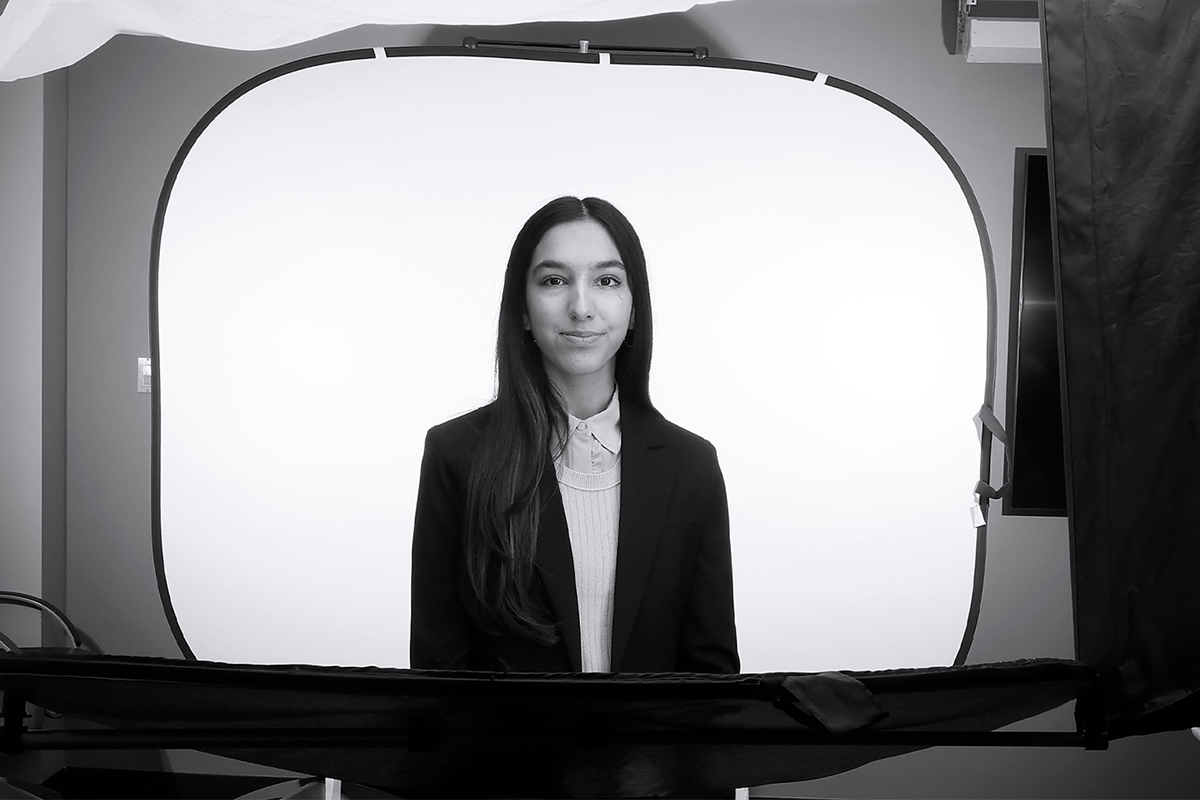
Photo: Blair Gable
This journalism is supported by a content partnership with the Public Policy Forum.
According to a 2022 public opinion poll by Deloitte, fighting climate change is a top priority for the majority of Canadian youth. Many members of Gen Z born after 1996 are fed up with the inaction of leaders and are taking matters into their own hands.
This is the case of Naila Moloo, a 17 year old grade eleven high school student from Ottawa, unceded Anishinaabe Algonquin territory, who decided to take action upon learning about the extent of the climate crisis as a child. Her work has already netted her many accolades, including being named one of Canada’s Top 100 Most Powerful Women by the Women’s Executive Network and the Emerging Leader Award from the Public Policy Forum.
We spoke to her about her research in green technologies, her passion for making STEM more accessible for all and her advice for other young people who want to follow in her footsteps.
I’m really curious to know how you first got interested in science and technology.
I think I was always interested from a young age, from the exposure by my parents and by school. Then last year before in grade nine, I joined The Knowledge Society (TKS), a STEM accelerator program, and that’s what kind of got me started on my bioplastic and solar cell projects.
Do your parents work in scientific or technological fields?
My dad is a surgeon and my mom used to be in law. So they were not really too much into engineering but my dad works in biology. He definitely introduced me to science, but biology is probably my least favorite science. I’m definitely more inclined towards physics and chemistry.
How did you first come into contact with TKS?
I got a scholarship [to attend TKS] through a science fair project I did in grade eight. I managed to get to the nationals there and then [TKS] reached out about the scholarship. That’s how I first heard about it.
Can you talk a little bit about some of the projects that you worked on at TKS or that started there?
My solar cell project got started at TKS. I started researching solar energy and how to leverage nanomaterials to create enhanced solar cells. That started in December [the year I was at TKS] and I’m still working on it. So it’s been a few years and now I’m just building flexible solar panels.
For my bioplastics project [author’s note: bioplastics are plastics produced from renewable organic materials], I started the research at the end of grade nine when I was still at TKS. I use what I’ve learned there to reach out to people and start getting feedback on my ideas.
My time at TKS definitely exposed me to areas of emerging technology. A big thing there was that they encouraged us to reach out to people via LinkedIn. I would say that they definitely gave me a lot of resources to start learning about things like solar energy and nanomaterials. That’s why I started reaching out to people.
How was the response to you reaching out to people? Because I know that a lot of people who are around your age can be very intimidated while doing that. So how did it go for you?
At the beginning, there weren’t a lot of responses, but some people were still responding. As I built up my profile and started sharing my articles and my work, people saw that I was doing research into their fields. So it started out with just a few people responding, and now there are more people who respond. Not everyone answers, but many people have been really nice to talk to.
How have you been able to benefit from that mentorship?
People I’ve worked with have given me a lot of opportunities – such as lab opportunities and feedback on my ideas. [I think that] if you have an idea, it’s really important to run it by people who are very experienced in the field.
In both of your projects, the process has not always been smooth sailing. Can you talk to me a little bit about some obstacles that you encountered on those projects?
It’s never smooth sailing. There’s always failure. For my bioplastics project, I’ve been working on it for two years in the lab and I’m still just working on building it out. Because something that you think is gonna work won’t end up working and then you have to do trial and error and figure out what is wrong. I experienced the same things in my solar cell project. Something that you think will take you a few weeks will end up taking like, eight months. It’s definitely a slow moving process.
What do you do to keep persevering in the face of those kinds of setbacks?
I think I really like the idea of the products that I’m trying to produce and the impact that those could have. That’s kind of what keeps me going – the fact that they could potentially be impactful if I can get them to work.
You’re also involved in a few other things. Can you tell me a little bit about your podcast?
I started a podcast called Curiosity a few years ago with one of my friends from TKS. We noticed that there are definitely a lot of podcasts out there, but not that many specifically directed at teens in terms of informing them of the latest news and technology. A lot of people aren’t aware of things like AI and blockchain. They just don’t know about [those things that are important to know because] they’re gonna be really impactful in the future. So we just try to bring in professionals, like CEOs of startups and people who work at big name companies, so that people can hear about these unconventional paths and see how other people got there.
Those are some quite complex topics. What do you do to make it engaging and interesting for your young audience?
We just start with the basics about what it is that they do. We always ask them about what they were like in high school, how they decided to pursue what they did in university to really connect with the listener. And then we walk through their life and how they got to where they are. [For example, we ask] how they got to their first job, so it’s very relatable. We don’t go straight to what they do right now. [We focus more on] how they began with what they’re doing and now where they’re at. We try to get advice from our guests to students so that it becomes a little more possible [for young people] to follow the same path.
I love that! Can you also tell me a little bit about your work with Light and Hope?
I’m on the board of the Light and Hope initiative. It’s based in Nairobi, Kenya and it helps students gain access to technology in Mathare specifically, which is a collection of slums. So I’m trying to build a mentorship program for them there. We’re creating workshops and bringing in people to do that. [We also] bring in guest speakers.
Why did you choose that specific initiative to get involved in? Why Kenya and why mentorship for young people?
It started out with me having a conversation with the founder of Light and Hope. Someone from TKS, one of the directors, put it out on one of our channels, saying they’re looking for feedback on their program. So I was down and I gave feedback on their website and their program, because they were just trying to get that from a bunch of different people. And then I kind of just kept in touch with them and realized that I wanted to work with them. I think mentorship for youth is really important.
Would you say that your personal experiences of receiving mentorship has influenced your decision to get involved in that mentorship initiative?
Yeah, definitely. People have taken the time to mentor me and give me feedback and I think the least I can do is try to help other people who definitely do not have the same access to resources that I do, but who may have the same interests [but] just don’t know yet because they haven’t been exposed to it and haven’t had that opportunity. Even if I can impact [just] one person and help to change their trajectory, that would definitely be a success for me.
How do you manage your time between all of these projects? Do you have any advice for other young people who might want to do a lot of things but are just finding it very hard to balance everything?
Before every week, write out your goals. Every day, write out your goals for the next day, so that you kind of know what you want to get done. Time blocking is something else [I do]. So if you have a class from one to two, and you have a space from two to two-thirty, [you can put] something you want to do there. If you put in “research” [in that space, you’re] more likely to actually do it [if it pops up on your phone screen]. Actually explicitly writing out what you want to get done and writing it out on your calendar as well helps.
You still have one year left of high school. Do you have any plans of what you would like to do after high school or is it too early to talk about that?
I would probably study mechanical engineering.
Are you planning to continue all of these other projects that you’re already doing in your post-high school life?
Yeah, hopefully! I would love to carry at least one forward. I guess we’ll see where they are at that point in time. But if not one of those projects, I definitely want to be involved in some kind of project in the climate space. So hopefully, I’ll continue my current projects if we see success with either or both.
Your job. Your mission. Your news.
With your support, the sector you're building gets the journalism it deserves, and you get a tax receipt.

Related Articles
Indigenous people bear brunt of climate change disasters: StatCan
New data from Statistics Canada shows that, despite only representing five per cent of the population, just under half of wildfire evacuations in 2023 were from communities where more than half the population was Indigenous.
Fires and floods: How Canada’s non-profits are responding to summer disasters
Several organizations have set up ways Canadians can help as more than 900 wildfires burn across the country
Nova Scotia approves Indigenous-owned, largest-ever wind farm to power hydrogen production
The massive 1.2‑GW wind farm locks in Indigenous-led ownership and will power Canada’s biggest proposed green hydrogen export hub.
