Montreal Sustainable Finance Summit: Inequality makes its way onto companies’ financial risk disclosures
The launch of the TISFD signals that social risk is no longer peripheral to financial stability, but is the next major test of whether markets can adapt to a world in crisis
Why It Matters
Living wages and the cost of living are systemic issues, not a collection of individual stories. Non-profits, community organizations, and social enterprises witness and absorb the human cost of inequality every day. Business and society interact; so experts say the social impact of this interaction needs to be disclosed and addressed, just like the impacts on climate and nature.
What risks Canadian companies disclose – and what they don’t – becomes more relevant every year when it comes to sustainable finance.
Climate and nature have found their way onto corporate balance sheets; a new frontier is emerging: inequality.
A short history of climate and nature financial disclosure
In December 2015 — the same month world leaders were signing the Paris Agreement —the Financial Stability Board established theT ask Force on Climate-related Financial Disclosures, known as the TCFD.
The Financial Stability Board is the global financial system’s watchdog; its job is to spot threats before they destabilize markets.
In 2015, it decided that climate change was one of those threats — not just for polar bears, but for pension funds.
In 2017, the TCFD released its disclosure recommendations, structured around four pillars: governance (who in your company is responsible for climate risk?), strategy (how does climate change affect your business plans?), risk management (how do you identify and manage those risks?), and metrics and targets (how do you measure them?).
In 2021, the IFRS Foundation — the body that sets the accounting rules companies use worldwide — created a new entity called the International Sustainability Standards Board, or ISSB.
In June 2023, the ISSB published two new global standards: IFRS S1, covering general sustainability-related risks, and IFRS S2, focused specifically on climate. Both global standards were built upon the Task Force on Climate-related Financial Disclosures recommendations.
Meanwhile, in June 2021, the Taskforce on Nature-related Financial Disclosures (TNFD) was launched.
Its premise: the natural world — forests, oceans, pollinators, freshwater systems — underpins the global economy, and companies are quietly destroying it without telling anyone what that means financially.
Two years later, the TNFD published its final recommendations.
The Nature-related Financial Disclosures standards are not yet integrated into ISSB standards, but the ISSB has already consulted on making biodiversity and ecosystems a priority topic for future standard-setting.
Social impact disclosure: the new challenge
In September 2024, the Taskforce on Inequality and Social-related Financial Disclosures — the TISFD — was formally launched, inspired by climate- and nature-related risk disclosure models.
The TISFD has the support of more than 100 organizations from across business, finance, labour, civil society, and international bodies.
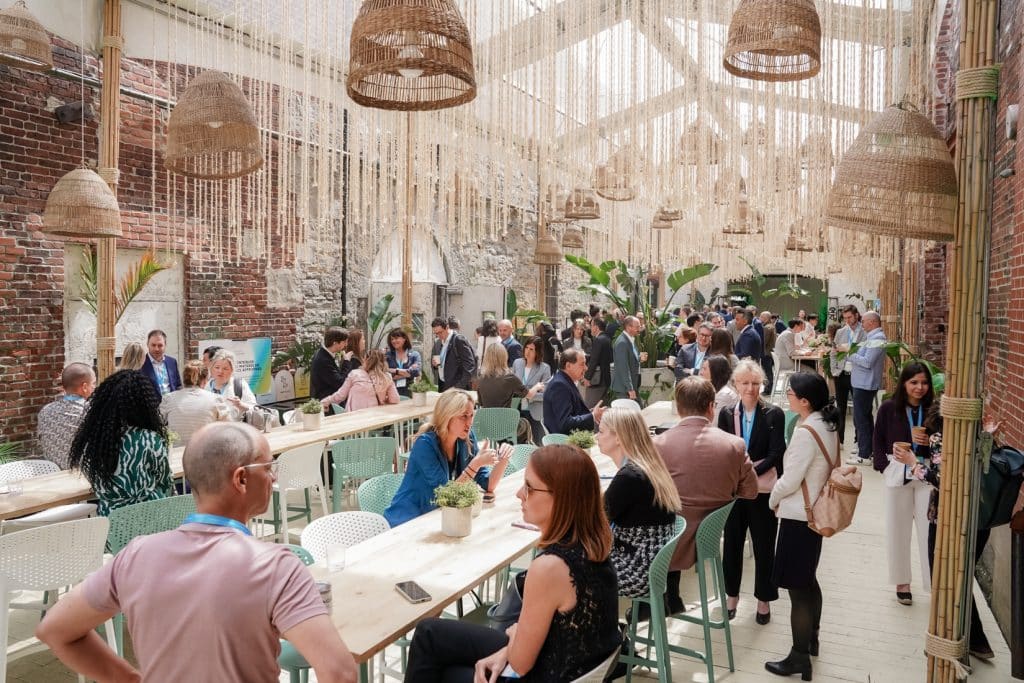
Simon Rawson, Executive Director of the TISFD, was a panellist at the recent Montreal Sustainable Finance Summit. Future of Good sat with him for an in-depth conversation on the ambition for social risk disclosure. The questions and answers have been edited for brevity and clarity.
Q: Tell us a bit about yourself.
A: I worked in politics as a diplomat for the British government, in consultancy, contributing to developing McKinsey’s social responsibility function, and in shareholder activism for the NGO ShareAction. Among the many campaigns we piloted, the living wage campaign is close to my heart.
We campaigned on two levels: changing the lives of tens of thousands of workers by securing pay rises and changing the bigger picture on how pension funds and asset managers thought about inequalities. It was the perfect foundation for my job with the Taskforce on Inequality and Social-related Financial Disclosures.
Q: So how did the living wage become a societal issue?
A: It might be quite profitable for a grocery chain to pay its workers as little as possible. But if you aggregate this behaviour, it becomes a societal disaster for three reasons. It’s impacting the economy as the consumer base is shrinking. So does [people’s] spending power – thus, growth. It affects politics and social cohesion; as more and more people feel left behind, polarization progresses. It creates financial instability, as no investor can divest from social risk because it is part of the system.
So it is not about the grocery chain or the retail store paying low wages to keep a neat balance sheet. It is about the instability of the two-tier economy we have created and maintained.
Q: First, there was climate risk disclosure. Then, companies were asked to disclose their nature-related risk. Now, where do human-related risks fit in the picture?
A: One of the things that will enable or prevent a successful transition of our economies to a low-carbon future is people. Are people supportive of the transition? Is this a transition which considers the impact on people or not? Where will people work after the transition? If your transition policies and strategies are poorly thought out, people will resist. No transition will happen if we do not consider the social dimension.
Q: What is considered in the framework?
A: It is a mental model that pushes companies beyond what they currently think they should report on four groups of people: their workers, the workers in their supply chain, consumers, and communities.
Q: It is not the best of times to add another set of disclosures, as climate investment faces headwinds…
A: Why did climate disclosure get ahead in the first place? Because extreme climate events affected the supply chains. Because the lack of water affected manufacturing. Because climate warnings affected infrastructures. Those were concrete signals. The rippling effect of the affordability crisis is a concrete signal, too. And it speaks louder than the political noise.
Q: Companies are being asked to disclose their carbon emissions. What social metrics is your task force working on?
A: There will be a small number of core metrics inducing system-level risk. We need more research to ensure we pinpoint metrics with an indisputable spillover effect.
Q: Humans are already being accounted for in the economy, aren’t they? Companies talk about ‘human capital.’
A: That is the problem: everybody has a different way to define the relationship between people and the economy. There is the human rights angle: humans have rights which should be defended and protected. The wellbeing angle: humans have needs that should be addressed. The human capital angle: humans are a resource that should be managed. We need a common framework for disclosing the interactions between a company and the people it is in relation to. So investors could compare and channel their money into companies that are more mature in managing their social risks.
Q: Your framework favours pre-distributive models over redistributive ones. Can you give an example?
A: Sure, take the financial sector capital allocation. It can accelerate the channelling of wealth to an ever smaller proportion of people. It could also channel it to ownership models having a pre-distributive effect. Models promoting employer ownership or employee equity. These models have the power to reverse the direction of wealth, reduce inequalities and reduce social risk.
Pre-distributive finance will always produce a more stable economic system than redistributive finance, in which the government makes payments to low-income citizens to compensate for inequalities.
Q: Future of Good has published articles on gender-lens investing and child-lens investing.Where does social risk disclosure fit in this continuum?
A: Gender-lens and child-lens investing are useful for impact-minded individuals, institutions and funds. Our framework’s focus is on aligning private capital as a whole, not just impact capital.
Q: Climate- and nature-risk disclosures can be seen as business opportunities. Many solutions are emerging. Could social risk disclosure be a source of solutions?
A: You’re right, there is a business case for energy efficiency, building retrofit and renewable energy. However, we are not at that level of maturity to identify the commercial opportunities in solving societal problems.
Still, many brilliant businesses do that. Affordable, social real estate is one example. Financial products that support financial inclusion are another. Micro-credit is a positive for individuals and the system.
Q: Recently, the Canadian shareholder activism group Investors For Paris Compliance ceased its activities, saying it reached the limit of its action and that regulation needed to take over. What is your take on that?
A: It’s a really interesting debate. My personal observation is that people love to sit and point across the table, saying, “We can’t do anything; they need to act.” Truth is, it is a lot easier for regulators to regulate when the market is already moving. Maybe in 20 years, we’ll be saying, like those climate shareholder activists: “You know, our task force can do no more; it’s time for policymakers to act.”
Q: What will be the indicator that the framework is a driving change?
A: Social risk will become a board-level conversation. When the board discusses an issue, it means it takes responsibility for it. It forces management to be more rigorous in handling, managing and reporting on the issue. So far, boards have considered social topics as political and sensitive, thereby avoiding discussion.
Developing an evidence-based common language for the economic and financial impacts of social issues will de-dramatize boardroom discussions.
Q: How can Future of Good readers can contribute to this framework?
A: We published a beta version on our website, and we are taking comments until July 31.
Your job. Your mission. Your news.
With your support, the sector you're building gets the journalism it deserves, and you get a tax receipt.

Author

Related Articles
Blended Finance Canada launches on West Coast
The new initiative is supported by the University of Victoria, Scale Institute and Spring.

Canada’s Sustainable Finance Taxonomy: What it is, what is happening and what’s coming next
Canada’s sustainable finance taxonomy faces big challenges, from oil and gas, Indigenous rights and the real meaning of the word ‘transition.’

First Bite Fund launches as Ottawa puts $1 billion behind domestic food processing
New revenue‑based loan fund aims to reach the 92% of food processors that conventional capital has overlooked
