Neighbourhood association launches technology lending library in east Toronto.
When the Centre for Social Innovation exited the Regent Park neighbourhood earlier this year, the Regent Park Neighborhood Association stepped in to pick up the pieces. However, questions remain about ongoing funding for community projects.
Why It Matters
Technology lending libraries – where community members can borrow hardware and access the internet – are helping to overcome the digital divide. But they are a relatively new type of organization. How can their impact be measured in the short and long term, and how can they continue to advocate for funding?
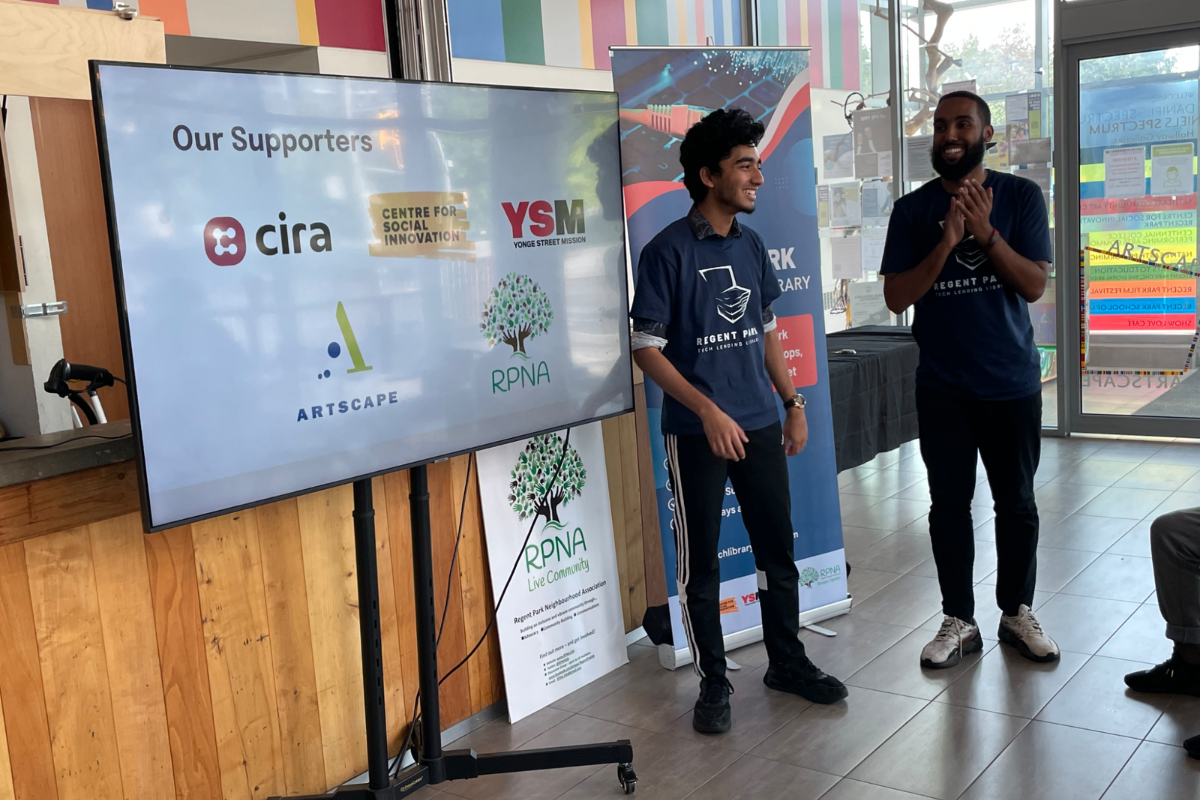
Program coordinator Abdirahman Mohamed (right) and staff member Shah Ehsan Haque (left) at the Regent Park Technology Lending Library opening in September 2023. Image courtesy of the Regent Park Technology Lending Library.
This independent journalism on data, digital transformation and technology for social impact is made possible by the Future of Good editorial fellowship on digital transformation, supported by Mastercard Changeworks™. Read our editorial ethics and standards here.
Growing up in Toronto’s Regent Park neighbourhood, Abdirahman Mohamed remembers sharing a slow internet plan with his large family.
“I had ten members in my family, and we were sharing an internet plan where we had ten megabits-per-second,” he says.
When the family recently transitioned to a gigabit-per-second internet plan, the difference in speed was immediately noticeable.
The story is the same for many families in the neighbourhood, Mohamed says. “They have struggled but might not voice it because of how normal it is for them.”
Shah Ehsan Haque, an aspiring journalist, says his friends often struggle with internet access because of how expensive plans can be relative to their families’ incomes.
“A lot of people talk about going to Tim [Horton]’s and Starbucks [to access WiFi], but the fact that people have to say that in the first place is an issue,” he says.
“These establishments have horrible Wi-Fi, but you also have to fit yourself and your needs into a commercialized space. They’re not open to the community – they have WiFi for their own commercial gain.”
Haque’s friends are now borrowing WiFi sticks from the new Regent Park Technology Lending Library, where Haque is a staff member, and Mohamed is the program coordinator. The library launched in September as an initiative that the Regent Park Neighborhood Association (RPNA) inherited from the Centre for Social Innovation (CSI).
The CSI had previously been running the Community Living Room in the area, a “gathering space, a community event space, a financial platform, and grassroots funding infrastructure,” which shut its doors in February 2023.
The organization had been granted funding from the Canadian Internet Registration Authority (CIRA) to start a technology lending library in the neighbourhood. The CSI has now transferred the entirety of the grant to the RPNA.
Along with WiFi sticks, residents of Regent Park can now borrow laptops and tablets for three days at a time and have the option to renew. All people need is a piece of identification and proof of address. One of the library funders is the Yonge Street Mission, which has offered to run internet safety workshops for users.
Uptake was slow to start, but once word-of-mouth spread through the community, activity at the library picked up. There is now a waiting list for the devices and WiFi sticks.
“The people checking items out have been very diverse,” Mohamed says. “Entrepreneurs and students are getting the internet sticks, and students and parents are checking out the laptops and tablets.”
Ismail Afrah, the RPNA’s treasurer, points out the benefits for small business owners. “Entrepreneurs want to use [card-based] payment systems, not just cash, but it’s hard to do that without WiFi,” he says. “So, some entrepreneurs are using the internet sticks to increase their revenue, and the library is able to generate and support entrepreneurs on their business journey.” This initiative brings economic development into the neighbourhood, he says.
A resident-led association steps into program management
The RPNA was initially established as a resident-led advocacy group, and shortly after, Afrah noticed the challenges of digital inaccessibility in the community. Parents could not access swimming lessons for their children, which are all booked through the City of Toronto’s online system and fill up early in the day.
These were issues that existed before the pandemic and were only exacerbated during it, adds Denise Soueidan-O’Leary, the director of community wealth and special projects at the CSI.
“Many families didn’t have the resources to have multiple computers. If you have a parent working online and children who have to do schoolwork online, how do you decide who gets the laptop?”
This issue motivated the CSI to apply for funding from CIRA to implement a technology lending library in Regent Park. At the time, the CSI was also transitioning from running a co-working space to a community-centric space in the Daniels Spectrum building. “[The Technology Lending Library] project would be a lovely anchor to have people engaged in the communal space,” Soueidan-O’Leary says.
However, financial pressures during the pandemic eventually forced CSI out of the Regent Park community – they were renting space in Regent Park and owning two buildings elsewhere in Toronto, one of which will soon be going on the market. However, the CSI had already used some of the funding granted by CIRA to buy hardware for Regent Park, such as laptops and tablets, to build their planned library’s inventory and lending infrastructure.
Therefore, the inventory was all set up for the RPNA to take on the project – and their five-year plan was always to hand over the CSI’s space and programs to the RPNA.
The only gap left was finding a lending management software to administer the flow of laptops, tablets and WiFi sticks around the community.
“We wanted to build as much infrastructure as possible and create opportunities for the community to be meaningfully included in owning, governing, running and making critical decisions about their own assets,” Soueidan-O’Leary says
“[The CSI] got this grant [from CIRA] because we happen to be the sort of organization that is capable of applying for it,” she adds. “We had the resources, like a grant writer and a back-end accounting team, to take on these things.”
“The capacity of resident groups [to take on programs] is often overlooked, and part of that comes from them not having the opportunity to do it. You need experience to get the job, and a job to get the experience, and community groups are caught in that trap.”
Because Regent Park “has a long history of marginalization and social challenge,” many service organizations are active in the community, Soueidan-O’Leary says. “There aren’t a lot of gaps for resident and grassroots organizations to come up through the cracks because there are so many organizations vying for funding,” she says. “This was a lovely way to elbow into the space without having to fight for it.”
Afrah adds that putting this program – among many others – into the hands of residents signals a shift to thinking about residents as “partners and collaborators” rather than “customers or clients.”
Can a neighbourhood association find and sustain funding?
Now that CSI has transferred the funding they were awarded to the RPNA to manage, the two organizations are still in communication, with the CSI team still a trustee of the funds.
Part of this guidance is being strategic about how to spend the initial funding so the technology lending library can sustain itself. “This grant was $100,000. That is zero in program dollars,” Soueidan-O’Leary says. “We knew it was about a year’s worth of dollars for equipment and salaries.”
Her approach was to pour money into infrastructure for the library, like the hardware itself, as well as storage and cabinetry. That way, she says, once the funding does run out, the RPNA is only looking to find enough funding to cover salaries.
“If the community likes it, it can still continue with volunteers if we run into a period of time where we don’t have funding,” she says. “That was part of the planning process, which would allow the project to be low-overhead going forward.”
The funding and the project will be crucial in helping the RPNA transition from a grassroots group to a non-profit business, Afrah says. It was officially incorporated as a non-profit in February 2022.
“Something people don’t think about is the need to have a not-for-profit bank account that has activity in it,” Soueidan-O’Leary says. Transferring all of the funding over into the hands of the RPNA allows them to build their bank account, internal accounting systems and accountability.
“Showing financial records or audited financial statements allows them the legitimacy of being respected as a real not-for-profit,” she says. “They can cut their teeth in terms of being looked at as a viable community program organizer and deliverer.”
Your job. Your mission. Your news.
With your support, the sector you're building gets the journalism it deserves, and you get a tax receipt.

Author

Related Articles
Quarter of all Canadian AI ventures could be categorized as ‘clean AI’: new research
At Toronto Climate Week, the global CleanAI Initiative shared research on the Canadian ecosystem, finding growing investment hubs in Vancouver, the GTA, and Kitchener-Waterloo.

Partnered Partnered content Non-profits are increasingly being targeted for cybercrime. Here’s how your organization can help protect itself
Being cybersecure doesn’t have to be daunting or expensive. A panel of experts discuss ways the non-profit and charitable sector can help protect itself in a constantly changing AI landscape.

Canadian astronaut, entrepreneur donates $15M to Concordia to launch new space school
Montreal’s Concordia University will be the home of the Mark Pathy Space Institute.
