Possible terrorist designation, airstrikes, further complicate Yemen aid delivery
80 per cent of Yemenis struggle to obtain necessities like food, water and health care.
Why It Matters
Yemen is facing rising levels of hunger. However, recent airstrikes and increased geopolitical tension could prevent assistance from reaching those who need it most.
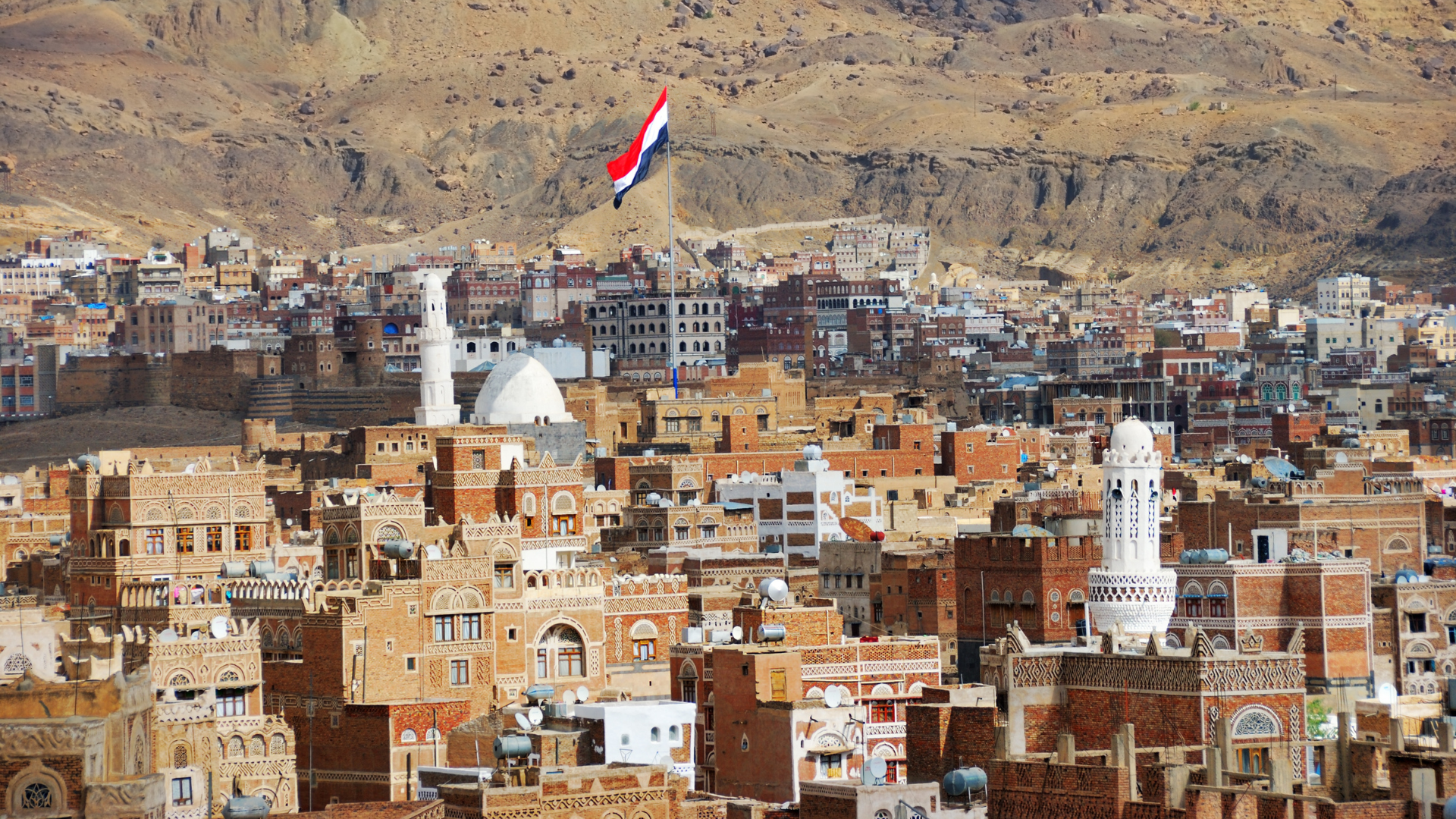
A flag flies in Sanaa, Yemen, inhabited for more than 2,500 years. The OId City of Sanaa is a UNESCO World Heritage City but has been destroyed by civil war. Canva/Getty Images
Canadian aid organizations are keeping a close watch on Yemen following U.S. and British airstrikes in the impoverished country and the federal government’s decision to consider designating Yemen’s Houthi movement as a “terrorist entity.”
“For the time being, it seems like the impact is limited, but there certainly is a risk, especially given how vulnerable and fragile the context is in Yemen right now,” said Stefan Epp-Koop, the Canadian Foodgrains Bank’s senior humanitarian manager.
“A number of the NGOs working in Yemen have said that this could have a considerable impact on their operations going forward,” he said.
“And that is certainly understandable in Yemen, where 90 per cent of the food is imported … so any disruption to trade, any disruption to shipping is going to have a significant impact on food security.”
Located in the southwest corner of the Arabian Peninsula, Yemen has endured a civil war between the Iran-supported Houthis, who control the country’s capital, Sanaa, and an internationally recognized government backed by a Saudi-led coalition since 2014.
Last October, Houthi special forces began seizing commercial vessels with ties to Israel and, following subsequent airstrikes, Britain. In recent weeks, the Houthis have also targeted ships in the Red Sea with ballistic missiles and drones.
The Houthis have said they will stop their attacks when a ceasefire is declared in Gaza, where Israeli occupation forces have killed more than 26,000 Palestinians since October. In response, Britain and the U.S. have moved warships into the Red Sea.
Amid this instability, Epp-Koop said 3.2 million Yemenis are experiencing “acute hunger.”
“It wouldn’t take much to make that situation a lot worse,” he said.
Eighty per cent of Yemen’s 21.6 million citizens currently struggle to access food, water and essential medical services, according to Action for Humanity, a British aid organization operating in the region.
“We are deeply concerned by the recent U.S. and UK airstrikes in Yemen, a drastic development in the region’s conflict,” said NGO’s in-country director, Mohammed Bahashwan.
“A return to hostilities would be highly detrimental for the people of Yemen and our field teams and will jeopardize our ability as an NGO to deliver assistance.”
Carelle Mang-Benza, policy lead at Cooperation Canada, said humanitarian actors have to contend with many issues when delivering aid, including complicated logistics and the safety of their staff.
“You are in a certain place to deliver lifesaving programs, but you have to be alive to deliver those programs,” she said.
“So each organization, in making their assessment, relies on various information sources, and they may at a certain point decide they need to pull out.”
If the federal government labels the Houthi movement a terrorist entity under Canadian Law, delivering humanitarian aid to Houthi-controlled regions of the country may be further complicated, according to organizations with experience working in conflict zones.
Assisting a terrorist entity is a crime under Canada’s Criminal Code, although the recently passed Bill C-41 provided exemptions to humanitarian workers providing life-saving assistance in response to emergencies.
According to the Government of Canada, the amendment allows “critical activities, such as the provision of humanitarian aid, health services, education services, programs to promote human rights, and resettlement services, to be undertaken by authorized persons in certain regions without threat of criminal liability where circumstances warrant.”
However, many Canadian aid agencies working in countries like Afghanistan have expressed concern with the legislation’s implementation.
Mang-Benza said Cooperation Canada’s member organizations are learning to work within the confines of the new legislation but that future advocacy on the issue hasn’t been ruled out if severe bottlenecks arise.
A terrorist designation for Yemen’s Houthis could impact future programming at the Foodgrains Bank, said Epp-Koop. While the organization isn’t currently working in Houthi-controlled regions of Yemen, it has in the past.
“We are able to program humanitarian aid in those contexts, but it does certainly put a limit on the kinds of activities you are able to implement,” he said.
“So that is something we are also keeping our eye on because that may impact future programming.”
While Yemen’s humanitarian situation continues to be dire, global attention appears to have waned as other conflicts, including that in Ukraine, have redirected international funding.
“But it’s not just Yemen; there’s so many forgotten crises. There are so many fires to extinguish and not enough extinguishers,” said Mang-Benza.
“However, the humanitarian crisis (in Yemen) is probably one of the worst in the world at the moment … and certainly it doesn’t get the attention it should get.”
A report by Save the Children last fall found humanitarian aid in Yemen fell by more than 60 per cent in the previous five years. Funding for the World Health Organization’s Humanitarian Response Plan for Yemen dropped from US$3.64 billion in 2019 to US$1.38 billion in 2023.
Some countries, including Kuwait, the UAE and Saudi Arabia, have cut their assistance to Yemen by more than 90 per cent. Canada, however, has increased its funding by 15 per cent.
The World Food Programme also suspended food distribution in Houthi-controlled areas last December.
“We are at the brink of leaving an entire generation behind,” said Rama Hansraj, country director for Save the Children in Yemen.
“If funds continue to deteriorate, particularly from our key donors, the consequences will be irreversibly catastrophic.”
The NGO was also one of 26 aid organizations that signed an open letter on Jan. 16, expressing “grave concern” over the impacts of recent military escalations in Yemen and the Red Sea.
“The humanitarian crisis in Yemen remains one of the largest in the world,” it read. “Political leaders must consider the dire humanitarian implications of military escalation and refrain from actions that could result in renewed large-scale armed conflict in Yemen.”
Your job. Your mission. Your news.
With your support, the sector you're building gets the journalism it deserves, and you get a tax receipt.

Related Articles
Trailblazing Iraqi-Canadian activist Yanar Mohammed killed outside Baghdad home
The feminist leader’s death is a devastating loss for women’s rights movements in Iraq and around the world, say advocates.
Humanitarian aid groups granted interim injunction to continue working in Gaza
Aid organizations from around the world came together to launch a formal petition to the Israeli High Court earlier this week.
