Stories to expect in 2024 that could change how grassroots organizations operate
Social purpose organizations closely watch inflation rates and landmark federal grants as they face uncertainty.
Why It Matters
As charities face declining volunteer numbers and inflation puts a dent in Canadians' donations, grassroots organizations need to look at the impacts of this in 2024 and find new income streams to help overcome it.

Food security and sovereignty organizations will likely feel the inflation pinch the most in 2024. (Canva/Supplied)
Come January, businesses and journalists peer into the misty future and try to divine the economic fate that awaits us.
If COVID-19 has shown us anything, social purpose organizations can experience a sudden change in fortune with little prior warning. So, my predictions for what 2024 holds for grassroots organizations are less like data-driven hypotheses and more like educated guesses.
Nevertheless, reflecting on what the past year has been like can be helpful, if only to be aware of any apprehension or excitement shaping our future expectations.
So, after going through our archive of stories published in 2023, here are my five predictions for what 2024 will hold for social purpose workers on the front lines of community change.
-
Inflation will continue to matter.
This one’s a given. This year, we will see how the continued effects of the pandemic and rising interest rates put pressure on all Canadians with limited budgets — including grassroots organizations.
Food security and sovereignty organizations will likely feel the pinch the most. As I reported in a recent article about a London, Ont. urban farm experimenting with a unique business model, the average price at grocery stores has jumped 20 per cent since 2020.
When Arts Network Ottawa and Ottawa Arts Council announced a surprise merger in late October, the executive directors of both organizations told me the rising cost of operations partly influenced the decision. They stressed that the main objective was to expand arts advocacy across the Canadian capital — but it certainly didn’t help that municipal funding had lagged behind inflation in recent years.
I wonder if more small non-profits will consider merging in 2024. It’s a tried-and-true strategy for ruling out economic turbulence among for-profit companies. (If you hear of any impending mergers, send me an email.)
-
The impact of the investment readiness program will begin to show.
The federal government has been touting the $50-million Investment Readiness Program (IRP) as a clear commitment to the social impact sector since it was announced in 2021.
In the latest funding cycle, 443 nonprofits, social enterprises and charities were promised $23 million. Regardless of whether the IRP is renewed in the 2024 federal budget, these recipients will be an essential data source for studying sector expansion.
Fortunately, Ottawa has committed to making some of that data public. There are some interesting statistical nuggets buried in the spreadsheets. For instance, while 23 per cent of the recipients sought funding to grow their operations, just four per cent were exclusively local operations, as opposed to the 16 per cent with regional impact.
IRP staff told me that a further release is planned.
-
The Social Innovation Advisory Council may give community-based organizations a more prominent voice.
The Social Innovation Advisory Council is another key plank of Ottawa’s social enterprise strategy.
The seven members were announced early this year. They have co-op governance, impact investing, sustainability, and entrepreneurship expertise.
I’ve heard from grassroots organizations that the federal government’s support for the non-profit sector seems to be directed more at larger organizations. I’ll be interested to see if the members of this council begin to shift that perception or have any other practical impact.
-
The fallout from Artscape’s receivership will be scrutinized.
After months of deliberation, Toronto’s oldest and largest affordable housing provider was finally put into receivership this month. It’s been a shock to the city’s cultural workers. Many say finding an affordable studio not owned by Artscape is impossible.
After a series of delays, we know what Artscape’s future will look like. The organization’s units can be sold if the receiver thinks it’s necessary to repay Artscape’s $31.7 million debt.
Meanwhile, their management services will technically still be Artscape-run, but WoodGreen Community Services — Toronto’s most prominent non-profit housing provider — will run day-to-day operations. Artscape’s core cultural hubs will be transferred to a new entity called ArtHubs Toronto.
The big question on everyone’s mind is: what will the receiver sell, and to whom? If Artscape’s units are sold to a for-profit developer, Toronto’s limited affordable housing options will be noticeably scarcer.
-
Canada Mortgage and Housing Corporation (CMHC) may introduce new programs or grants.
At the inaugural conference of the Canadian Network of Community Land Trusts in October, attendees told me that targeted CMHC funding for land trusts would be a welcome catalyst to the sector’s growth.
The affordable housing crisis has made land trusts a pressing alternative to for-profit real estate. Out of 41 active trusts, 11 were founded after 2020, and five are still unincorporated.
Land trusts vary greatly in governance and function. CMHC has been holding meetings to help fix a general definition. In the U.S., federal funding from Washington was only possible after such a definition.
I’ll watch for updates on whether the CMHC is considering anything similar.
Your job. Your mission. Your news.
With your support, the sector you're building gets the journalism it deserves, and you get a tax receipt.

Related Articles
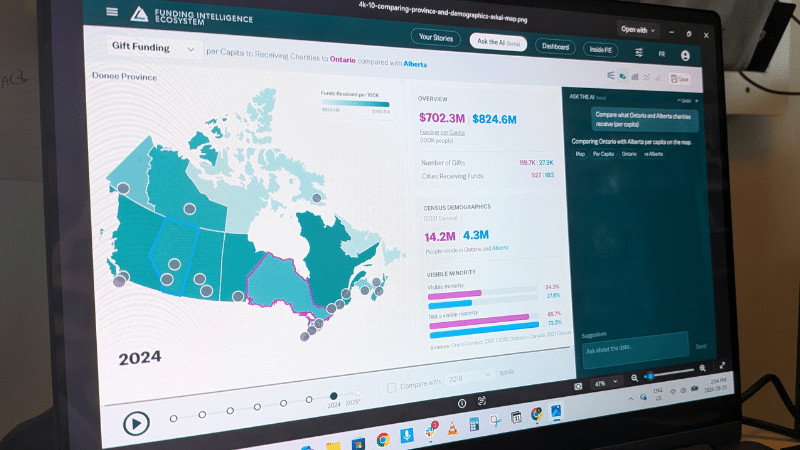
Imagine Canada launches visual tool to ‘see’ non-profit funding landscape
A new data visualization tool designed to let funders, non-profits and researchers understand the entire non-profit funding ecosystem

Deadline looms for non-profits, charities to report ‘foreign principals’ to Ottawa
Charities, non-profits and institutions must now register any arrangements with foreign principals working to effect government behaviour

Non-profit housing org pilots $20 million loan guarantee pool
Specifically developed for Nesting Ground’s portfolio of affordable housing properties, the non-profit is looking to grow the loan guarantee pool to $50 million in its second round.
