Tampons and pads are becoming more expensive. Mutual aid is here to help.
Why It Matters
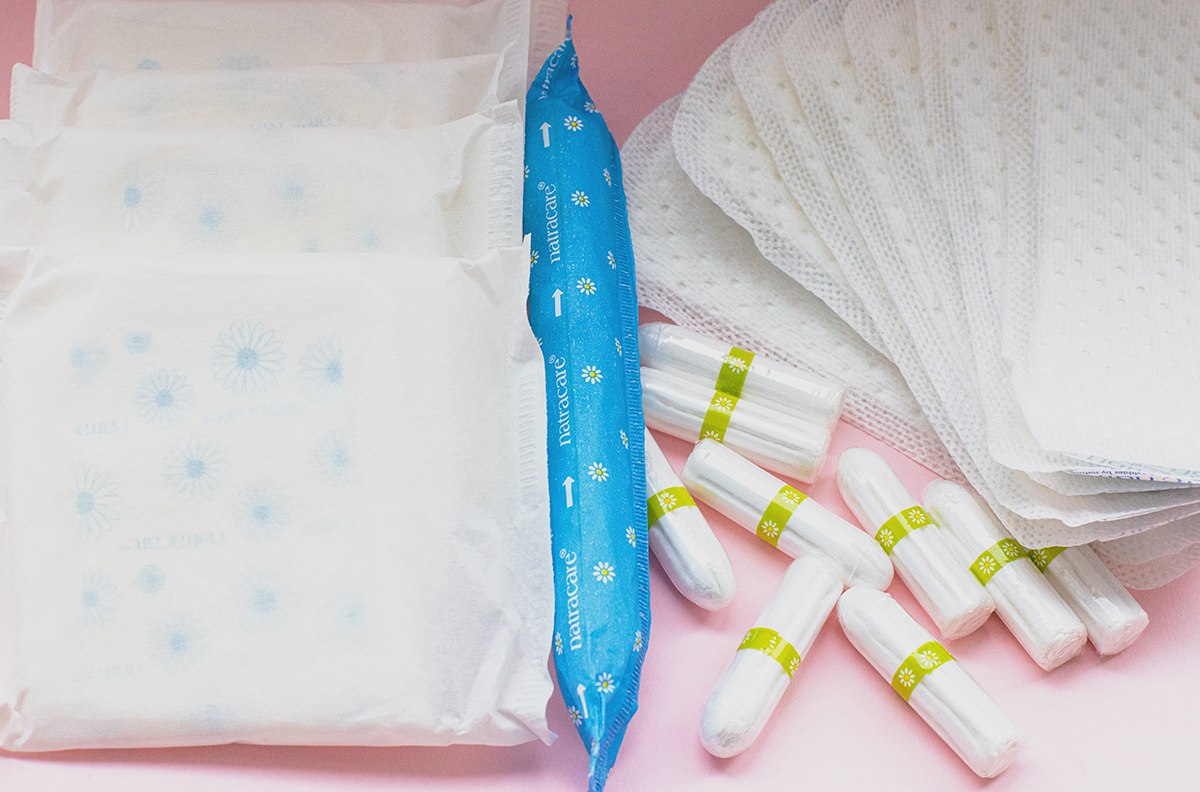
Much has been made of mutual aid networks combating food insecurity during the pandemic. But these networks are also combatting period poverty as the cost of tampons and pads rises.
This independent journalism is made possible by a Future of Good editorial fellowship on community resilience, funded by Cooperators. See our editorial ethics and standards here.
Mona Grenier would like you to think of menstrual products as you think of toothpaste: an everyday need that should be available to all.
Grenier and her colleagues at the Vancouver Community Fridge Project secure donations of food and essential household items for some of the city’s publicly accessible community fridges and pantries. But she says people need to consider donating menstrual products like tampons and pads as frequently as they think about food.
That’s why she makes a point of talking about menstruation to her almost 100,000 TikTok followers. “I am trying to destigmatize menstrual products and the talk around menstrual products as a whole,” she says.
Mutual aid networks have become more notable over the pandemic as a way for neighbours to provide each other with groceries, medicines, and other essentials. One study found over 194,000 Canadians in Facebook groups dedicated to mutual aid in the spring of 2020 alone. As menstrual products have become more expensive recently, mutual aid networks like Grenier’s have stepped up to distribute them where needed.
Statistics Canada data shows that from February 2020 to July 2022, the pandemic drove prices of personal care items like tampons and pads up 4.9 per cent. Still, interest-driven inflation in the last year has widened that margin to 13.5 per cent as of this July. Research shows that low-income people who menstruate have been driven into “period poverty” by these costs.
A 2023 survey from Plan International Canada found that a quarter of Canadian women had to choose between buying menstrual products and other essentials within the last year. When United Way conducted a similar survey in British Columbia in the first year of the pandemic, they found that Indigenous and disabled people were almost twice as likely to have suffered through a period without menstrual products compared to the average person who menstruates.
One of the more popular mutual aid projects to emerge in recent years is the Personal Care Bank, a series of free-for-all boxes containing tampons, pads, and hygiene essentials like soap and lotion. First established in Toronto, the network has added locations in Vancouver and Peterborough, Ontario, and has distributed over 100,000 items this year alone.
“Mutual aid is such a powerful tool because it connects people who want to help with a way that they can,” founder Will Emilio wrote by email.
“Social services and other registered organizations are typically slower to adjust to [changing needs], which can change quickly [from] person to person. Being [nimble] and flexible keeps us flowing in the direction of the need and allows community members to contribute their ideas and skills in a manner that directly impacts people.”
A legacy of change
The term “mutual aid” was first coined by the anarchist thinker Peter Kropotkin in 1902. Still, it has been a mainstay of social movements for much longer. Dean Spade, professor at Seattle University of Law and author of a widely acclaimed 2020 book on mutual aid, says marginalized people have supported each other across North American history. “The Underground Railroad itself is a mutual aid project,” he says.
Many contemporary mutual aid organizers cite the Black Panther Party as inspiration, which in the 1960s and 70s brought mutual aid to major American cities with their free breakfast programs, winter clothing donations and other “survival programs.” Their public messaging connected their Marxist ideology with the need for Black communities to provide for themselves under Jim Crow.
“They were heavily targeted by police,” Spade says. “That was also very publicly visible: seeing how threatened the status quo was by people giving out food, having free ambulance services, all these necessities.”
Spade says mutual aid is a response to the inadequacy of existing social structures and services, which explains why COVID was such a catalyst. “COVID made visible in that way the many, many crises we live under.”
Organizers often say mutual aid is distinct from charity because it builds lasting solidarity instead of providing one-off donations. “Charity is not at all about collective action,” Spade says. “It’s not about the underlying issues.” Mutual aid requires a “shared understanding that the cause of the crisis is the systems we live under, not the people in crisis,” and “an invitation to collective action.”
Making menstrual products publicly available in community fridges can help encourage others to donate and fight the stigma around menstruation, Spade says. It is also inherently inclusive: transmen and non-binary people can access tampons without explaining to shelter staff that they menstruate too.
Taking action
Emilio founded the Personal Care Bank in response to the inadequacies of existing services. While executive director of Twelve, a charity that distributes free menstrual products to shelters and individuals, he noticed that uptake was greatest when people could request the products they needed directly from the website.
“This was very successful, and we saw a huge spike in the number of organizations and people we served. That said, if you didn’t use any of our partnered organizations or didn’t know about us, then we had no way to reach you.”
Inspired by Toronto’s community fridges, Emilio left menstrual products, soap, toothbrushes and other personal care basics in boxes around the city. He chose locations by considering the greatest need, and where existing social services may not provide free or low-cost personal care products.
Emilio and his team of volunteers stock each care bank daily according to their guidelines. They don’t stock items that have been opened or can be used for self-harm, like razors and medicines, but stock personal protective equipment and naloxone, an opioid overdose medication.
The initiative has recently started to allow individuals to host a care bank — “similar to how free libraries work,” Emilio said — and has partnered with the Toronto Public Library to build boxes at three branches. A local artist decorates each care bank and businesses can choose to host one outside their storefront.
Some businesses have social purpose goals that move them to host a care bank, like the Bare Market low-waste grocery store in Toronto. Owner Dayna Stein says their partnership is a natural fit because they aim “to spark social and environmental impact.”
Yet other businesses are motivated to give back to the communities that sustain them. Sierra Leedham, co-owner of Black Diamond Vintage in Toronto’s Parkdale neighbourhood, says she requested a care bank because she previously hosted a community fridge on site. Her neighbourhood has a large low-income and racialized population; rapid gentrification and municipal neglect have hit longtime residents hard in recent years.
Although they don’t have concrete numbers, Leedham and Stein feel their care banks are at capacity. “It gets checked by community members multiple times a day, and a lot of times, there isn’t anything in it for people,” Leedham says. “The need outweighs the donations.”
“That’s always the thing with a lot of mutual aid efforts. Everyone’s like, ‘I wish we didn’t have to, but we’ll always take care of each other as much as we can.’”
Looking ahead
Because mutual aid networks are propped up by individuals, they come under strain when household budgets are squeezed by rising costs like they have been this past year. In January, the Globe and Mail reported that mutual aid networks were already seeing a decrease in donations as the generosity of the early pandemic fades.
For years, social purpose organizations working in menstrual health have called for broader legislative changes to make menstrual products accessible beyond the reach of their own services. That advocacy led to the 2015 federal abolition of retail sales tax on menstrual products — although some provincial taxes remain — followed by pledges to make them free in First Nations schools on reserves and federal workplaces in 2021.
More recently, Ottawa has invested $25 million in a first-of-its-kind menstrual equity fund, distributed to five non-profits to test “approaches to distribute free menstrual products to community organizations serving diverse low-income populations” and scale existing distribution networks at the grassroots level.
In British Columbia, the provincial government and United Way have distributed a $750,000 funding pool to test more local approaches after the government expanded free menstrual product distribution in schools last year. Grantees receive between $10,000 and $25,000 and are expected to release their proposals by March 2024.
Nearly all organizers agree legislation would have an impact, but there’s disagreement about whether mutual aid is superior in some respects. For Grenier, who sees the stark need for more menstrual product donations, policies to distribute menstrual products at scale, like in public bathrooms, are essential. “I help some people, but I can’t help all the people who need it,” she says.
But for people like Spade, who sees governments and capitalism as vulnerable to enormous crises like COVID and climate change, building self-reliance and unity within marginalized communities is equally critical.
He points to the long history of people making their menstrual products historically around the world and now mainly in the Global South. Many poorly designed products can be unsanitary and lead to infection, but there are also well-researched ways to make them at home. Some DIY recipes are sanctioned by aid relief organizations like ActionAid and UNICEF.
“We’re not going to be able to provide every single thing to every single person because the boot of the system is on our necks. We’re working with very few resources. But it’s going to be — and has been — during a crisis all we have.”
Tell us this made you smarter | Contact us | Report error