The missing middle: Why $1 billion for food hubs may build wealth, but won’t bring cheaper groceries
Different tools are needed to address what are connected but ultimately separate issues: food accessibility and food affordability, say experts
Why It Matters
For decades, Canada exported its raw food, which was then processed in the U.S.As a result, communities lost their processing capacity, and farmers lost a revenue stream. While the Carney government’s $1 billion investment in food hubs will likely advance food sovereignty and community wealth, there’s no guarantee it will translate into cheaper groceries on market shelves.
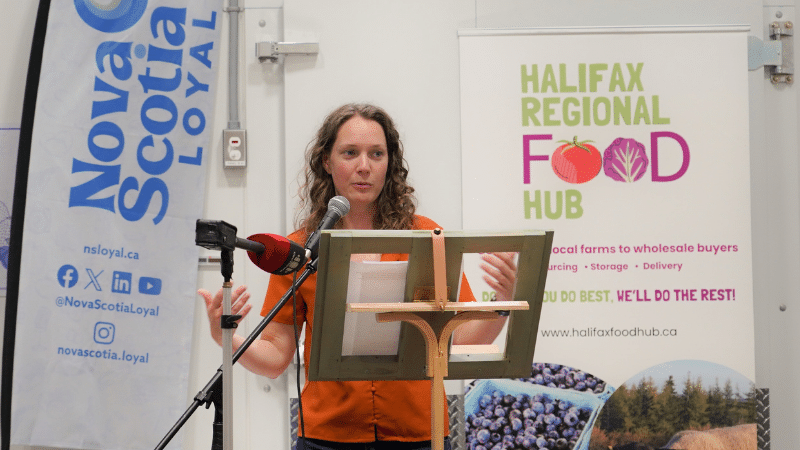
Since last July, 30 Nova Scotia producers have been able to advertise and distribute the carrots, cauliflowers, beets and other food they grow on the Halifax Food Hub virtual store.
After a customer makes an order, producers deliver it to a central drop-off for the hub’s rented truck to pick it up. The food is repackaged at the Dartmouth warehouse and then delivered to customers.
“Suppose multiple customers order carrots from the same producer. She packs it all together; we then sort the orders by customers at our facilities,” said Eli Milton, executive director of the hub.
“Aggregation benefits the producer and the buyer, who can consolidate orders.”
Before the hub, Milton owned her own vegetable farm. She later moved to another farm, where she sold surplus produce wholesale.
The hub, a non-profit cooperative, was created by a local group of food producers and buyers. It is financed by an $850,000 grant from the Community Economic Development Fund, a program from the Nova Scotia Department of Growth.
Milton is already looking for additional financing, including the $1 billion Food-Link Fund included in the $3.2-billion National Food Security Strategy announced by the Carney government last June, a 10-year program.

The National Food Security Strategy recognizes that a small number of large companies control a large share of Canada’s supply chain, said Justin Cantafio, director of policy for the Centre for Local Prosperity, in Halifax. The strategy also notes that consolidation exists at all levels of the food system.
“It is wild to see that in political language! Ten years ago, as a guy with a nose ring and a mullet, I would get laughed out of a room for bringing up competitiveness, oligopoly and sovereignty,” he added.
The Food-Link Fund is investing in the “missing middle” of the food system, said Rebecca Tran, co-owner of The Station Food Hub Company, a social purpose organization in rural Nova Scotia.
The role of local food hubs
Local food hubs address farmers’ lack of control over prices, said Ann Higgs, executive director of Growers Station, an incorporated non-profit in Prince Edward Island.
“Farmers set their own prices for the food they advertise on our virtual market; they know what they need to get to be able to survive,” said Milton.
Hubs also give independent grocers and local farmers wholesale access outside the big chains’ distribution networks, especially in rural/remote/northern areas.
There are two broad categories: selling hubs, connecting farms to buyers, and processing hubs, which transform raw products. Some have a dual mission.
Most food hubs shorten the supply chain; they serve communities first.
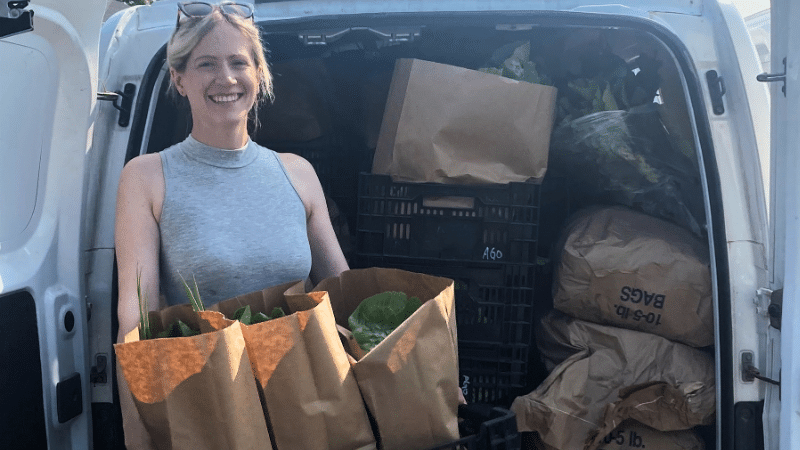
“We source from PEI or Nova Scotia, but we are not bringing Mexican tomatoes or Saskatchewan lettuce,” said Higgs.
The new federal funding lands after decades of disinvestment.
The problem: why local hubs disappeared, and what it cost communities
In 2018, Tran invited a few friends over for dinner to discuss their local food system. Linda Best was part of the group.
Best has been an apple producer and, for the last 16 years, has led Farmworks, an investment cooperative that provides loans to Atlantic food-sector businesses.
That night, the group drew the food system spectrum, with farmers at one end and grocery stores at the other.
“Over the last decade, we lost 20 per cent of our farms. Today, only 10 per cent of the food Nova Scotians consume is local,” said Best.
Nova Scotia’s situation is no different from the rest of Canada. It reflects decades of policy favouring “cheap export-oriented food policy, plus corporate concentration,” said Phil Mount, vice-president of policy at the National Farmers Union, who also operates a livestock farm with his wife.
This commodity export policy led to the disappearance of domestic infrastructure: products were mostly processed in the U.S., and Canada bought transformed food, he added.
“When we had the orchard, there were six regional facilities that could process our drop apples; now there are none,” said Best.
Meanwhile, food distribution has concentrated. “This oligopoly situation is squeezing farmers,” said Mount.
On average, Canadian farmers receive about 14 per cent of the retail price of food. However, for supply-managed products, whose farmgate prices reflect costs, that share is 38 per cent.
The National Food Security Strategy emphasizes the need for more distribution options for farmers.
Tran, Best, and the other guests had reached the same conclusion eight years earlier, at that dinner. It led to the creation of the Station Food Hub Company.
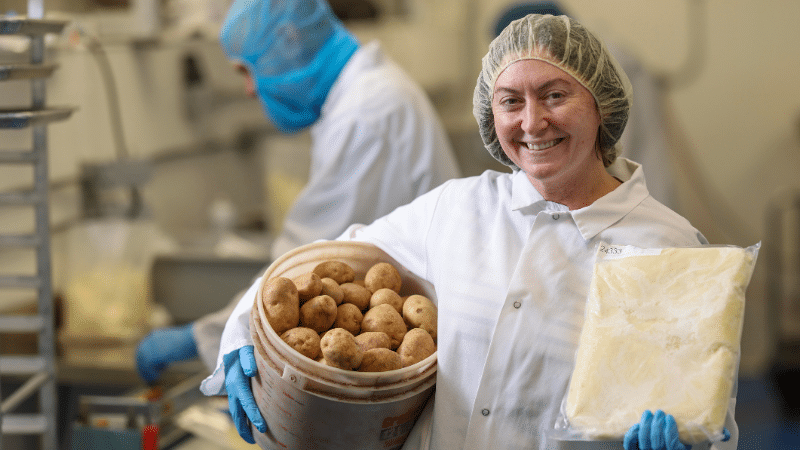
“We buy imperfect products from local producers and turn them into mashed potatoes,” said Tran. “We sell pallets of these frozen products to large distributors. It created a new revenue stream for farmers.”
Lessons from Ontario’s and BC’s earlier food hubs programs
As it reinvests in the missing middle of its food system, the Government of Canada can take some lessons from the past.
In 2017, the Ontario government invested in food hubs, said Moe Garahan, executive director for Food Communities Network.
At the same time, B.C. launched its own food hub program.
Both programs provided substantial funding for a short period of time, three to four years.
“It was not enough to cover the deficit period; regional infrastructures need longer to reach viability,” said Garahan.
“It takes seven years for a food hub to reach financial stability,” added Mount.
For the B.C. program, the hubs were given a specific set of instructions and parameters toward value-added manufacturing.

“The government adopted a very narrow definition of food hubs, not considering aggregation, warehousing and distribution,” said Sarah Breen, regional innovation chair in rural economic development at Selkirk College, in Nelson, B.C.
“The hubs that survived naturally migrated toward the value chain development, connecting different aspects of the food system,” added Breen.
These hubs broadened their activities because that was what their communities needed, she said.
What about food prices?
When the strategy was announced last June, it was widely presented as a response to rising grocery bills.
Yet the government’s own strategy paper concedes that food prices are largely beyond its control.
Will investing $1 billion in food hubs lower the price of food Canadians pay?
The short answer is no, and the reason isn’t the one people usually reach for.
The intuitive story goes: middlemen squeeze farmers, so fix the middle and fairer prices ripple down to the shelf.
While nobody interviewed disputed the first half of that story, they all disagreed with where the ripple actually goes.
The Halifax hub, like most hubs featured above, avoids the big chains altogether, selling instead to restaurants, institutions and independent retailers, said Milton.
This means the food moving through a hub rarely reaches the shelf, where most Canadians compare prices.
A hub can change what a farmer earns without changing what a shopper pays, because increasingly, they aren’t the same market.
That is where market power comes in, and farmers remain price-takers, said Mount.
“We are not going to solve the problem of decades of creating cheap food. True cost has been evacuated from the system,” he added.
A hub can improve that math for the farmers who sell through it. But it can’t undercut the concentrated retail chains that set prices for everyone else, because it was never competing in that market to begin with.
Even inside a hub’s own channel, local food costs more to produce.
“Local and cheaper are not the same thing,” said Breen. Local producers operate at a smaller scale, pay regional labour rates and can’t match the economies of scale of imports, so their costs are structurally higher.
Closing that gap would require a subsidy or a tax intervention that nobody is proposing in the current fiscal climate, she added.
Put the two together: retail concentration explains why farmers get squeezed, even when they reach a market.
Cost explains why, even in a perfectly fair market, local food would still be more expensive than the imported alternative. A hub doesn’t make either problem disappear.
And the only way a hub could visibly lower prices is by paying farmers less, which defeats the purpose of building one, said Cantafio.
His organization’s key performance indicators framework treats this as a rule, not a suggestion: a hub should never be scored a success for lower prices if the savings come from producer returns.
However, a hub can blunt the sharpest swings. Cantafio’s own collaborative research found grocery-store inflation outpacing inflation at farmers’ markets between 2018 and 2023. That’s stabilization, not deflation.
How to make food hubs work this time around
The size and matching requirements for the Food-Link grants are not yet known.
However, regional food organizations across Canada surveyed their members to shape their advocacy.
Most of the recommendations can be found in this document from the Common Ground Network, a collective of researchers, civic, community, and industry organizations, government, Indigenous and settler communities.
These recommendations fall into three categories: mechanics, fairness, and impact measurement.
Address the mechanics: work on supply and demand, not just the missing middle
“You can’t just concentrate on the missing middle,” said Garahan. “You need to address both ends too and at once: the supply and the demand.”
The supply will be addressed by investing in a diverse range of new farmers: new Canadians, young, urban, second-career individuals, and Indigenous communities, not just family successions, said Garahan.
The ongoing consultations for Canada’s 2028-2033 agricultural framework are an opportunity to seize, said Mount.
“The next agriculture framework should work hand in hand with the National Food Security Strategy: food hubs serve farmers and farmers supply food hubs,” said Mount.
To grow and strengthen its community of producers, Growers Station offers mentorship programs, peer-to-peer learning, and is planning wholesale education for small-scale farmers.

To address the demand for food hubs, all interviewees pointed to the National School Food Policy, launched in 2025, and more widely to public procurement.
“If federally funded institutions, like prisons, schools, and hospitals, buy a third of their food through local hubs, it would guarantee volume and stable income to farmers who could invest and create a financial ripple effect in the communities,” said Cantafio.
“What I love about school food is that we have schools in very small communities. We have an opportunity to anchor that into the regional food supply that exists around those schools,” added Garahan.
For example, the Leamington District Secondary School in Ontario does not have a cafeteria. Since 2024, it has used its $10,000 grant from the farm-to-school program to offer a salad bar every Tuesday featuring local food and homemade vinaigrette.
Meanwhile, the East Three Secondary School is located 200 kilometres north of the Arctic Circle, in the Northwest Territories. The school used the farm-to-school grant to install a hydroponic infrastructure to grow food for students.
The farm-to-school program is an initiative of the partnership-based charity farm-to-cafeteria, funded by private and government grants. Since its creation, it has helped 76,640 students from 199 schools across nine provinces and two territories to access fresh food, mostly local, regularly.
Be mindful of fairness: tailor to regional differences
The Food-Link Fund will finance food hubs and food terminals.
Food terminals handle a much broader geographic range than food hubs, including imports, and require producers to operate at a larger scale, said Milton.
Toronto hosts one of the biggest food terminals in North America, the Ontario Food Terminal. The 1.7-million-square-foot facility includes a main wholesale hall and a farmers’ market with more than 500 stalls.
There is some concern among interviewees about how the $1 billion fund will be allocated between food hubs and food terminals.
“Ottawa must be cautious about a one-size-fits-all approach that replicates the Ontario Food Terminal model in remote, rural, northern or Indigenous communities where volume-based models don’t work,” said Mount.
Food-Link’s funding details have yet to be disclosed. “Regional needs and capacities should be considered when establishing grant thresholds and the matching requirement. Otherwise, the fund won’t create new options for remote and rural communities,” said Tran.
Pick the right impact metric
The food hub in Creston, B.C, has provided a space to help small processing businesses scale up, said Breen.
“Maybe for some of these entrepreneurs, it started as a hobby. They sold at the farmers’ market. Now, they are actually making a living off what used to be a hobby. In a small community, that is a big deal. Like that’s somebody creating steady, stable employment. It’s an additional business paying taxes within the community. So you get these spin-off effects,” she added.
Food hubs are community wealth-building instruments, said Cantafio. “The impact measures should be about how much local wealth is actually created.”
It includes wealth for producers, such as the number of producers gaining access to institutional, wholesale, or independent retail markets for the first time because of the hub, or the percentage of final sale value retained by producers and processors.
Regional wealth creation could be measured by indicators such as the value of purchases shifted from out-of-region and corporate supply chains to regional food producers and processors.
Long-term food security would be demonstrated, for instance, by the percentage of publicly funded infrastructure held by public, cooperative, Indigenous, non-profit, municipal, or community ownership.
Of course, missing from this list is the price of groceries. Food hubs are built to make the food system more resilient and more fairly distributed, not cheaper.

Lower prices would not end food insecurity anyway, said Goodwin Ude, the executive director of Kingdom Acts Foundation.
“Food insecurity is not a function of a lack of food or food scarcity; it’s a function of inadequate income or employment,” he said. “It’s when people cannot earn enough to buy the kind of food they want.”
A hub, however well-designed, can make local food more available and pay farmers more fairly, but it can’t raise the incomes of the people who struggle to afford food.
What hubs change is the logic of the market itself, said Garahan, noting the difference between a supply chain – a common term when talking about food distribution – from a value chain.
A value chain means “prioritizing those relationships instead of seeking in every single transaction the cheapest exchange,” she said, “so that over the course of time it’s a win-win relationship.”
“The $1 billion for food hubs isn’t charity. It’s an attempt to rebuild a critical part of the economy that was allowed to disappear,” she concluded.
Your job. Your mission. Your news.
With your support, the sector you're building gets the journalism it deserves, and you get a tax receipt.

Author

Related Articles

Imagine Canada launches visual tool to ‘see’ non-profit funding landscape
A new data visualization tool designed to let funders, non-profits and researchers understand the entire non-profit funding ecosystem

Deadline looms for non-profits, charities to report ‘foreign principals’ to Ottawa
Charities, non-profits and institutions must now register any arrangements with foreign principals working to effect government behaviour

Non-profit housing org pilots $20 million loan guarantee pool
Specifically developed for Nesting Ground’s portfolio of affordable housing properties, the non-profit is looking to grow the loan guarantee pool to $50 million in its second round.
