They won’t take your money: Why these charities are newly restricting donations from controversial corporations
Some Canadian non-profits and charities are rejecting donations from corporations whose work, they say, is misaligned with their mission.
Why It Matters
Charities need money. But they also have strong values and a reputation to protect. In light of domestic and international charity scandals; and increasingly powerful movements for racial and social justice; some charities are turning away from donations from controversial corporations — whose money, the charities see, as not worth the moral sacrifice or the public relations risk.

This story is part of the Future of Good editorial fellowship covering the social impact world’s rapidly changing funding models, supported by Community Foundations of Canada and United Way Centraide Canada.
In the winter of 2019, RAVEN, a Victoria-based environmental justice charity, had a tough decision to make.
For nearly a decade, they’d been building a relationship with a local funder, a family foundation keen to support their work — legal defense for Indigenous peoples protecting their territory. And the money they were looking to raise was time-sensitive — funds to support three nations in their bid to stop the Trans Mountain Pipeline, and funding to support another nation, the Heiltsuk, in a case seeking restitution for a massive oil spill.
They were keen to apply for a sizeable grant from the family foundation, but before they did, the charity needed to closely vet their donor, as per the protocol outlined in their gift acceptance policy. What they learned was disheartening.
“[We] found the patriarch of the foundation made his money in mining and was still active in South America, and not in a good way,” says Laurie MacKenzie, development director for RAVEN. In South America, the company that generated the funds for the foundation, was operating a silver mine that local Indigenous people had been fighting for nearly a decade — practices at direct odds with the charity’s mission.
“We immediately told the grant manager we would not be willing [nor] able to accept funding from their foundation.”
For RAVEN, rejecting funds tied closely with extractive industries had been commonplace for some time. But the experience prompted them to take a closer look at their gift acceptance policy — the policy that guides accepting (and rejecting) donations. What they realized was that their policy had not kept pace with the organization’s work to decolonize their operations — work that had begun years earlier, and continued at pace throughout the pandemic.
In the weeks that followed, staff proposed a change that their board readily accepted: to reject all future donations from any donor who does not respect Indigenous people’s free prior and informed consent (FPIC). It was a seemingly simple inclusion, buried deep in a dense policy, but it highlights a powerful trend taking place at some non-profits and charities across the country — of an increased willingness, amongst activist charities and mainstream charities alike, to be explicit about who they aren’t willing to take money from.
For a crop of environmental charities, a deepened commitment to uphold the rights of Indigenous peoples has resulted in several new FPIC conditions showing up in gift acceptance policies. And for several more mainstream charities, a new refusal to take corporate donations from controversial companies has emerged — styming potential gifts from oil and gas companies and pharmaceutical companies, to name two.
These shifts, fundraising experts say, are in response to two forces — high-profile charity scandals that have made charity staff and boards of directors’ more cautious about their brands; and racial and social justice movements, accelerated during the pandemic, which have pushed charities and non-profits to adopt new practices.
But those who have changed their tune, it’s one thing to say no to a gift — and it’s another thing entirely to try and find other funders to fill the gap. To do so, many are doubling down on building deep, values-aligned relationships with individuals donors, family foundations and mission-aligned businesses alike.
What’s a gift acceptance policy?
If you’re not a fundraiser, a major donor, or a governance geek, you may not have heard of a gift acceptance policy. Despite their low profile, they’re one of the essential tools in the arsenal of most charities and non-profits — a document that outlines the types of donations a charity will accept (for example, real estate, bequests, or cash), procedural rules around processing donations, and crucially — what kind of gifts a charity will reject.
In the 1970s and ‘80s, as charities evolved in size and sophistication, some charities adapted the standard-issue gift acceptance policy to screen out specific donors whose funds they’d refuse. Chief among them were donations from corporations who produced tobacco, alcohol, weapons or pornography — so-called “sin” companies. Charities in some specific sectors also developed screens of their own. Many environmental charities, for instance, developed policies that restricted donations from entities — corporate sponsors, major donors or family foundations — where the primary revenue generation had been from the extraction of fossil fuels.
Screens of this kind were important both externally and internally. For prospective donors, they sent a strong signal about the charity’s values and priorities — that their preferred eco-charity didn’t take money from a fossil fuel foe, or that their favourite cancer-fighting charity wouldn’t accept a gift from a tobacco behemoth. And for staff, they were also useful — offering clear, board-approved guidance about who was in and who was out, simplifying donor prospecting and creating shared clarity around values and mission.
But beyond making sure that charities had one, the ‘screen section’ of these policies hadn’t seen much action in a couple of decades — until recently, when fundraising professionals noticed another bump in activity. Specifically, a willingness on the part of a new crop of charities — both mainstream and activist alike — to be explicit about whose dollars they’ll reject.
Rejecting funds from mis-aligned corporate donors
The Art Gallery of Ontario isn’t what you’d necessarily consider an activist charity. Yet unlike some sector peers, the gift acceptance policy organization’s policy takes a firm, explicit stance on donation screens — weeding out potential donations from oil and gas companies, in addition to the more commonly excluded tobacco and weapons manufacturers.
“The AGO does not accept sponsorships or partnerships that are not consistent with the brand, mission and values of the Gallery, which at present includes oil, gas, tobacco, and weapons manufacturers,” says Andrea-Jo Wilson, manager of public relations with the AGO, by email.
“Although there have been relationships in the past (but never with weapons companies, to be clear), the AGO strives to model a better future, through art and its actions, and our policies and partnerships are intended to reflect and support this objective.”
Though not stated by the AGO, some fundraising professionals suggest that this trend may be caused by increasing sensitivity on the part of donors to corporate behaviour — and the speed at which news this behaviour can travel and negatively impact the charity’s brand.
“Donations are hypersensitive…the message that ‘oh this is a great donation,’ can turn in eight hours to ‘oh this is a really bad donation’,” says Michael Nilsen, vice president of the Association of Fundraising professionals, of the way that social media is influencing donor perceptions of charitable partners and gifts.
The trial of American sex offender (and major donor) Jeffery Epstein was a “tipping point” for some U.S.-based charities, Nilsen says, causing them to look at their gift acceptance policies and “maybe see some holes within it,” he says. In Canada, the investigation into WE Charity and their funding relationships with several high-profile corporations, including chemical producer Dow Canada, had a similar effect.
Some mainstream international development charities have also parted ways with corporate donors from contentious industries. Doctors Without Borders, for instance, will not accept donations from companies whose principal revenue is derived from oil and gas or pharmaceuticals, among other sources.
The policy states that the provisions exist to limit the acceptance of funds from organizations whose operations are in “direct conflict” with the humanitarian work of the charity, or which could limit the charity’s ability to “provide humanitarian assistance in any way.”
For Jen Love, a fundraising consultant with Agents of Good, these policy shifts are an obvious reaction to increased public awareness of social, environmental and racial justice — movements that gathered considerable steam during the pandemic. “It’s a reckoning that’s coming for all charities around what money are you taking in [and] from whom,” she says. “Authenticity is currency for charities. Donors need to trust you. If you’re raising funds in ways that don’t align with your values, you’ve got a problem.”
For some environmental charities, this attention has been placed squarely on Indigenous sovereignty, and has resulted in efforts to decolonize their policies.
“For years, we’ve been working with Indigenous clients, [and] watching Indigenous people be stewards of the land, but bearing a disproportionate burden of environmental degradation,” says Devon Page, executive director of EcoJustice, a charity that fights environmental cases against corporations and government bodies where the environment is at risk.
“We just completed a new strategic plan, and embedded within it is a commitment to act regarding equity, diversity, inclusion and reconciliation,” he says. As part of that plan, the charity is looking to revise their gift policy to reject donations from any companies that don’t respect FPIC, a similar provision as the one developed by RAVEN.
“In this day and age in Canada — we’re a Canadian non-profit charity — we should be modern and progressive when it comes to recognizing the need for reconciliation and restitution of Indigenous people,” he says.
But deciding to reject funding from one source means that it needs to be made up by another. Recognizing this, charities and non-profits who are rejecting funding from corporations and government, are setting their sights more heavily on individual donors and values-aligned family foundations.
Building new revenue streams with values-aligned partners
In December 2017, Indigenous Climate Action (ICA) sent a clear message to would-be funders: we won’t take your money if you’re financing climate destruction.
The Indigenous-led organization was just two years old, and working hard to build the funding base that could sustain the ambitious work they had planned. In the summer, they’d learned about a new grant offered by Aviva, a prominent insurance company, for an “original solution to tackle the consequences of climate change.”
The organization applied, and was thrilled to learn they’d been selected for the $150,000 grant. “They came [to] us, and were like, ‘You are exactly who we want to fund’,” says Sheila Muxlow, director of development for ICA.
But when they completed their due diligence of the funder, ICA learned that Aviva’s parent company held over half a billion dollars in passive investments in several companies operating in Alberta’s tar sands. With this new knowledge, ICA publicly refused the grant — to surprising consequences.
“I think, to be honest, it actually did help to bolster more support for the organization,” says Muxlow. “I think there was a recognition of the integrity that we’re trying to hold.
Following the announcement, a family foundation got in contact with ICA. They told the Indienous-led organization that they’d seen the announcement and wanted to make up the funding gap — by signing their own cheque to the organization for $150,000.
“We’re in a time in the world where people are looking for some real transformative change…For ICA to be able to stand on these strong principles and say, ‘We’re actually serious about wanting to do this work in a transformative way’.”
In addition, AVIVA told ICA that they were willing to begin discussions to explore divestment from the tar sands — a bold proclamation, resulting from an unorthodox approach to advocacy.
In subsequent years, ICA has stuck to this policy. Just last year, for instance, they walked away from a potential multi-year gift from the Mastercard Foundation, after learning of the foundation’s links to CitiBank, a major banking partner of many fossil fuel companies, Muxlow says. ICA has also intentionally steered away from many government grants, due to a lack of trust that the government will uphold stated commitments to Indigenous peoples.
But steering clear of these sources of funding has meant that ICA has had to rely much more heavily on values-aligned family foundations and on individual donors.
To do so, ICA has engaged in a variety of values-aligned appeals. On Canada Day, for instance, the organization made an explicit appeal, calling on donors to make a symbolic $153 donation to ICA representing the “153 years plus of organized genocide” in Canada. The call raised about $14,000. ICA has also worked to secure multi-year gifts with several foundations, whose work ICA sees as better aligned with their values, including the Catherine Donnelly Foundation, the McConnell Foundation and the NOVO foundation.
In addition, the organization is also exploring opportunities for “wealth redistribution within the environmental movement,” says Muxlow, looking for support from settler-led environmental charities to support the Indigenous organization.
In total, the results of this fundraising have been modest, but steady — with the organization’s budget growing steadily to just over $1.1 million in 2020. In this year, 60 percent of the organization’s revenue came from grants, 20 percent from major donors, and the rest was earned through crowdfunding, monthly sustainers, bequests, and federal COVID-19 wage subsidies (a rare exception to ICA’s reluctance to take government dollars).
For RAVEN, another organization who has rejected funds from several corporate and government donors, fundraising has focused on deepening engagement with individual donors, foundations and values-aligned businesses.
To drive donations from individual donors — a group that generated over 55 percent of the organization’s total $1.5 million budget in 2019 — the charity uses a digital-first approach. Crowdfunding and peer-to-peer fundraising are the two most popular tools, enabling donors to fundraise on the charity’s behalf. To aid supporters in this effort, the charity shoots compelling videos, develops informative social media posts, and offers donors a clear narrative about the purpose of the campaign.
“When we accept a new campaign, we work with the lawyers to create an overarching narrative, a web page and some social media posts — basically a communications kit that the nation [we’re partnering with] approves,” says Ana Simeon, RAVEN’s fundraising campaigns director. The charity also works with videographers and visual artists to shoot a video on the territory of the nation and develop compelling graphics.
“The [fundraising] comes from the story itself, because the story itself is so compelling that you don’t really have to oversell it. You just have to let Indigenous voices speak and then make the ask. And people give — that’s what we’ve found,” she says.
They used this approach in 2019, for instance, in raising funds to support the Beaver Lake Cree Nation — the first group in Canada to ever challenge (and be granted a trial) over the cumulative impacts of industrial development in their territory. Doing so yielded considerable success, raising over $1 million to support the Beaver Lake Cree’s legal defense.
This fundraising approach relies heavily on individuals understanding the charity’s work and aligning strongly with it. To support this mandate, RAVEN regularly hosts webinars with their community, hosts a podcast, and has active social media accounts — all focused on helping Canadians better understand the intricacies of Indigenous land rights and sovereignty.
In addition to their focus on individual donors, RAVEN has also worked to engage businesses to fundraise on behalf of the charity, succeeding in landing values-aligned partners including Lush, Patagonia, Salt Spring Coffee, and others. To encourage donations of this kind, RAVEN asks companies to consider donating a portion of daily, weekly or monthly proceeds to charity; to set up a fundraising team and invite staff to join; or to brand a specific product, with some portion of proceeds supporting RAVEN.
But not all charities — environmental or otherwise — are taking this approach. Many others have gift acceptance policies that do not exclude any donors explicitly, and rather state that the charity reserves the right to reject any donation that is misaligned with the mission of the organization or that could harm the brand of the charity.
Within this broader framework, some charities welcome donations that others see as at odds with their goals.
Is greater systems change possible through partnering with corporations?
The Natural Step is an Ottawa-based charity that partners with industry, non-profits, and communities to develop an economy that “thrives within nature’s limits”.
In approaching their work to curb the climate crisis, the charity’s gift acceptance policy has taken a decidedly different shape, welcoming donations from energy sector partners, many of whom participate in the charity’s social innovation labs.
In the last three years, for instance, the charity has secured just over $2 million from the Suncor Foundation, the charitable arm of its namesake corporation, which specializes in the production of synthetic crude from oil sands, among other energy products. In addition to financial support, Suncor has also participated in the charity’s Alberta-based Energy Futures Lab, an initiative that gathers non-profit, government and corporate partners, seeking to develop new partnerships and business models that transform the province’s energy sector.
Natural Step takes this approach, says David Hughes, president of the charity, based on a recognition that their work to transform energy systems can’t be done without these large energy producers.
“We know that there’s kind of a very legitimate approach to advocating against those companies, and in some way disengaging with them and not accepting gifts from them,” he says, “[But] in our case, we think it’s essential to be working with them, working from the inside out, and trying to get them on the path towards greater sustainability — and to try and accelerate that shift.”
For the Natural Step, partnering with these corporations allows them to be “stronger together,” he says, by leveraging the social capital established during the lab — with actors from across sectors — to develop solutions that shift systems “at scale.”
“We would not take funding from a company that is looking to greenwash and to simply put their name on our work. We’re really taking funding from those companies that are actively engaged in our labs, actively involved in finding new solutions, and that we’ve deemed to be leaders and truly committed to the shift and the change that we’re striving for.”
As evidence of the possibility of this model, Hughes notes that the Energy Futures Lab, which also leverages funds from government and family foundation partners, has funded innovative projects that support the retraining of oil and gas workers in solar jobs and strengthen Alberta’s ‘carbon capture’ capacity, among other aims.
In funding this work, the Natural Step’s work differs considerably from that of EcoJustice or RAVEN’s. In 2019, the charity raised over $2.3 million, with approximately one third of funds coming each from corporate sponsors, private foundations and government. Individual donations play a limited role in the organization’s revenue, Hughes says.
Across the country, this approach — of having fewer explicit donor screens — is perhaps more common, but is one that some charities with more targeted gift rejection policies say could contribute to greenwashing or ‘charity-washing’.
Avoiding public perception of “big fat cheques” influencing charitable actions
For Fawzia Ahmad, her organization’s gift acceptance policy is a matter of integrity. Canopy is a Vancouver-based charity, which, like the Natural Step, partners with corporations and other actors — in their case, aiming to preserve Canadian forests.
Ahmad is the organization’s engagement and operations director and has been responsible for leading the implementation of the organization’s gift policy for over fifteen years. In that time, the organization has taken a different tack than the Natural Step, explicitly naming that they won’t take funds from corporations that operate in any of the sectors that Canopy works to transform. This has meant turning down many donations from the charity’s corporate program partners, but, she says, it’s also meant preserving the company’s integrity.
“If we’re giving kudos to a company we’re working with and they’ve done a really great job on their environmental side of things…we’re not wanting anyone to say that we’re congratulating them publicly because a big fat cheque has been passed or [because] they fund us on an annual basis,” she says. “I think that [would] undermine the work of [the] companies and undermine our work and what we’re trying to achieve.”
Rejecting these donations hasn’t been easy. It’s forced the organization to rely more heavily on individual donors and foundation partners, groups who sometimes have less capacity for high-value gifts. But it’s also given the organization greater license, she says, to tell a partner to “pull up their socks” if they’re not respecting the environment and acting on shared values — without worrying that such a call could impact Canopy’s capacity to meet payroll or keep the lights on.
It’s an approach that Ahmad and others who have developed more defined policies, would like to see more charities take.
“I think it would be great if other organizations had similar lines, because together as a movement, that would send a very clear message” she says.
Your job. Your mission. Your news.
With your support, the sector you're building gets the journalism it deserves, and you get a tax receipt.

Related Articles

Explainer: The divergent fix-it paths of Ontario and B.C.’s condo oversupply problem
Both provinces have too many tiny, shoebox condos, but both are taking different approaches to fixing it.

Elbows up: Spring Impact Capital calls for a giant spreadsheet of available early-stage Canadian capital
The Vancouver impact investor wants to crowd-source a free, national directory
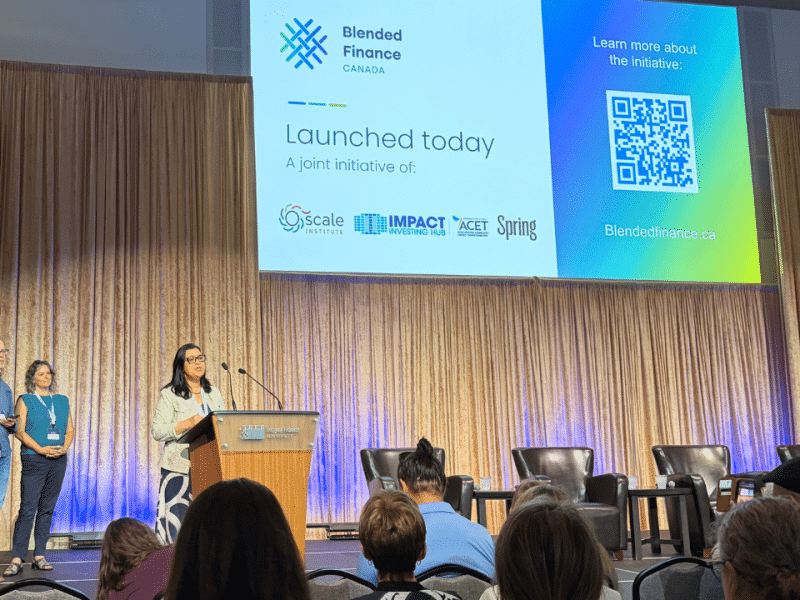
Blended Finance Canada launches on West Coast
The new initiative is supported by the University of Victoria, Scale Institute and Spring.
