Uncertainty of Trump’s trade war signals tough times for Canadian non-profits
Pivot to local procurement policies could benefit social purpose ecosystem.
Why It Matters
Economic uncertainty is creating new challenges and greater demand for social services as non-profits face a possible drop in donations. Patriotic procurement policies could provide a silver lining.
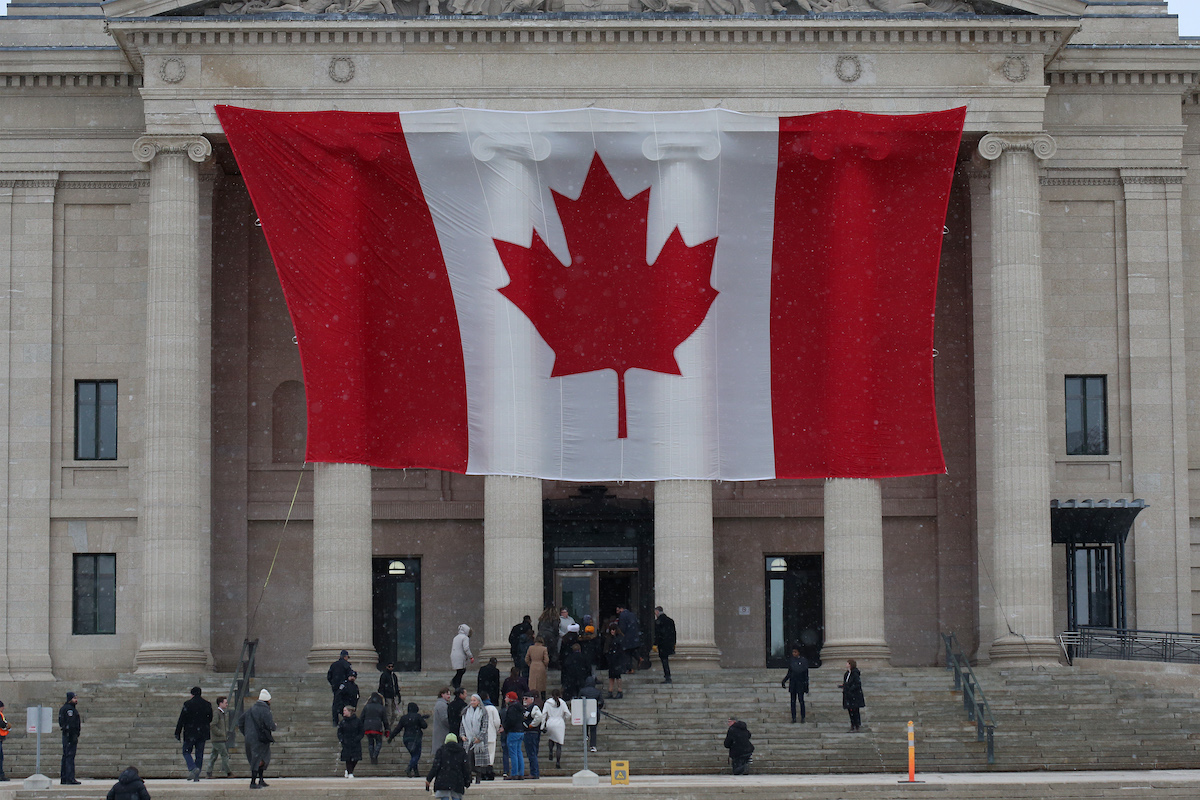
A giant Canadian flag hangs from the Manitoba Legislative Building in Winnipeg. (Photo: Shannon VanRaes)
Social purpose organizations across the country are taking stock as they prepare for a trifecta of increased costs, higher demand and fewer dollars in the face of an American-led trade war and looming tariffs.
“This has been top of mind in every conversation I’ve had for the last two or three months,” said Pamela Uppal-Sandhu, interim co-executive director and director of policy at the Ontario Nonprofit Network.
“Big picture, the theme has been one of uncertainty; we’re just not sure what this is going to look like.”
Bruce MacDonald, president and CEO of Imagine Canada, echoes that sentiment.
“If I was using one word to describe the sector’s mood right now, it’s apprehension,” he said, noting the Canadian Chamber of Commerce estimates incoming U.S. tariffs will cost every Canadian $1,900 per year, leaving a family of four scrounging for an extra $7,600 to make ends meet.
Speaking to the Montreal Gazette earlier this month, Immigration Minister Marc Miller said the 25 per cent blanket tariffs threatened by U.S. President Donald Trump could also lead to more than one million Canadians losing their jobs.
Higher costs combined with rising unemployment will likely result in fewer Canadians donating to charity, said non-profit leaders, with those who continue to donate likely making smaller contributions.
“Companies in Canada may also make cuts because of tariffs or slow down operations, and often, community investment budgets are a place they look to cut first,” MacDonald said.
Stock market volatility will impact foundations with large investments, and an economic downturn—now predicted by many economists and expected by most Canadians—could leave funders with less capital to distribute as returns on investment dimmish, he said.
An expected pivot towards smaller government has added to uncertainty in the non-profit sector. Both Prime Minister Mark Carney and Opposition Leader Pierre Poilievre have signalled major funding shifts should they win the next election.
“They’re looking at cost reductions … and that could mean looking at lower inputs for our sector,” MacDonald said. “Many people are nervous about that. And then you roll in the equity and inclusion aspects, and it’s a time of instability.”
Karen Ball, president and CEO of the Nonprofit Chamber in Calgary, said she expects the trade war to chill independent individual donations and corporate contributions.
“In Calgary we have a slightly more outsized dependence on corporate donation than perhaps in other places in the country,” Ball said. “So that’s always a bit worrisome.
“And, like other provinces, but here in particular, we have a fairly large dependence on trade with the U.S. for our primary industry. And so that tends to make everybody worried about what the finances of everyday Albertans are going to look like.”
With that in mind, social service providers are bracing for a potential surge in demand as people struggle to meet essential needs, she said.
“Whatever the fallout from the trade war might be, people will lose jobs, people will fall into poverty, which means needing more access to our services, housing, food, mental health and addictions,” said Uppal-Sandhu.
“So inevitably, we’ll see a massive surge on the social service side.”
However, economic upheaval won’t impact all Canadians equally, she said. Marginalized or equity-deserving communities will be harder hit by an economic downturn.
Uppal-Sandhu said those same communities are also at risk of being scapegoated as people seek answers for failing systems and financial hardship.
“People tend not to ask why the system is failing; they start looking at each other, and equity-deserving communities can become targets,” she said, adding that rising xenophobia has already primed the pump.
“That hate and polarization stuff is so real, and it is underlying all of this that we’re going to see.”
Arts and culture will be hard hit
Some non-profits will see larger impacts than others, Ball said, pointing to the arts and culture sector, which continues to struggle to recover from the impact of the Covid-19 pandemic.
Canadian festivals relying on American performers must grapple with a lower Canadian dollar, she said, while Canadian artists who normally head south may rethink their travel plans in the face of changing immigration norms and growing patriotism.
“We’ll probably see arts and culture decline even further; we’re already seeing closures,” said Uppal-Sandhu.
She said when people have less disposable income, theatre and festival tickets are often the first things to go.
Rising procurement costs are also expected to impact non-profits across the social purpose sector, as retaliatory tariffs increase expenses, lower the value of the Canadian dollar, and buoy inflation.
“With over 2 million people visiting food banks this month alone, the impacts of these tariffs will only further exasperate an already dire situation,” Food Banks Canada wrote in a recent social media post.
The organization, which represents 5,500 food banks across the country, said the imposition of tariffs on Canadian goods will hike food prices, making it harder for food banks to meet demand as buying power diminishes and demand increases.
Food bank use in Canada has nearly doubled over the last five years.
Potential silver lining
However, Uppal-Sandhu said the coming upheaval may also present an opportunity for growth and greater stability in the long term.
“This is a moment of seismic shift,” she said.
“So we’re really deeply thinking about how do we seize this moment, we’re having these deep philosophical conversations about the role of government and what kind of social contracts do we want to have as communities … how do we take this as an opportunity to do something different?”
Canada’s social purpose sector has promoted local economic development for years with mixed results. Now, Canadian patriotism has catapulted local procurement into the limelight, with individuals, companies and governments pivoting toward community wealth building.
“How do we strengthen local economies? That’s been top of mind for our sector forever,” said Uppal-Sandhu.
“Now, everyone is talking about buy social, buy made in Ontario, buy made in Canada, buy local … this is a huge shift.”
The next step is to scale and integrate these shifts into public policy, she said.
Non-profits that deliver government services also compete against international for-profit companies for contracts in some cases, Ball said.
Now, thanks to the American-led trade war, municipal and provincial governments are rethinking procurement practices.
“When services are procured locally, those dollars tend to stay in the local economy; they pay for local employees that make purchases in their community,” she said.
“And so the impact of being able to think about local procurement, I think, is a silver lining for some non-profits.”
Your job. Your mission. Your news.
With your support, the sector you're building gets the journalism it deserves, and you get a tax receipt.

Related Articles

First Bite Fund launches as Ottawa puts $1 billion behind domestic food processing
New revenue‑based loan fund aims to reach the 92% of food processors that conventional capital has overlooked

New database maps Canada’s $17.3 billion DAF landscape and where philanthropic wealth is concentrated
A new database is highlighting Canada’s donor-advised fund landscape in an effort to increase transparency, but not all sector leaders believe the tool will have that effect.

Edmonton housing fund uses values-aligned, blended financing to create affordable homes
The Housing Prosperity Fund combines values-aligned financing, community investment and family-focused housing to create a model it hopes can scale across Canada.
