Welcome to Steinbach, Canada’s most generous city
On average, residents of this small Manitoba city donate 4.31 per cent of their income to charity, far above the national average of 0.62 per cent. Why?
Why It Matters
Steinbach’s culture of generosity traces its roots back to the city’s Anabaptist founders, but a lot has changed since 1874 — and more will change in the years to come.
STEINBACH / TREATY 1 — When the Mayor of Steinbach thinks about generosity, he thinks about cucumbers.
As a boy, his father would ask him and his siblings to organize gurkjen they harvested from their garden according to size; they kept the short lumpy ones for themselves, while the straightest, longest and ripest ones were set aside for neighbours unable to garden for themselves.
“That was a lesson I got taught, to give your best away,” says Earl Funk, who runs a family butcher shop when not attending to mayoral duties. “I think that’s a part of Mennonite culture, you know?”
Although he doesn’t currently attend a Mennonite church, Funk was — like many Steinbachers — raised in a Mennonite home, speaking Low German or Plautdietsch. He says the spirit of generosity is deeply rooted in the community of 18,000 and connections to its Mennonite heritage are hard to ignore.
“I think it has become a culture that has been taught and handed down,” says Funk. “Generosity can be contagious.”
But Manitoba’s third largest city isn’t just generous, it’s the most generous city in the country.
While Canadians on average donate 0.62 per cent of their income to charity, Steinbachers donate 4.31 per cent, according to Statistics Canada data compiled by Charitable Impact.
Located just beyond the Red River Valley’s eastern edge — only an hour’s drive from Winnipeg — Steinbach is surrounded by some of the country’s most productive farmland. Agricultural equipment dealerships mark the city’s northern entrance, followed closely by car showrooms, big-box stores and shopping centres, which cater to the province’s entire Southeast corner. Canadian flags, two to a pole, guide drivers towards the city centre.
But a few minutes before the Main Street turn off sits a cluster of barns and clap-board buildings, punctuated by a timber-framed windmill; the 40-acre campus of the Mennonite Heritage Village, dedicated to preserving and sharing the history of the Russian Mennonites who founded Steinbach in 1874.
Executive Director Gary Dyck says that “for better or worse” Steinbach and its neighbouring communities are frequently referred to as Canada’s Bible Belt. “And often that’s meant in a negative way, but it does recognize something about the community and the Christian values that are prevalent in this area with the Mennonite population.”
Anabaptists who follow the teachings of Menno Simons — a Dutch priest who left the Roman Catholic Church in 1536; the height of the Protestant Reformation — Mennonites fled persecution during the 16th century, first settling in what’s now Poland, Germany and Switzerland. But in the late 1700s, many Mennonites moved to Ukraine at Catherine the Great’s invitation. Mennonite colonies flourished there until the 1870s, when a “Russification” plan threatened their religious exemption from military service.
In response, some 18,000 Mennonites emigrated to Canada and the United States. By 1881, 7,000 had made their way to Manitoba, settling in one of two tracts of land set aside for them by the government of the day. More followed after the Bolshevik Revolution.

Gary Dyck, executive director of the Mennonite Heritage Village, stands in an exhibit featuring Mennonite floor patterns (above) then walks past one of the village’s heritage buildings (below, left). A woman walks past a restaurant offering “Borscht to Go” in downtown Steinbach. Photos: Shannon VanRaes
“As Mennonites, we know that things can change very quickly and that we need each other, so there’s been a kind of self-reliance that’s developed over the centuries,” Dyke says. That includes helping those in need, what Dyke describes as “a history of sacred stewardship” over earthly goods.
“The thought is that, really, it all belongs to God,” he says.
At Grace Mennonite Church, a mid-century edifice on Steinbach’s southside, associate pastor Kyle Penner turns to the words of Menno Simons himself to sum up the spirit of generosity alive in the small city: “True evangelical faith cannot lie dormant, it clothes the naked, it feeds the hungry, it comforts the sorrowful, it shelters the destitute, it serves those that harm it, it binds up that which is wounded, it has become all things to all creatures.”

Kyle Penner, associate pastor at Grace Mennonite Church. Photo: Shannon VanRaes
The Mennonite faith tradition not only encourages adherents to follow the teachings of Jesus, but to see Jesus in others, Penner says. That might look like dropping off soup for a neighbour, raising money for church programs, donating to international development projects or welcoming refugees.
“We’re pretty quick to give because this is part of our DNA,” he says. “And it has been for all of Steinbach’s history and all of our Anabaptist, Mennonite history — and for all of our Christian faith histories.”
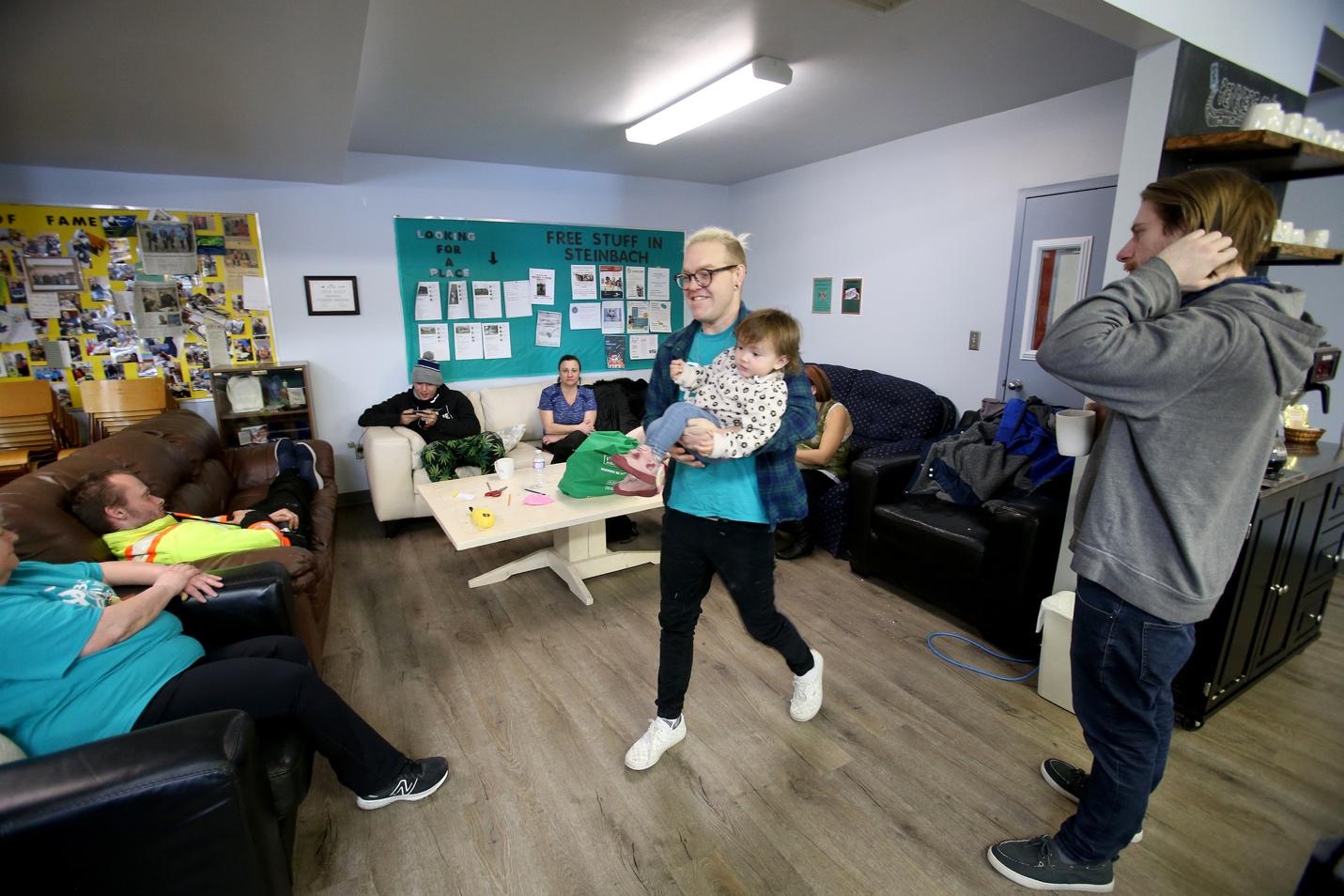
That generosity is palpable at Steinbach Community Outreach.
On a recent Monday morning, two men in camouflage jackets pop into the organization’s bustling drop-in centre with boxes of sausage, while a third man, unrelated to the first two, hands a massive wedge of cheese to a volunteer in a blue t-shirt. Soon after, a young mother walks in with a contribution of winter clothes; she holds the door for a donation of fresh buns and lunch meat left over from a funeral on her way out.
“I think the people of Steinbach are just awesome,” says Irene Kroeker, the organization’s founder and executive director. “But then again, I grew up here so I’m used to it.”
Kroeker begins to explain the many services Steinbach Community Outreach provides, ranging from counselling and tax preparation to connecting people with affordable housing, but is interrupted by one of the organization’s 80 volunteer cooks who’s arrived with a batch of schmaut kucki — cream cookies with pastel icing — she’s baked before coming in to help with lunch preparation.
Those accessing the organization’s food program don’t just receive ingredients, but balanced, prepared meals. Freezers are stocked with homemade soups and casseroles, all carefully labelled and dated. Sometimes, people donate entire cows.
The bulk of the outreach organization’s general revenue comes from tax-receipted gifts, although special projects may be funded by provincial or federal grants. Un-receipted gifts are an important source of income as well, accounting for nearly one fifth of the non-profit’s funding in 2021.
Volunteerism is another key facet of the city’s generous spirit, Funk adds, noting more than two thousand people came out for Steinbach’s last spring clean-up event — so many that some were sent to clean-up other communities.
But that doesn’t mean the city is immune to the complex social issues seen in larger centres, Kroeker stresses. Steinbach has about 30 chronically unhoused individuals and more than 700 people rely on Steinbach Community Outreach to get by each year.
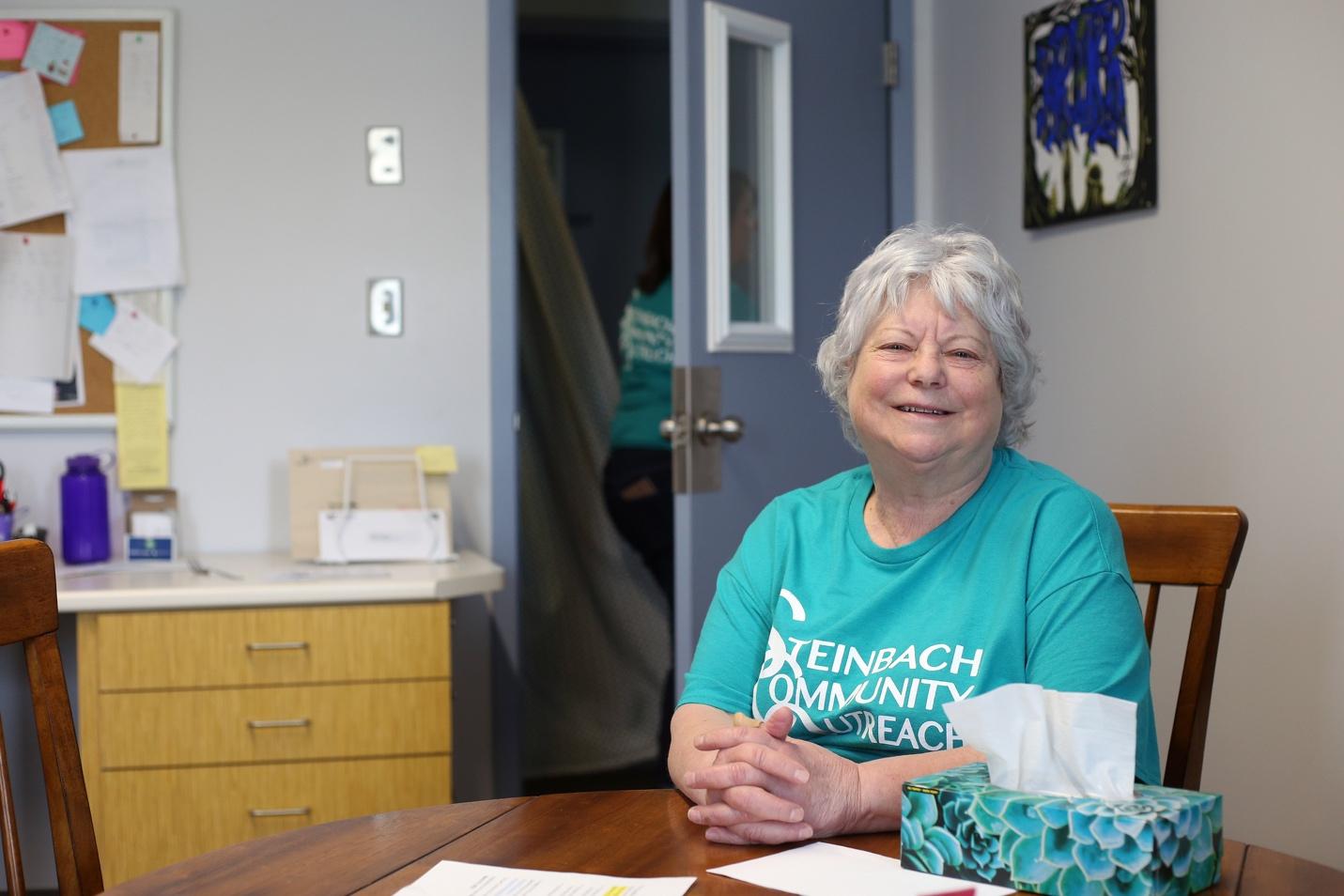
Irene Kroeker, founder and executive director of Steinbach Community Outreach. Photo: Shannon VanRaes
The organization also operates a homeless shelter and is building a 24-unit affordable housing complex. Additionally, Steinbach has a dedicated food bank, South East Helping Hands, which supports about 330 families.
In 2019, the city’s many service providers came together to form the Steinbach Poverty Coalition; about 17 per cent of families in the district are considered low income and Manitoba has the highest child poverty rate of all provinces at 20.68 per cent.
The pandemic also increased rural homelessness across Canada, including in communities like Steinbach. In 2021, Steinbach Community Outreach transitioned 30 individuals and families off the streets and into long-term housing, while proactively preventing an additional 47 households from losing shelter.
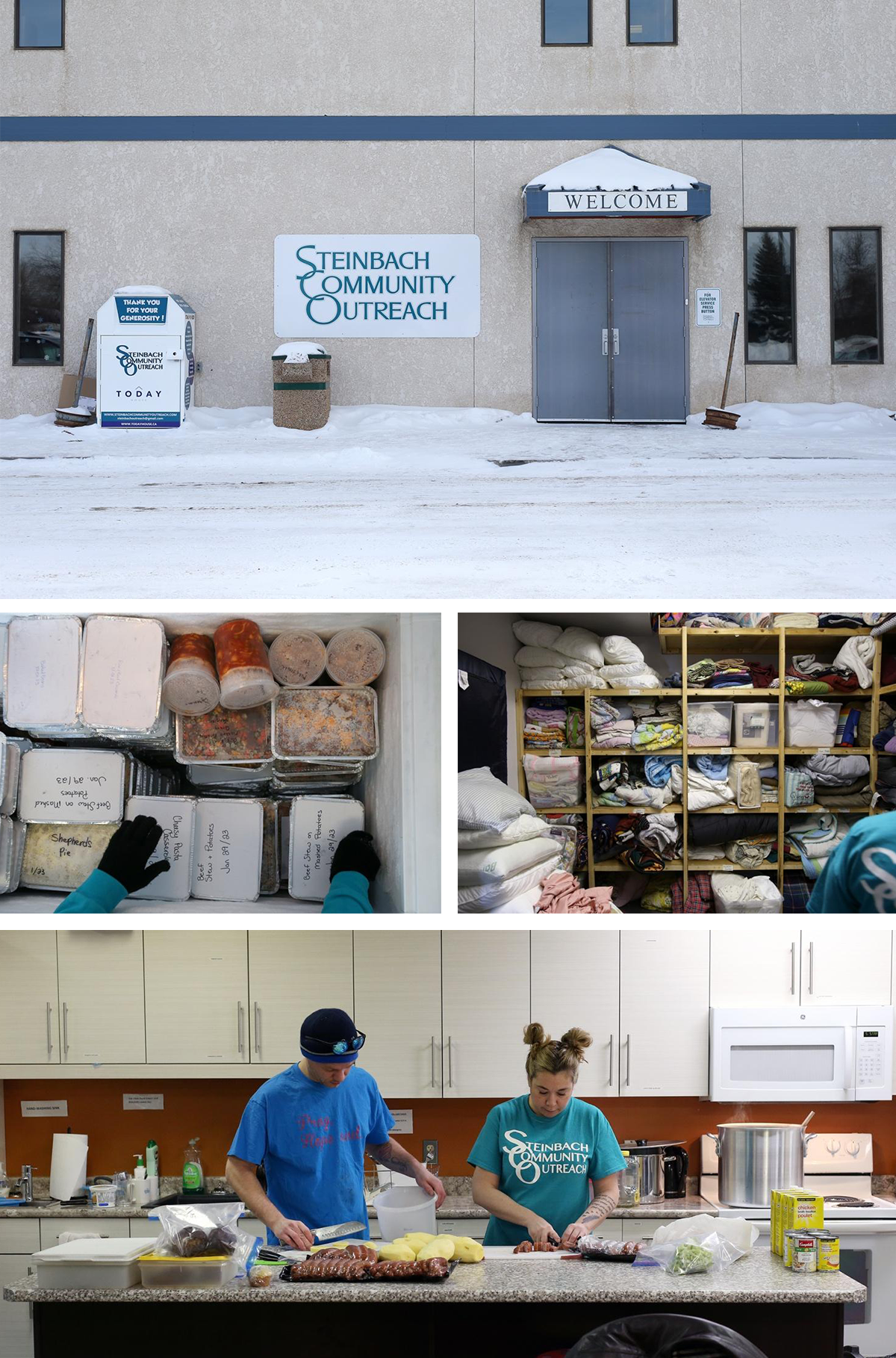
Freezers filled with homemade meals and a room storing blankets at Steinbach Community Outreach. (Bottom) Justice Enns-Kehler and Donna Swarzynski prepare potato and sausage farmer’s soup. Photos: Shannon VanRaes
Penner, who was born and raised in Steinbach, says there’s nothing wrong with celebrating charity and generosity, but adds it comes with certain risks.
“We celebrate charity and our generosity and I think that’s OK, but I don’t think we quite ask what’s going on behind it and why is it that generosity is needed,” says Penner. “We have work to do on justice and systems that go beyond charity. Those are larger, longer-term questions that I think are sometimes hidden behind our generous spirit.”
That generous spirit, some say, can also let civic institutions off the hook when it comes to addressing the root causes of poverty or funding local social service programs. “When I give food to the poor, they call me a saint. When I ask why they are poor, they call me a communist,” says Penner, quoting the late Catholic Archbishop, Hélder Pessoa Câmara, of Brazil.
But today’s Steinbach is not the Steinbach of 1874 — or even 2004. The city’s population has more than doubled in the last 20 years thanks largely to immigration. “We don’t all go to church and we certainly aren’t all Mennonite,” says Penner.
Mergie Fiesta Seewald came to Canada from the Philippines 17 years ago, first settling in Alberta before moving to Manitoba “for love” a few years later. Last December, she was honoured as the South EastMan Filipino Association’s volunteer of the year.
For her, Steinbach’s culture of generosity and giving was a big part of the city’s draw, something that fit with her own worldview and a desire to live in a close-knit community where people support each other.
“Ever since I came here, I found it to be the most friendly, most helpful place,” says Seewald. “If it’s snowing and you go into the ditch, you know someone will stop and help you, if you are online and you say you need something, people will help you out. It’s amazing.”
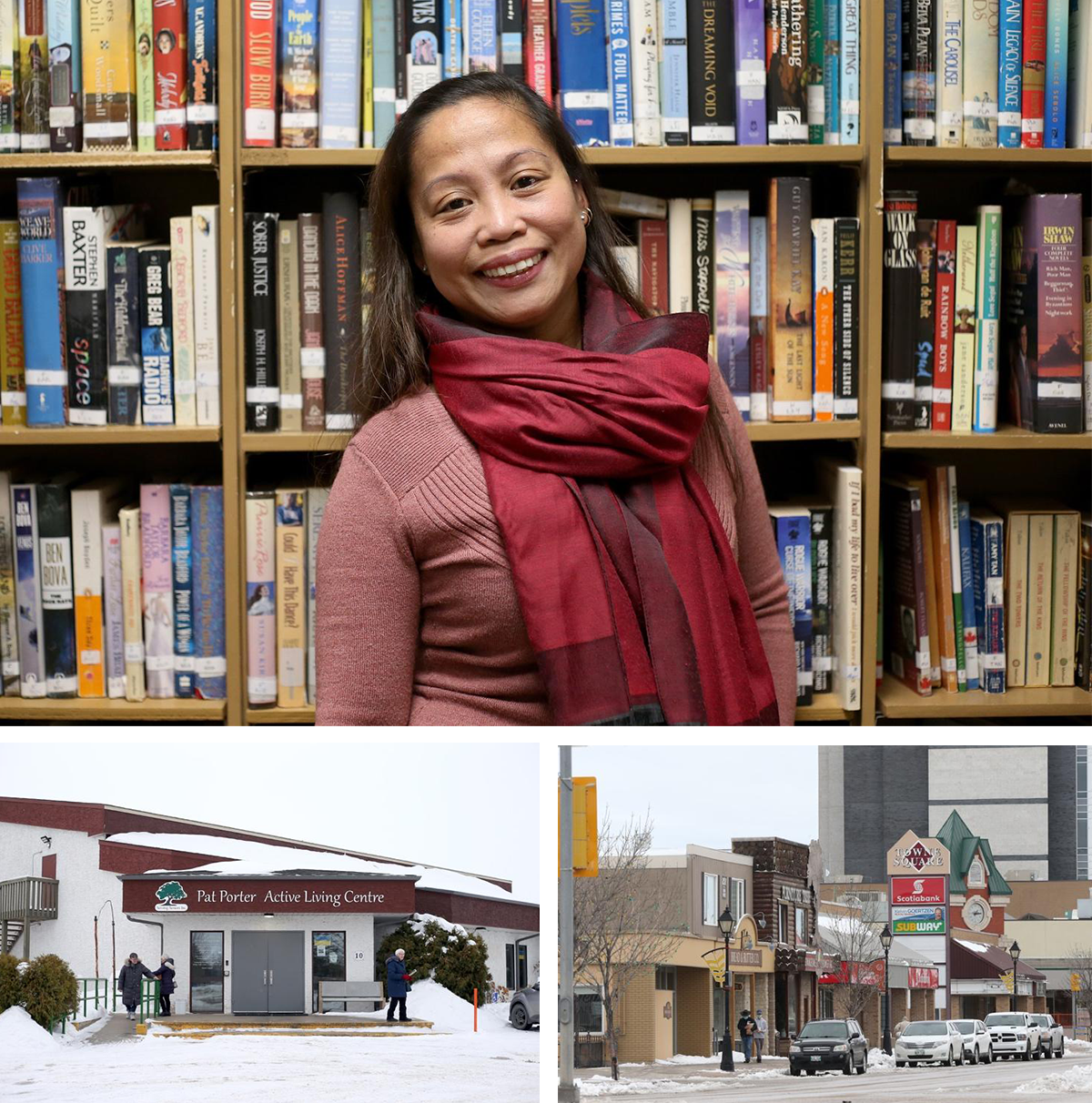
Mergie Fiesta Seewald (top) and the Pat Porter Active Living Center where she volunteers (bottom left.) Steinbach’s Main Street (bottom right). Photos: Shannon VanRaes
Much of her volunteer work is with new immigrants, but she’s also a regular volunteer at the Pat Porter Active Living Centre.
“You get to hear a lot of stories, you know, and it’s not just one ethnicity,” Seewald says. “You talk with the Mennonites, you talk with Ukrainians, you talk with other nationalities. The population of people from India is growing too, because people want to live in a place that’s comfortable to them.”
Nearly 500 immigrants choose to make Steinbach their home in 2022, according to Eastman Immigrant Services, coming from countries like Nigeria, India, Mexico, Iran, Russia, Syria and Ukraine. More than 21 per cent of the city’s current residents were born outside of Canada.
Mayor Funk says Steinbach offers immigrants a low cost of living, in a safe, progressive community with strong business and manufacturing sectors, often in need of skilled labour. But he adds it’s the city’s unique culture, much of it tied to generosity and volunteerism, that leads people to fall for the Prairie outpost.
“We have to love each other,” says Funk.
“We don’t have to agree on everything, and people in Steinbach don’t agree on everything, but we can agree to care for each other … we don’t have to share the same belief system in order to be partners together in this thing we call life.”
He’s confident the city’s culture of generosity will only continue to grow along with the community, even as fewer residents claim Mennonite heritage. No one culture or religion has a monopoly on generosity, he adds.
Determining exactly how many Steinbachers identify as Mennonite, either religiously or culturally, is challenging. More than 40 per cent of residents claimed German heritage in the 2016 census, which could indicate Mennonite heritage, but not necessarily.
Someone with a Mennonite background might also list Russian, Mexican, Uruguayan, Bolivian or Paraguayan heritage. When Manitoba forced Mennonites to join the public school system in the 1920s, some moved to South America, only to have their descendants return to Canada in more recent decades.
But about 30 per cent of Steinbach’s residents claim German as their mother tongue, which includes Plautdietsch or Low German. And half of Canada’s approximately 200,000 Mennonites live in Manitoba, which also happens to be the country’s most generous province.
Winkler, Canada’s second most generous city, was founded 130 kilometers west of Steinbach by another group of Plautdietsch-speaking Russian Mennonites in 1876.
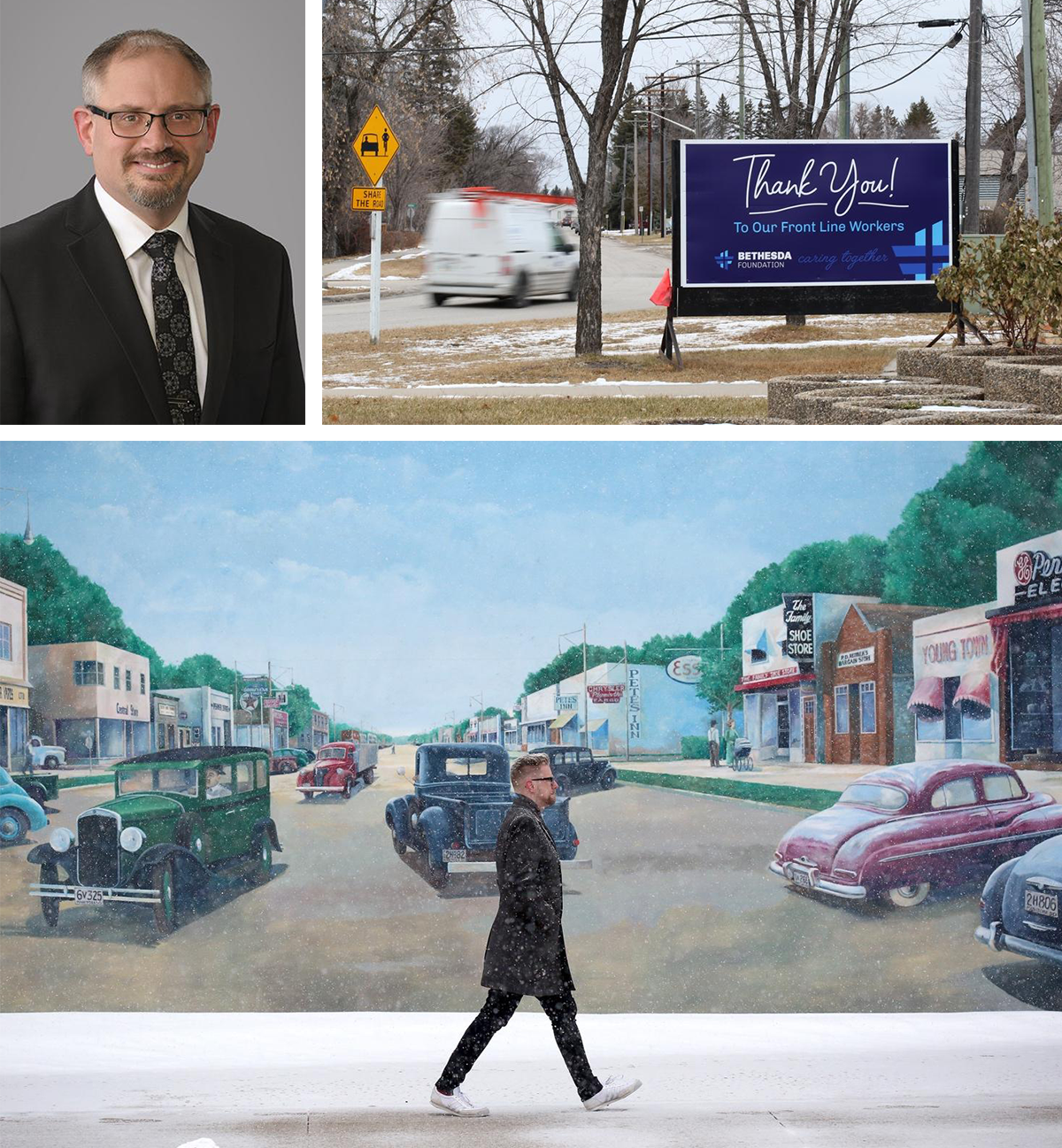
Steinbach Mayor Earl Funk (top left). Photo: courtesy of the City of Steinbach. A sign thanks frontline workers (bottom left) and a man walks past a mural depicting Steinbach’s historic Main Street. Photos: Shannon VanRaes
But Kroeker stresses Mennonites are not a monolith. “I am Mennonite and I grew up with the idea that we give as much as we receive,” she says. “But is that true of all Mennonites? I wouldn’t go that far.”
Other changes also signal a shift away from religious hegemony. In 2008, Steinbach City Council voted 4-2 to allow the community’s first liquor to open and in 2011 the majority of Steinbachers voted in favour of allowing bars to operate in the previously dry community. Although a 2018 vote on allowing cannabis retailers was defeated by a wide margin.
Whatever the future holds for Steinbach, Dyke says the city’s past will remain unchanged, including its Mennonite roots, which he hopes will continue to inspire generosity as the city grows and changes in the years to come.
“There is something really wonderful here, I think people feel it when they come, and I think the next generation will hold onto that,” he says.
Your job. Your mission. Your news.
With your support, the sector you're building gets the journalism it deserves, and you get a tax receipt.

Related Articles

Redesigned Canada Housing Benefit could reduce homelessness by more than half: Report
End Homeless Canada’s new report shows if Canada’s Housing Benefit is redesigned, it could dramatically reduce homelessness in the country.

Partnered Partnered content Mental health support must better reflect how young men seek care: GreenShield report
New data reveals how stigma and traditional expectations of masculinity are shaping young men’s mental health, and why care models need to evolve.
School forest initiative set to expand outdoor learning in Ontario
Many students in Ontario will head outdoors under a new classroom and forest initiative.
