What 2024 holds for social finance
From transition finance to the impact of real estate on climate change solutions, here are eight things Future of Good expects to make news in the social finance sector this year.
Why It Matters
Through solutions journalism, Future of Good highlights what might go right tomorrow and who’s showing the way in the social finance ecosystem. With a critical eye, we keep the reader up-to-date on how finance is being shaped to be a tool, not an end.

Most journalists ask, ‘What went wrong yesterday, and who’s to blame?’
Solutions journalists ask, “What might go right tomorrow, and who’s showing the way?”
The latter was said by David Beers, founder of Vancouver’s The Tyee and a Canadian solutions journalism pioneer, and it’s a succinct and accurate description.
In May 2023, I joined the Future of Good team as a social finance reporter. My contribution would be to report on social finance through the solutions journalism lens.
Solutions journalists report, with a critical eye, on solutions to social and environmental challenges – but they don’t ignore the limits of those solutions.
Over the last six months, I wrote about many social finance solutions like community bonds, non-profit housing, blended finance, conservation finance, cooperatives, and shareholder climate activism.
I’ve reported on initiatives in Quebec, Nova Scotia, British Columbia, and Ontario.
The stories I wrote in 2023 had a common thread: finance was used to tackle a social or environmental challenge. For 2024, here is what I will keep an eye on.
1. Hybrid structures

Kim and Steve Hatcher, cofounders of Coywolf Farm and Canning Sauce Company, are among the 152 Nova Scotians benefiting from FarmWorks. This for-profit co-op has brought 500 investors, providing SMEs $8.5 million in loans. (Submitted)
Hybrid organizations combine for-profit and non-profit. They diversify their sources of revenue to tackle complex problems better. Not relying on one stream of income makes these organizations more robust.
Legal innovations like Community Interest Companies in Nova Scotia and Community Contribution Companies in British Columbia make these hybrid models possible. I expect more of these unique structures for non-profit organizations to pop up in 2024.
2. Community finance
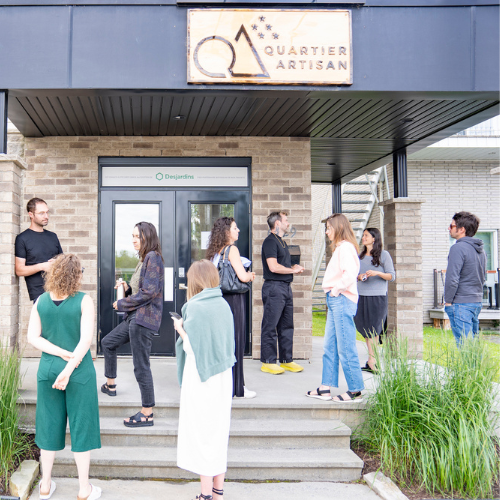
Artisan accelerator program Quartier Artisan, in Lac-Mégantic, Quebec, will use Fonds l’Ampli to match the dollars it will raise from the community. (Submitted)
“Buying is voting” (Acheter c’est voter),” said Quebec eco-sociologist and activist Laure Waridel.
Investing is voting, too. Citizens can contribute to community building by investing where their money can improve their neighbourhood’s quality of life and services.
Community finance adapts to this desire, creating investing tools in farms, sustainable food, affordable housing, energy transition, arts, community hubs, and nature conservation.
This year, communities will want more say in how the money they invest in local charities directly impacts their communities.
3. Non-merchant real estate
“Any non-merchant real estate project submitted to the City will get the fast-track treatment,” said Sherbrooke Mayor Evelyne Beaudin last year. “It is one way to create affordable housing faster.”
Another Quebec mayor, Longueuil Catherine Fournier, is taking the same stance. “We want to reach 20 per cent of non-profit housing on our territory,” she said.
“It will take time. For now, we barely reach three per cent. But it is essential to equilibrate for-profit and non-profit housing,” she said.
The interest in a more robust non-profit housing sector can be observed from coast to coast.
In Quebec, we will keep an eye on l’Achat. The Alliance des corporations d’habitations abordables du territoire du Québec (ACHAT) is a group of collective enterprises in real estate (owners, operators, and developers non-profit, coops and parapublics organizations) unique in the national social economy network.
4. The Canadian Climate Investment Taxonomy
Like all countries, Canada needs a clear definition of what green investment is and is not. Once defined, financial tools can be designed to mobilize and accelerate capital deployment to achieve climate objectives.
This taxonomy is challenging in a country where the fossil industry is heavy in the economy.
The future Canadian climate taxonomy must help differentiate transition investment and green investment.
The “green” label would apply to low-to-no carbon projects or activities accelerating Canada’s clean energy transition: renewables, battery and storage technology, and Electric Vehicle infrastructure.
As the Canadian Climate Institute explained, “The ‘transition’ label would apply to projects substantially reducing emissions from hard-to-decarbonize sectors. Transition-labelled projects would also have limited lifespans and avoid making it either more complex or more expensive to transition to net zero in the future. For example, a steel producer installing an electric arc furnace to reduce emissions from its operations would be a project eligible for transition investment status.”
A roadmap for the Canadian Climate Investment Taxonomy was presented in March 2023. In 2024, Future of Good will report on how it is progressing.
5. Transition finance
As countries struggle to meet Paris Agreement goals, we will hear more about “transition finance.”
The best definition is this Financial Times column.
Transition finance refers to funding for highly polluting companies.
For Canada, a significant fossil fuel producer, it raises the question of what sort of transition we imagine here.
Will it be one in which the energy and industrial sectors in 2060 are dominated by all the same giants, just without carbon emissions? Or one in which many of these businesses have faded away, replaced by a new generation of companies focused on low-carbon innovation?
6. Agricultural community land trusts
Community land trusts protect long-term affordability by permanently removing a piece of land from the commercial market.
How it works: An owner can donate land to a community land trust, or a city, foundation, or a group of individuals can buy it. The land then has no formal owner anymore. It instead belongs to its mission, which includes housing affordability, nature conservation, sustainable farming and other eco-uses.
A board of trustees, chosen among stakeholders, is accountable for the land and respecting its mission.
Community land trusts can protect housing, local stores, nature, or farms.
But in the meantime, the prices of farmland have skyrocketed.
“Farmers take on a lifetime of debt in the hope of selling their farms for much more than they paid for them,” said Hubert Lavallee, president of Protect-Terre.
“This will be their retirement money. But young people can’t buy these farms – they’re way beyond their means. It’s unsustainable.”
Protect-terre supports the creation of agricultural community land trusts. There are eight agricultural community land trusts in Quebec and eight others in the process.
I am expecting this model to continue throughout the country
7. Outcomes financing
In January, Future of Good published its first article on outcomes financing. We will keep this innovation on our radar.
As a type of social bond, outcomes financing targets specific outcomes to social or environmental challenges. The investors get repaid according to the delivery of those outcomes, monitored by an independent third party.
Unlike most social bonds, outcomes financing is codesigned with the community, expressing the community’s needs and desired outcomes.
Outcomes financing is best suited for complex problems that government programs must address more effectively.
8. Conservation and restoration finance
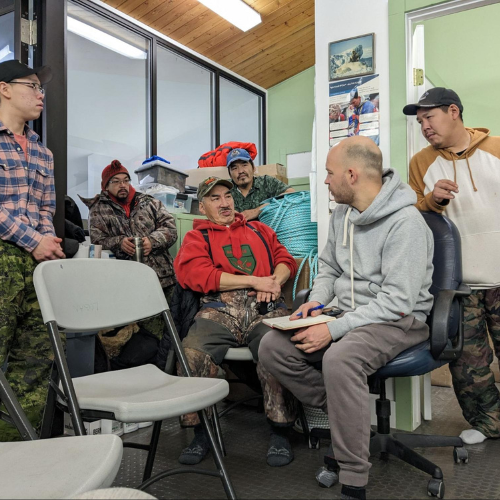
Nunavut Aviqtuuq Guardians is a nature-conservation initiative. Co-benefits from investments in this program are estimated to have generated $12 million since 2016 in Nunavut. Talha Awan, Smart Prosperity Institute
Last November, we published a story on Nature Investment Hub (NIH).
NIH is a conservation finance initiative partnered by The Natural Step Canada and the Smart Prosperity Institute.
NIH is a hub that hopes to bring all stakeholders to the table to create robust nature-based solutions and attract investors to finance them. The hub hopes to generate $20B for Canada’s natural land conservation and restoration.
Nature-based solutions – centred on the conservation, restoration and management of the world’s ecosystems – could contribute around 30 per cent of the global mitigation required by 2030/2050 to achieve the 1.5/2°C temperature rise goal agreed to under the Paris Agreement.
It is one of the nine conclusions of this position paper by the United Nations Framework Convention on Climate Change.
In 2024, we will continue to monitor Canadian conservation and restoration finance.
Your job. Your mission. Your news.
With your support, the sector you're building gets the journalism it deserves, and you get a tax receipt.

Author

Related Articles

Elbows up: Spring Impact Capital calls for a giant spreadsheet of available early-stage Canadian capital
The Vancouver impact investor wants to crowd-source a free, national directory
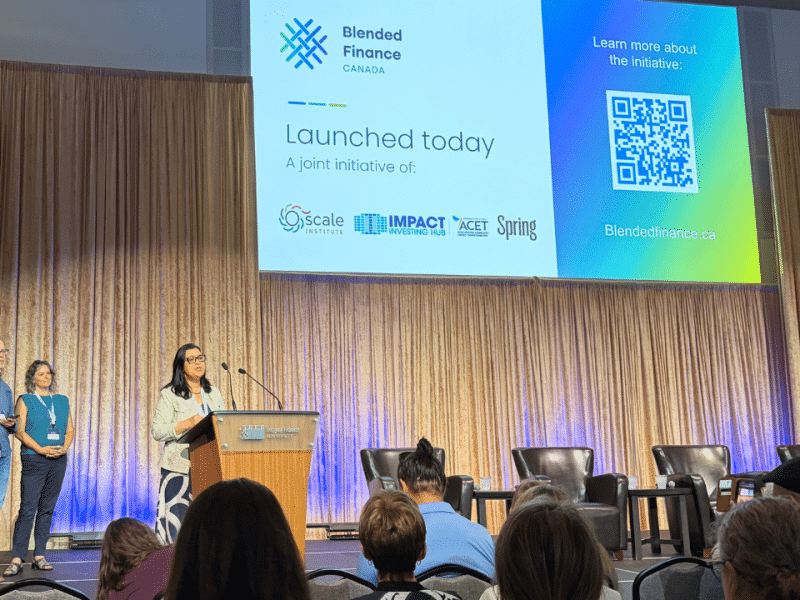
Blended Finance Canada launches on West Coast
The new initiative is supported by the University of Victoria, Scale Institute and Spring.

Canada’s Sustainable Finance Taxonomy: What it is, what is happening and what’s coming next
Canada’s sustainable finance taxonomy faces big challenges, from oil and gas, Indigenous rights and the real meaning of the word ‘transition.’
