Deep canvassing: How an innovative American door-knocking method is invigorating Canadian environmental campaigns
By patiently listening, canvassers have remarkable success swaying opinion
Why It Matters
Contemporary climate research shows the best way to convince skeptics is to patiently engage with their existing beliefs. Deep canvassing is a political mobilization strategy social purpose organizations like Neighbours United use to do just that: their campaign in a rural B.C. smelting town influenced 40 per cent of residents surveyed and helped pass clean energy legislation.
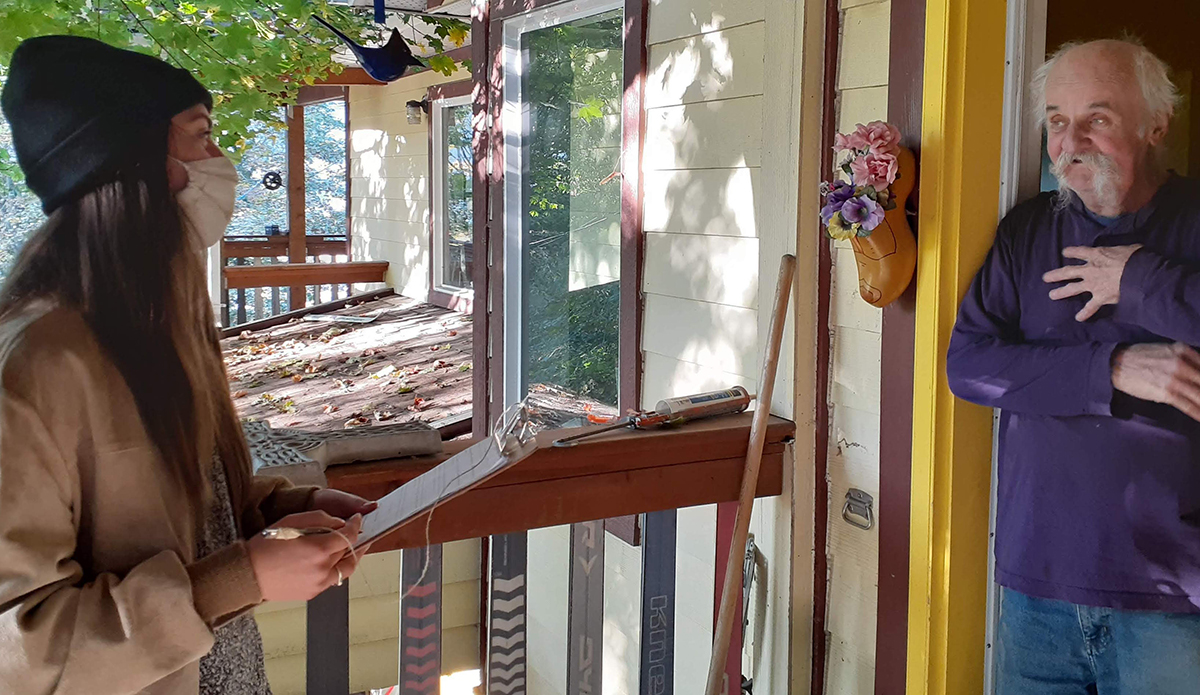
Photo: courtesy of Neighbours United
This independent journalism is made possible by a Future of Good editorial fellowship on community resilience, funded by Cooperators. See our editorial ethics and standards here.
When the man he was trying to convince disclosed that he’d protested against COVID restrictions, Joshua Workman immediately felt he wasn’t going to get very far.
Workman was standing on this man’s doorstep in suburban Calgary, Alberta, volunteering with a door-knocking campaign. They were spreading awareness about the climate crisis before the 2023 provincial election. The campaign’s main objective was to convince voters in this riding that government tax breaks to oil and gas companies should be ended and reinvested in renewable energy.
Volunteers were in this neighbourhood specifically to speak with climate skeptics and oil sector workers. But Workman was talking to someone who’d helped shut down the Alberta-Montana border in early 2022; the same time the ‘freedom convoy’ was occupying Ottawa. “I would have put him into a bucket of also being very resistant to climate action,” Workman says. “But it turned out that my initial impression was totally wrong.”
Workman and his fellow volunteers were employing a door-knocking strategy called deep canvassing, first developed in the U.S. in the 2010s to advance progressive causes and increasingly being adopted by environmental organizations in Canada. Deep canvassing is all about radical empathy: its adherents are trained to respond to skepticism with curiosity by patiently asking questions at someone’s doorstep instead of hammering them with facts and figures to make their case. Why do they believe what they believe? What feels off or disagreeable about ‘the other side’? Are they personally affected by the policies being discussed?
Volunteers also share personal stories of their own. Workman had a story about cancelling travel plans to pay off some credit card debt his family had accrued from the rising cost of living in Alberta. It turned out to be the bridge between the two men.
“They were not seeing it as fair that oil and gas CEOs were making millions while the average workers were really struggling,” Workman says.
Ultimately, the man signed the petition, and Workman became more patient. “One of my favourite parts of doing deep canvassing was that it was this really unique opportunity to be in conversation with Calgarians who I might not have otherwise interfaced with. It helped me to see a more beautiful, fulsome picture of these individuals and the challenges and lives they lead.”
“The thing that continues to surprise me all the time is how positive it feels to have conversations with people, even if they don’t move along our scale in terms of change on the issue,” says Molli Bennett, organizing director of the “Alberta Talks” campaign Workman volunteered with. “It feels valuable to be engaging in the skill of having conversations — helping to depolarize, plant seeds, engage people in their democracy.”
A success story
Alberta Talks is the second deep canvass on environmental issues in Canada and worldwide. The first was run by British Columbia-based organization Neighbours United from 2020 to 2022: a campaign for renewable energy in Trail, B.C., a small smelting town in the Kootenays. Over 40 per cent of citizens increased their support for renewable energy, and in April 2022, the city council unanimously voted to shift the town entirely to green energy by 2050.
This canvass started when Executive Director Montana Burgess first heard about deep canvassing on a podcast. “My jaw dropped. This is engagement organizing cranked up to a ‘Spinal Tap 11,’” they say, referencing the classic 1984 comedy.
With deep canvass training from the US-based New Conversation Initiative and research guidance from the Yale Program on Climate Change Communication, Burgess and their team spent a year developing what is now recognized as one of the most successful canvasses. Organizers have long known that even a single-digit influence on voters can help pass legislation. The 40 per cent increase Burgess and her team achieved is remarkably powerful in comparison.
The Trail canvass also aligned with a longstanding conclusion in climate psychology: Skeptics are more easily persuaded if they feel listened to and understood before being presented with information that contrasts with their beliefs.
Burgess says this was particularly evident in Trail, where many citizens were employed in the mining shelter despite a century of lead pollution from the local smelter. “It’s that jobs versus environment argument — the perfect place to test and figure out how to do deep canvassing on an environmental issue.”
Bennett feels a similar effect applies to Alberta Talks. Surveys have shown that while most Canadians support renewable energy, the lowest support is in Alberta. A July poll from Abacus found that 36 per cent of Albertans didn’t support or were ambivalent on federal clean energy legislation, compared to a 29 per cent national average. Bennett attributes this to the province’s economic dependence on the oil and gas sector, and a national discourse that paints Albertans as more opposed to climate action than they are in reality.
“Environmental and climate movements haven’t done enough to include people who hold different views as theirs at the table,” she says.
“So Albertans feel defensive and judged.”
The success of Alberta Talks and the Trail campaign is inspiring new canvasses. Neighbours United is planning two in B.C. addressing upcoming legislation supporting old-growth forests and gas line-free housing developments, one in Newfoundland targeting oil and gas exploration, and one supporting a push for rural solar power in Ohio and locally run power grids in Maine.
Meanwhile, Alberta Talks is targeting a new set of Calgary neighbourhoods. Bennett says that her team has ambitions to scale the canvass across the city and hopefully beyond, but for now, they are focused on engaging Albertans “in the hundreds, not the many thousands.”
The secret is listening
In 2009, Steve Deline could never have known he was about to help invent deep canvassing. The Californian government had repealed a same-sex marriage bill that passed several months before, and Deline and his colleagues at the Los Angeles LGBT Center were determined to get it back. They were going to knock on people’s doors and talk to them about the issue, trying to humanize it by sharing their personal struggles with homophobia.
As Deline puts it, there was no real strategy or name for this tactic, just a desire to plant a “kernel of an idea” for equality. He sat in his car, asking his boyfriend (now husband) for emotional support. He had never door-knocked — it wasn’t a strategy LGBTQ+ activists typically used at the time. But he did it anyway, trying his best to be non-confrontational, and was immediately taken with how receptive people were to this approach.
Within a few years, the Los Angeles LGBT Center started formalizing this approach into a standard set of techniques for difficult discussions. The rules centred on the person, not the issue. Ask questions. Withhold judgment. Share your experience and ask for theirs.
By 2012, California restored its original position, and Minnesota was the next state to vote on marriage equality. Deline and his coworkers moved to the Midwest for four months to train 14,000 volunteers in this new strategy. Over 220,000 conversations later, the bill was passed, and the canvassing caught the attention of two political scientists.
David Broockman of the University of California, Berkeley and Joshua Kalla of Yale ran an experiment and found that deep canvassing successfully reduced prejudice towards transgender people by a significant margin for at least six months after a conversation with canvassers. The New Conversation Initiative and its sister organization, the Deep Canvass Institute, were set up to research this method and train organizations.
Deline is still with the Initiative today. He says he feels like a “steward” for the history of deep canvassing as a mobilization strategy developed by the LGBTQ+ movement and spreading to other progressive causes.
Kalla has continued to research deep canvassing and says the evidence for its effectiveness continues to grow. Most canvasses influence opinions in 10 percent of all conversations — far less than the 40 percent the Trail campaign achieved but enough to pass legislation.
His research has shown that telling personal stories is one of the biggest sources of deep canvassing’s success. A conversation is most persuasive when a canvasser shares an anecdote that directly concerns the issue instead of analogies or metaphors, although it doesn’t matter whether the anecdote is from personal experience or relayed secondhand.
This is because narratives naturally lower our defensiveness to new ideas, Kalla says, and distract anyone from arguing back with an immersion into the story. “As you get into the story, you want to hear the beginning, middle, and ending — the full narrative arc. That gets you listening to more of what I’m trying to say.”
Logistical difficulties
But figuring out which anecdotes to share can be a challenge. Each canvasser uses a script to guide their conversations, prompting specific questions and responses based on how the person they talk to reacts.
Campaigns vary widely, so it’s hard to come up with general figures, but Deline estimates that creating a script for a new issue can take eight to 12 months while refining a similar script for a new campaign can take two to three months.
The Trail campaign took a year to find a workable script. Once a program objective is chosen, a core staff team spends months tweaking the script by trying it out on potential targets. Burgess says other organizations often approach them seeking support but are unprepared or unable to dedicate staff to script development for months at a time. “It’s the most resource-intensive type of organizing I have ever personally been a part of,” Bennett adds.
It’s also an emotionally challenging process since each staff member has to develop the skills of active listening while in conversation with people they may disagree with. However, developing a team of empathetic staff is critical if volunteers are to be trained in the same approach, Deline says.
Finding those volunteers can also be a challenge. Burgess and Bennett both say a successful canvass requires deep connections to the communities organizations serve. Staff have to meet potential volunteers face-to-face at events to convince them to join a canvass. Those relationships aren’t formed overnight, but when they exist, word spreads and volunteers come forward without prompting.
Once those volunteers are found and trained, staff still need to create a supportive environment where they can seek support for difficult conversations they have. Workman says the Alberta Talks campaign was so fulfilling for him because there was a debrief at the end of each day. Each volunteer talked through their emotions while others listened in a “meta” canvass. Burgess says these debriefs are often followed by another just for staff so they can support each other after a full day of supporting volunteers.
Because of all these steps, deep canvassing is often more challenging than organizations realize, Burgess says. Neighbours United offers a four-step roadmap guiding others through the process, but the very first step is making sure there is a narrowly defined goal that requires a canvass in the first place.
“You can change someone’s mind around a specific policy priority,” Burgess says. “You can’t make someone supportive of all climate action.”
When all the criteria are met, deep canvassing can be a transformative mobilization strategy for organizations and their volunteers. Most participants report a feeling of personal growth after canvassing. Workman volunteered for just six canvasses and is already eager to return.
And Deline, who’s been canvassing for much of his adult life, has become deeply changed and more willing to look beneath superficial differences. He’s learned to see the same “underlying mass that I am” in every person influenced by fearmongering and divisive political rhetoric.
“Our side has a harder job: to create trust, connection and inter-reliance together. Those things are harder to generate. But we have the power to do that if we pick up the right tools.”
The organizations mentioned in this article are willing to support others in their own deep canvass. The New Conversation Initiative and the Deep Canvass Institute offer training and support. The Yale Program on Climate Change Communication can assist with research support. Neighbours United offers a free roadmap and toolkit for starting a canvass and is open to further collaboration upon request. Alberta Talks can offer advice but not ongoing mentorship at this time.
Your job. Your mission. Your news.
With your support, the sector you're building gets the journalism it deserves, and you get a tax receipt.

Related Articles
Federal court rejects Ottawa’s bid to quash youth-led climate case
Federal Court says youth climate advocates deserve a full hearing on whether Ottawa weakened Canada’s 2030 plan.
New UBC-Kelowna tool helps cities plant trees where they’re needed most
CanopyFit maps physical barriers alongside heat and equity data to maximize shade and cooling.

Canada’s Sustainable Finance Taxonomy: What it is, what is happening and what’s coming next
Canada’s sustainable finance taxonomy faces big challenges, from oil and gas, Indigenous rights and the real meaning of the word ‘transition.’
