Putting reliability to work: Why Canadian businesses should hire neurodivergent people
Studies show employers are open to hiring people who are on the autism spectrum or have intellectual disabilities but often aren’t sure how to do so.
Why It Matters
Most neurodivergent people in Canada are either under-employed or unemployed. With a skilled labour shortage and pressures to increase production, Canadian businesses are missing out on a valuable source of reliable employees, much to their detriment.
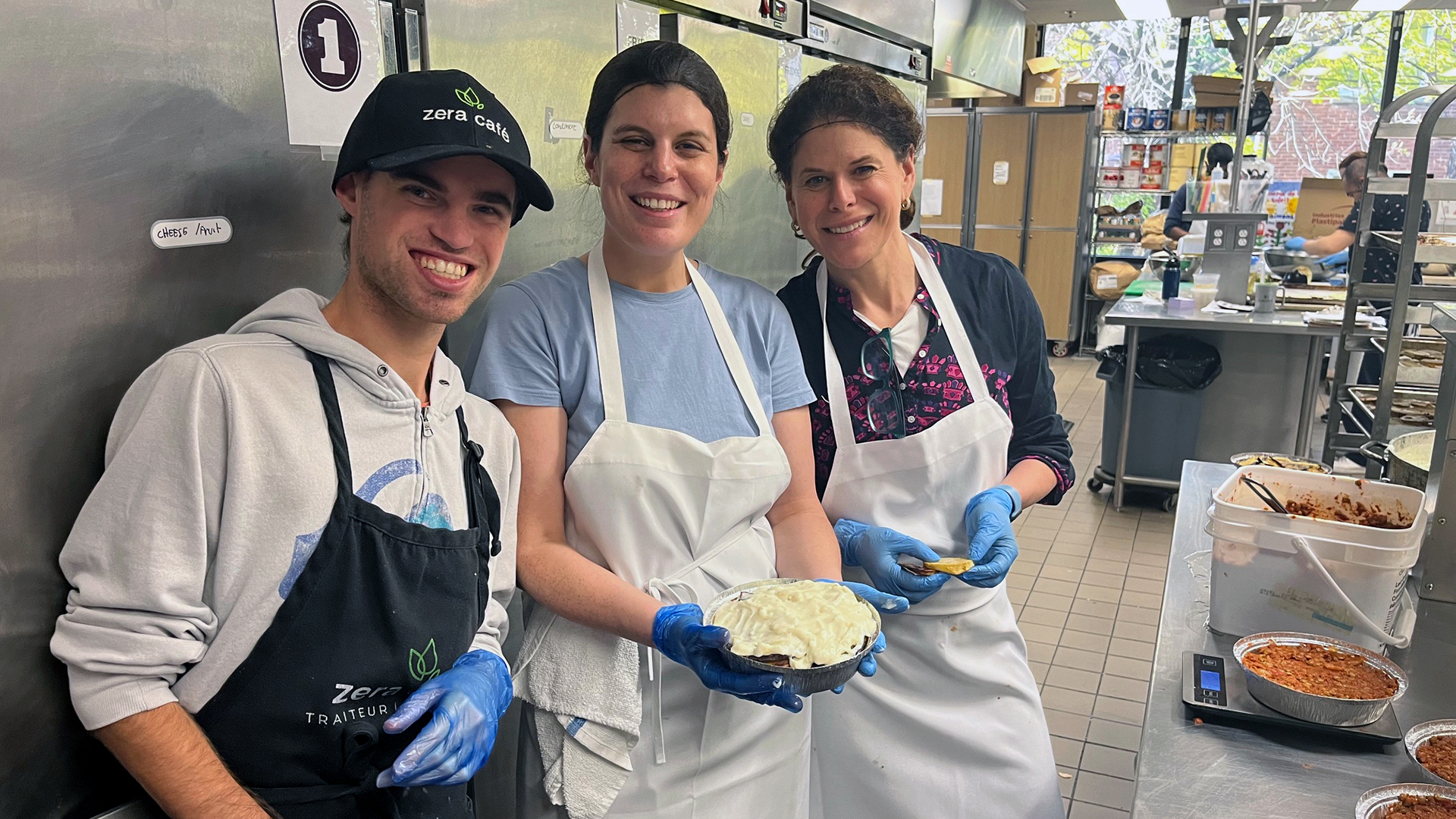
Daniel Lach, Laura Harris, and volunteer job coach Arianne Aberman in the Zera Cafe. (The Azrieli Foundation/Supplied)
Drizzle fell as Stephen transferred a stack of completed wooden pallets into storage with a forklift; the day was grey, damp and chilly, although not enough to spoil his mood.
“It’s a great place to work,” he said, smiling during a break inside the lunchroom.
“Great for a lot of people, a great place to learn skills too.”
Finding work hasn’t been a problem for Stephen, who first put his size and strength to use as a farm labourer. Later, he turned to temp agencies but found they lacked stability.
“It would be that kind of random,” he said. “A good job one day, the next dragging a concrete hose up three floors.”
Stephen began building pallets full-time at a social enterprise operated by Community Living Tillsonburg 13 years ago, who then promoted him to team leader. On the Autism spectrum, he was initially nervous but said he has grown into the role and takes pride in keeping things running smoothly.“Just organize things, keep it going, build some pallets.”
It was a Friday, and like many other shift workers in Tillsonburg, Ont., Stephen looked forward to the weekend, hanging out and playing video games with friends or checking out Venom, his favourite Marvel character. However, he also looks forward to Monday mornings.
“I’d have to be rich to stay home,” he smiled. “But I enjoy coming to my job I like, for sure.”

Stephen inside the pallet shop. (Future of Good/Jeff Tribe)
“Steph has learned over the years what the role of a leader in the back is, and accepted it and done it very well,” said Norm Meron, properties manager with Community Living Tillsonburg (CLT).
The pallet shop supplies a half-dozen customers with various designs and dimensions, said Meron, each template recorded in Stephen’s little blue book.
“We strive for top quality, on time, all the good customer service points,” Meron added.
From business to social enterprise
Formerly part of the Adult Rehabilitation Centre, or ARC Industries, the pallet shop was converted to a social enterprise about five years ago, continuing to pay the bills while providing a safe, healthy and positive working environment. Most employees are in the Ontario Disability Support Program, and while there is some clawback of those benefits, working provides a financial advantage.
“Everyone who works here is paying bills, buying groceries, paying for their fun, social times,” said Meron.
“We’re all people first,” said Meron, emphasizing CLT’s belief in inclusion in every aspect of life. “And Steph is just one of the success stories.
David Cunningham, employment coordinator with Community Services Tillsonburg, oversees the social enterprise and the Options for Employment program, which supports everyone’s entry into the workforce. However, it focuses on people with mental or physical disabilities or delays.

Norm Meron is the engineering services supervisor with Community Living Tillsonburg, and David Cunningham is the employment coordinator with Community Services Tillsonburg in the pallet shop. (Jeff Tribe/Future of Good)
Clients are assessed for their level of employment readiness and offered skill development programming. The pallet shop and related social enterprises then train workers for future employment in the larger community.
Retention support is based on the individual, said Cunningham, and can include direct job coaching (such as helping someone learn to chop vegetables, for example.)
“It’s paving the way so certain barriers, certain disadvantages don’t interfere with the same chance to be successful in a job,” said Cunningham, including public perception around those who do not present as neurotypical.
The community wants to see diversity of all kinds, including in employment, said Cunningham, where neurodivergent employees tend to work hard, display pride in their work, have low absenteeism and turnover rates, and their positive attitude can improve their work environment.
“They want to succeed more.”
Most neurodivergent people are under or unemployed
About 88 per cent of the 500,000 neurodivergent individuals of working age (16-64) in Canada are either underemployed or unemployed, said Orly Fruchter, manager of neurodiverse initiatives at the Azrieli Foundation.
This is not representative of their abilities or desires, Fruchter added.
“It’s more a reality of the current lack of supports.”
The foundation launched the INfinity Prize, which aims to increase the employment rate and provide equitable career opportunities for neurodivergent Canadian adults. It was open to small and mid-sized jobs and social enterprises in Canada with fewer than 500 employees and a scalable business model.
The prize package featured a $100,000 award plus weekly coaching for two years and in-kind support from the foundation, including use of office space, consultations, introductions and networking.
There are many incubators and innovation prizes for underemployed Canadians, said Fruchter, but none previously existed for neurodivergent people.
Montreal’s Zera Cafe, a not-for-profit meal service providing house-cooked meals, fresh baked goods, and catering services, was the inaugural winner. The other two finalists were Goodness Gift, a gift-giving service featuring art and design, order processing and delivery, and La Cuisine Collective Hochelaga/de Maisonneuve, which promotes healthy eating through a collective kitchen, grocery store, catering service and farm.
The three represented, respectively, a social enterprise created specifically to employ neurodivergent people, one that evolved over the years and a third which pivoted in the last year and a half to include vocational training and employment for the neurodivergent community.

Orly Fruchter, manager of neurodiverse initiatives at the Azrieli Foundation. (The Azrieli Foundation/Supplied)
“Anyone can take this on,” said Fruchter. “I think that is one of those perfect examples and models.”
The prize was awarded on Oct. 25 in Toronto at an event highlighting neurodivergent ability rather than disability. Musical accompaniment for cocktail networking, entertainment (Michael McCreary, ‘The Autistic Comedian’), and swag bag contents all showcased the abilities of neurodivergent people, what they can do, and the benefits of creating a supportive space where potential can be realized.
“If we get the ball rolling, there is more opportunity,” said Fruchter.
As part of its initiative, the foundation shares a five-step program entitled Putting Neurodiversity to Work on its website.
Why should you hire someone who is neurodivergent?
Neurodivergent individuals make great employees because they tend to have an affinity for continuity and consistency, said Fruchter.
“There is a very low turnover rate when it comes to this population. Once you’ve trained them, once you’ve provided them with the supports that they need, they will be a very committed employee.”
They also tend to be punctual, making them reliable, she said.
Neurodivergent individuals also generally create a space where others enjoy being, said Fruchter.
A fourth advantage ties to a revenue-generating perspective — having neurodivergent people working for you reflects on others’ values, she added.
“People always want to support an entity or a business that’s doing great work.”
Despite those advantages, there is room for improvement in the for-profit sector in employing neurodivergent people, she said.
Ready, Willing & Able (RWA) has been doing its part to build an inclusive for-profit workforce built on the strengths of people with intellectual disabilities and the autism spectrum since 2014. Its business-case focus differs from many, said its national director, Don Gallant.
“We take great pride in speaking business-to-business,” said Gallant, hoping to create “special jobs for special people.”
“We work with employers on the basis of, if you do this, this is nothing but good for your company,” he continued, adding hiring people with intellectual disabilities or autism will positively contribute to a business’s bottom line.
In simple terms, employers in ‘all shapes, sizes and colours’ want good employees, said Gallant.
“And very simply, Mr. or Ms. Employer, I can get you good employees.”
Gallant corroborated the advantages, including staying longer at a job, fewer sick days, punctuality and enhancing company culture.
“All the good things employers look for in an employee, our candidates bring to the table.”
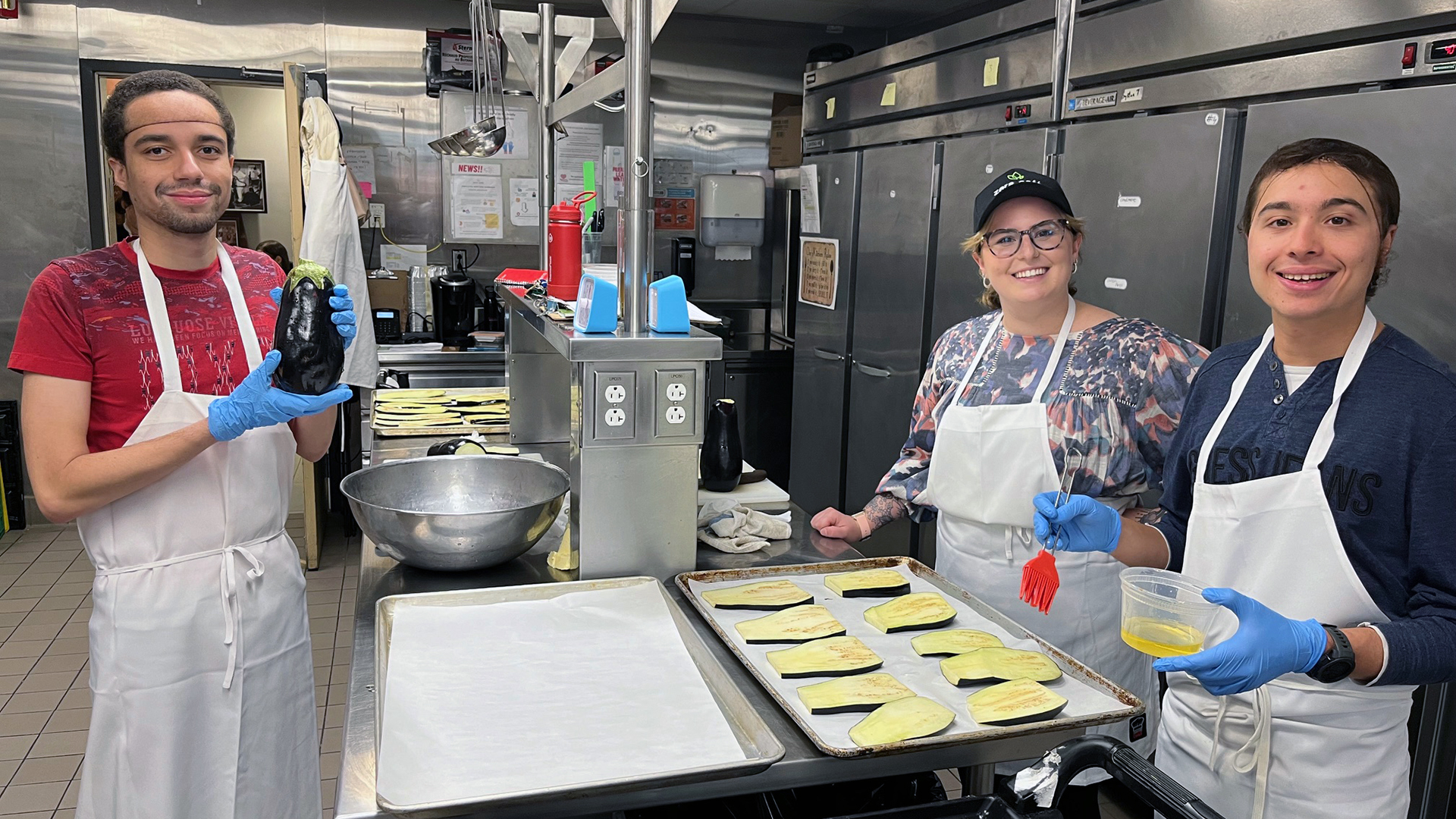
Julien Robin, lead job coach Lauren Richardson, and Adamo Morrone at the Zera Cafe. (The Azrieli Foundation/Supplied)
RWA’s research showed employers understood the benefits of inclusion and diversity within their workforce and were not disinclined to hire people with intellectual disabilities or autism.
However, they weren’t sure where to find these candidates, and if successful, they were uncertain how to connect to job support.
RWA helps bridge that gap in 30 communities nationwide.
For example, if an employer commits to hiring, RWA shares the job description with agency partners, typically provincially or territorially funded, to find jobs for people. When the HR journey begins, up to and beyond the point of hire, RWA provides what the job seeker needs, such as interview support and a job coach, defines any job-related special equipment required, or sources transportation.
“Whatever the person will need related to their particular employment challenges, we can provide and offset in an ongoing way,” said Gallant.
RWA also supports the employer, hosting ongoing information sessions with senior management or HR. For example, they might discuss how to interact with persons with intellectual disabilities or autism, make the interview process more inclusive or help rewrite job descriptions in plain language.
“Hopefully … they’ll be inclined to hire again and again and again,” said Gallant.
What about wage subsidies?
Gallant does not endorse wage subsidies for two reasons, starting with the fact that if the subsidy disappears, so does the job.
“So it’s not a good path to sustainable, long-term employment.”
Secondly, Gallant said subsidies send the wrong message to employers — that the government must subsidize their wages because the employee can’t entirely do the job.
RWA has facilitated 4,300 hires nationally without subsidy with the strategy that companies have a job to fill; candidates who meet the job description requirements deserve full wages for their work.
“I want you to hire because it makes good sense for you, and we’re going to demonstrate and prove how much good sense it makes,” said Gallant.
“It is, quote, ‘the right thing to do.’ But the right thing to do is not the reason to do it. You’ve got to do it because it makes sense to you as an employer.”
So much is about expectations and stereotypes, said Gallant, and as long as “What we do feeds those negative stereotypes and misconceptions, we’re never going to move the needle.”
“Helping a person with a disability get a job is not an exercise in social work. It’s employment, it’s HR, it’s labour, it’s a labour market issue.”
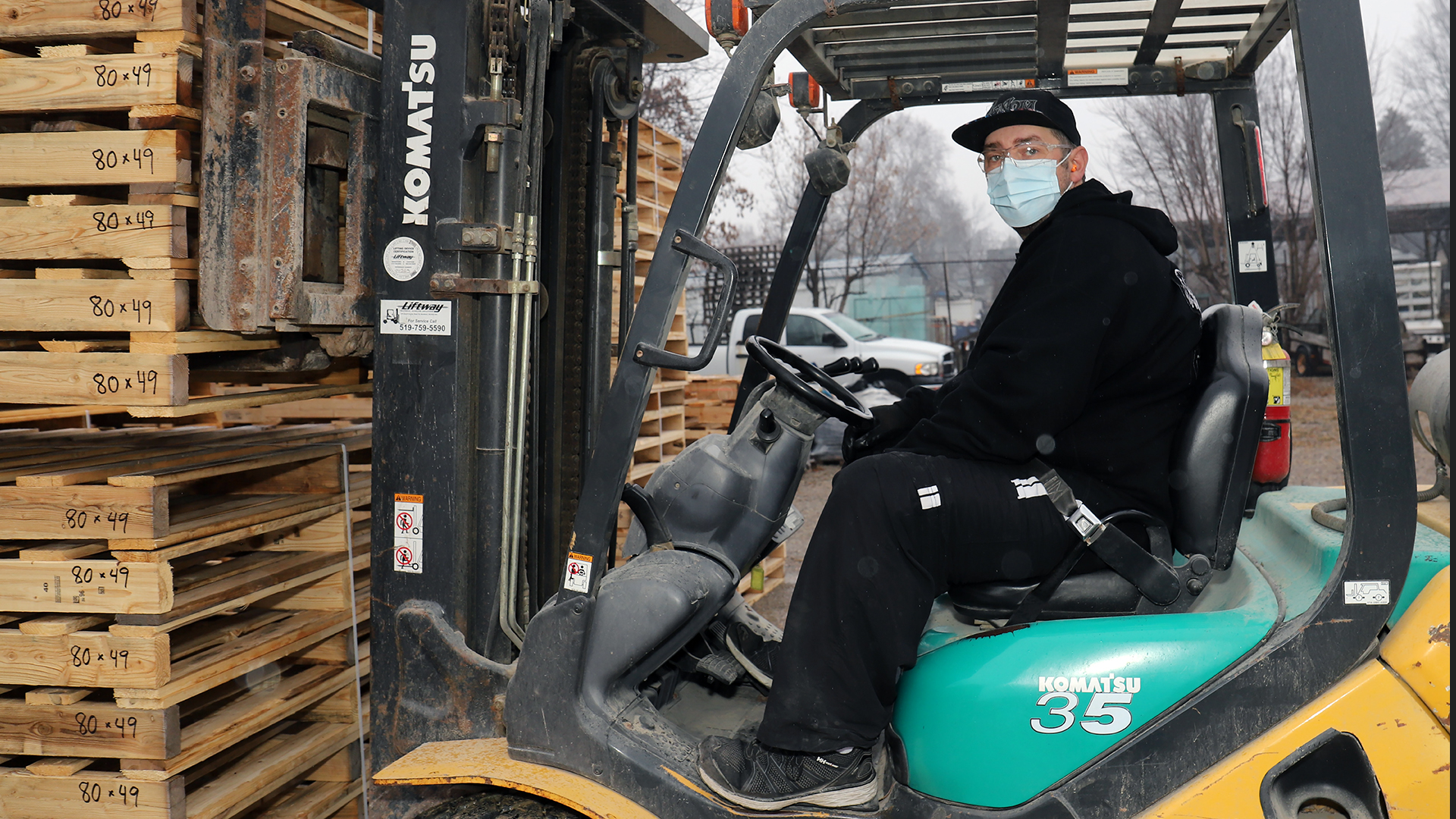
Stephen stacks pallets at the pallet shop. (Jeff Tribe/Future of Good)
RWA’s goal is not simply to source jobs but to open doors to careers.
More needs to be done to assist employers, employees and the supports around them to create intentional paths to career advancement and more equitable access to emerging workforce opportunities, said Gallant.
“We’re not guaranteeing promotions because you can’t do that. But you can prepare a person to take advantage of a promotion opportunity which might come up.”
Employment is much more than about a wage, he added.
In Canada in 2023, the employment rate for people with disabilities is around 50 per cent and only half that in the two populations the organization supports.
“One in four is employed, which means three in four are not. I think it is majorly embarrassing for Canada to say that.
“They have been ignored for much too long.”
Your job. Your mission. Your news.
With your support, the sector you're building gets the journalism it deserves, and you get a tax receipt.

Related Articles

Partnered Partnered content How construction contracts became the blueprint for social change in Manitoba
Manitoba is a leader in social procurement, with decades of partnerships among government, businesses and social enterprises that have shaped a model other communities can learn from.


‘The need is endless’: Food insecurity highest in Canada’s Black, Arab and Indigenous communities
Food insecurity gaps aren’t closing, so community organizations across Canada are trying new ways to help beyond just providing food.
