Canada’s largest sector starved: Inside the financial crisis reshaping Canada’s fraying non-profits
As governments retreat from core services, non-profits are absorbing the fallout, without the funding, workforce stability or policy attention needed to sustain it. Why?
Why It Matters
Canada’s non-profit sector is now propping up essential social services while being structurally underfunded, overworked, and overlooked in federal policy. With billions sitting idle in private foundations and burnout rising across frontline organizations, the country is quietly shifting its social contract onto a system that was never designed — or resourced — to carry it.
This is the second of a three-part series exploring the relationship between Canada’s charities and the governments that ignore them. This series was funded thanks to a generous donation to our Claim-A-Story initiative, which allows our readers to help directly fund news stories that Future of Good is working on. Read the first story here, and find part three here.
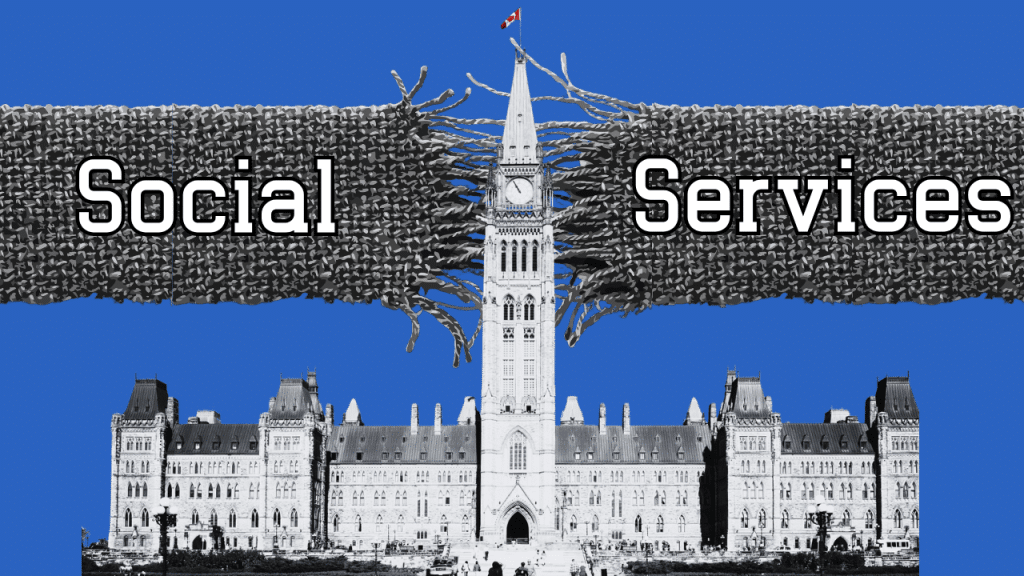
As Canada’s public services face increasing budget constraints, the burden of social welfare is being quietly shifted onto a non-profit sector that lacks the funding to sustain it.
Across the country, a series of crises is taking place. Widespread dissatisfaction is being felt across the country with health care access, rent is too high for many to afford, and grocery prices have been rising above the inflation rate and skyrocketing since 2021. These stresses became particularly acute during and after the COVID-19 pandemic.
Beginning in 1995, federal and provincial governments have been cutting services, attempting to “balance budgets,” and experts say this has caused a slow degradation of Canada’s public service.
David Macdonald, researcher at the Centre for Policy Alternatives, said Mark Carney’s Liberals are a return to this status quo, and that this mentality will ultimately hurt the non-profit sector.
Carney has announced significant budget cuts for projects that don’t align with the Liberals’ capital spending plan.
“These cuts are terribly ill-considered. There is nothing ‘ambitious’ in cutting social transfers to other levels of government and calling them savings,” wrote Macdonald.
The burden is being placed on the shoulders of the third sector and non-profits, with overworked and underpaid staff, he said.
Tristan Ouimet-Savard, an employee of the Réseau québecois de l’action communautaire autonome (RQ-ACA), said the provincial government is relying on the community sector to fill gaps left by the public service.
“We’re not cheap labour. We’re not patching the holes of the public services. We’re an alternative — a force of social transformation,” said Ouimet-Savard.
“You can’t lower the budget of the public sector and increase the (burden of the) community sector. What would that do? We would just do the work of the public sector at a cheaper rate.”
Non-profit community groups are highly specialized and operate as an additional force for social change rather than as a public service.
But despite their contributions to society, most non-profits struggle to make ends meet, and non-profit employees experience higher levels of burnout than those in the for-profit sector.
Burnout and the scarcity mindset that leads to more
“Burnout rates are very high,” said Lisa MacDonald, editor of Hilborn Charity E-News. “A lot of people are in the sector and work in the areas they are in because they have an emotional connection and passion for it.”
Some workers will therefore work extra hours without pay, even if they are not paid a living wage in the first place, she said.
“The whole sector revolves around a scarcity mindset – that all dollars should be going to the charity in question, which doesn’t leave a lot of room for investing in the professionals who are leading,” MacDonald said.
She contrasted this with the for-profit sector, where “people don’t blink at or question salaries [that provide] a living wage.”
Caroline Chartier has seen this scarcity mindset in action. In Quebec, the sector needs an injection of about $2 billion to keep going, she said.
Chartier, in addition to being the spokesperson for Le Communautaire à boutte, a grassroots movement in Quebec that has organized more than 10,000 community workers to strike, also works for Centre Roland-Bertrand. This non-profit advocates for impoverished people while promoting their development and autonomy.
In 2025, the Quebec government helped fund the centre.
They received $3,600. Total.
Her staff consist of 65 employees, whom she pays for 52 weeks a year. The government funding helped give all 65 a $1.06-per-week raise.
Nick Mulé, professor at York University and co-author of The Shifting Terrain: Public Policy Advocacy in Canada, explained that the fix to the sector’s problems requires a range of approaches.
“It’s so difficult to talk about the sector, right? Because it’s so massive,” he said.
“A lot of the populations being served by the non-profit sector are not seen as a priority by the state, sadly.”
There needs to be policy advocacy on behalf of the sector to correct this, said Mulé.
Shifting contexts for every sector within the non-profit world require different approaches.
Joy Smith, a former conservative MP and founder of the Joy Smith Foundation, thinks that non-profits should not rely completely on government grants. Her foundation works to educate and fight against human trafficking.
“All our money is raised privately. The only government money we have is for a project here, and a project there. One of our partners is here in Canada. They fly our traffic victims from province to province, free of charge for us,” she said.
She believes that relying on government grants isn’t a solid solution, since governments change constantly and their priorities with it.
“(It’s) understandable. There’s been a lot of challenges around international makeup, between our neighbour to the south and others,” she said.
Still, whether the fix comes from private investors or public investment, everyone agrees: more money is required.
The hierarchy of non-profits
In Canada, there is a hierarchy of non-profit status: non-profit organizations (NPOs), registered charities, and foundations.
NPOs are founded to serve the public good, and do not pay taxes on revenue. They can include activities such as festivals, sports clubs and associations.
NPOs can earn profits, but those profits must be reinvested within the organization and cannot be paid to stakeholders. NPOs can’t offer charitable receipts for donations.
Charities, however, are an NPO that can issue tax refund receipts to donors. They must do “charitable activities,” according to the Canada Revenue Agency, which regulates Canada’s charities and NPOs. To be designated a charity, they must fit into the CRA’s charitable categories. Universities and hospitals are examples of registered charities.
Foundations are a type of registered charity and exist in three forms: private, corporate or community foundations. They generally exist to distribute funds to other charities through grants, but they may also engage in charitable activities. Some examples of foundations include the Winnipeg Foundation, Makeway or the Trottier Family Foundation.
Charities as organizations go back to the beginning of Confederation. Victorian societies relied on charity, particularly the church. In Quebec, the Catholic church tended to social services. In English Canada, every Protestant church had its own charitable society or foundation, while governments at the time approached philanthropy in a laissez-faire way.
After World War II, Canada’s federal government formed a consensus around Keynesian economics, investing in massive infrastructure projects to build a robust welfare state and significantly reducing the burden on charity.
However, the sector today might be described as an unwieldy, decentralized beast that is an easy target for governments that are employing austerity measures.
As Canadian social services are barely being maintained, the charity sector is growing in terms of workers, size, and the number of people using it.
The sector’s GDP is growing at a rate of 2.9 per cent in 2024, compared to Canada’s total GDP of 1.5 per cent for the same year.
It remains one of the largest sectors in the country, generating 8 per cent of Canada’s GDP, surpassing the GDP generated by retail.
In 2022, the sector generated about $216.5 billion of GDP for Canada, rivalling major resource sectors such as mining, oil, and gas.
Not only is it a major contributor to Canada’s GDP, but it is also the country’s largest sector.
This does not account for the labour savings from volunteers. If the worth of volunteer hours is factored in, the GDP contribution of the sector rises to 8.5 per cent.
Today, more than two million Canadians access food banks each month. Millions more access other vital services provided by non-profits and charities, and every Canadian uses non-profit services at multiple points in their lives, from sports clubs to schools to libraries to health care.
Yet many of the experts we interviewed say the sector remains ignored by the Canadian government.
Money in the bank
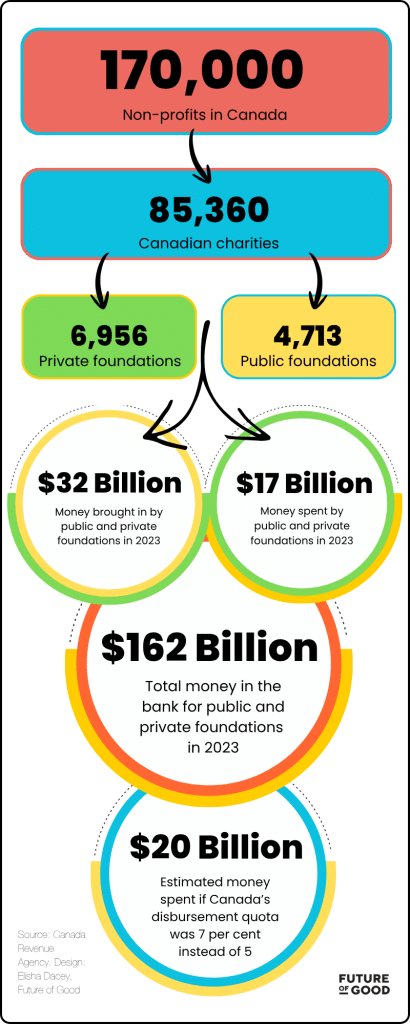
According to the CRA, there are more than 170,000 non-profits in Canada. Under that umbrella are about 86,000 charities, and within those 86,000 charities, there are 11,000 private and public foundations.
These 11,000 foundations are often established with funding from major donors – legacies left by wealthy families such as the Molson Foundation, the Chagnon Foundation, or the Rossy Foundation.
Within Canada’s foundations, there is between $162 billion and $200 billion in assets, according to CRA data, which is generating as much as 12 per cent interest annually.
In 2023, the disbursement quota was increased from 3.5 to 5 per cent, as mandated by the federal government.
Some foundations disburse more than the mandatory 5 per cent, but many continue to spend less than they earn in interest.
Paloma Raggo, a PhD researcher in philanthropy and professor currently on leave from Carleton University, said some foundations are more interested in self-perpetuation than in humanitarian work.
“Private foundations with an endowment will not be spent out,” she said.
These foundations have long existed as the legacy of a wealthy family, she added.
“Foundations are a bit tricky, because they’re not formally part of the state. They’re not part of the public service or private,” Mulé said.
“One of the great criticisms about them, particularly from minority groups and groups that have a hard time getting funding, is that their issues are not a priority with these private foundations. And it’s really hard to break through that.”
In the 1970s, Canada’s foundations were mandated to give 3.5 per cent of their wealth to charitable activities. It was changed to five per cent in 2023 and slated for review in 2027.
A spokesperson for the federal department of finance said any increases would not be considered until after the review.
“The Government still intends to evaluate the disbursement quota changes to ensure that they have been effective in providing additional support to the charitable sector,” the spokesperson said.
“As this review has not yet taken place, It would be inappropriate to speculate on any potential changes.”
Still, despite this policy change, billions more are sitting in foundations, growing in value every year, said Raggo.
“Is your goal to end poverty? If that is really the goal, then you shouldn’t be needing something forever, right?” Raggo said.
“How do you make that argument to donors to become a monthly donor or a legacy donor, for example, when what you’re hoping is that people aren’t going to need food banks?” Macdonald echoed.
She explained the complexities of fundraising when the ultimate goal is to abolish the root problem– it’s hard to perpetually raise money when the ultimate goal should be to go out of business eventually.
Instead, Raggo said foundations tend to be more interested in perpetuating the legacy of the family after which they are named.
With a policy change, massive sums of money could be rapidly pumped into the non-profit sector, but the larger question looms: How do you bring about policy change that lasts at the federal level? The non-profit world has a choice: either advocate for the change themselves, or nothing will likely be done. Watch for Part Three of this series on Friday.
Your job. Your mission. Your news.
With your support, the sector you're building gets the journalism it deserves, and you get a tax receipt.

Author

Related Articles

Show your cards: Quebec entrepreneur urges young customers to vote in the upcoming elections
Historically, youth aged 18-34 have the lowest voter turnout in provincial elections, according to Elections Canada.
Deadline looms for non-profits, charities to report ‘foreign principals’ to Ottawa
Charities, non-profits and institutions must now register any arrangements with foreign principals working to effect government behaviour

Explainer: The divergent fix-it paths of Ontario and B.C.’s condo oversupply problem
Both provinces have too many tiny, shoebox condos, but both are taking different approaches to fixing it.
