Model keeps Canada’s social sector from advocating for themselves, Canadians: experts
A scattered funding model and a lack of accountability in government mean the social good sector’s advocacy efforts are scattered – when they exist at all.
Why It Matters
Finding solutions to the social sector’s fragmented advocacy efforts will save time and potentially millions, if not billions, of Canadian taxpayer money. With better advocacy comes better cooperation, and with better cooperation comes better services.
This is the third of a three-part series exploring the relationship between Canada’s charities and the governments that ignore them. This series was funded thanks to a generous donation to our Claim-A-Story initiative, which allows our readers to help directly fund news stories that Future of Good is working on. Read the first story here, and the second story here.
Canada’s current system of grants and donations is preventing the social services sector from budgeting for the long term and for advocating for itself, say experts.
“It’s this dynamic we live in all the time. Our organizations aren’t able to budget for the future,” Caroline Chartier, co-spokesperson of Le Communautaire à boutte, and director for Centre Roland-Bertrand, said.
Financial support for non-profits is an unpredictable mix of government grants and donations, with family foundations funding projects and organizations that follow their personal interests.
The most important thing now is for non-profits to begin doing major advocacy work, said Nick Mule, professor at York University, but it’s not an easy endeavour.
“There (are) restrictions placed on charities doing advocacy work… charities in essence were restricted from engaging in advocacy work ” Mule said.
“There’s a price for silencing a sector and a sector that is serving, again, the most vulnerable members of our population,” he said.
“We’re restricting ourselves as a country from strengthening ourselves if we can’t assist those that need it the most.”
The restrictions on charitable advocacy are a catch-22, said Mule.
The sector can’t move forward without stronger advocacy pushing for better policy, but the people in charge of these organizations are “being put in a position of biting the hand that’s feeding them. So if you had something critical to say, or you even had something productive to say, there was a fear that the state, the ones that are funding you may take it as a criticism and then punish you for it and pull back funding.”
In 2003, former Prime Minister Jean Chrétien’s government implemented a CRA administrative rule that allowed a maximum of 10 per cent of an organization’s funding to go into advocacy work.
In 2018, the Justin Trudeau Liberals removed that cap in their budget implementation act. However, instead of using the term “political activities,” as has been used for decades, they used “public policy dialogue and development activities” or PPDAs, said Mule.
As a result, few organizations know that the advocacy cap has been removed, and therefore don’t invest more money to fight for policy change, he added.
Despite good intentions behind the change, charities and non-profits are still afraid to speak up, he said.
Funding remains so precarious that it’s better not to advocate and deal with present realities than to speak up and lose everything, Mule added.
“Anyone who raises in their organizations or agencies, ‘you know, maybe we should question this or advocate for a change,’ (the response is) no, no, no, no, no, we can’t do that. We can’t risk our funding,” Nick said.
This chilling effect is a legacy of the Stephen Harper government, said Katherine Scott, researcher at the Centre for Canadian Policy Alternatives.
“The terrible thing that happened under Harper was that he went after charities, saying that they were foreign-funded, which was a complete crock,” she said.
“The chill of wielding the tax code and wielding the threat that you would lose your charitable status… those were dark times. I mean, the threat of audit would just drive organizations out of business.”
Under Trudeau, things were only slightly better, she said, adding that organizations are still struggling to financially recover and remain risk-averse.
As for current Prime Minister Mark Carney, Scott said the sector and advocacy don’t appear to have crossed his mind.
“He’s got his objectives to expand the military– and that’s coming from somewhere. There are many, many programs that are queued up and potentially lapsing. And that is the money. So obviously that’s a chunk of which goes out to grants and contributions to support the sector. I think federally those sources of funds are certainly going to dry up.”
So then the response has to be different– and more stable than the give and take of federal grants, said Joy Smith, founder of the Joy Smith Foundation.
“I’m not criticizing the present government, they’re pretty good,” she said.
“Governments come and go and they have different priorities… Any government cannot just turn on the switch and give out money. They have to look at a number of issues, whether it be the economics or the different priorities of each individual province in our great nation.”
Her foundation has avoided government grants because Smith finds it less stable.
Or perhaps, a home in government
One way to help the sector and hold levels of government to account would be to establish a home within the government, argues Imagine Canada. Imagine Canada is the country’s largest charitable advocacy organization.
In a brief written by Imagine Canada in October 2022, the group argues the charitable sector needs a dedicated secretariat within the federal ministries.
While the CRA currently houses the Charities Directorate, it’s responsible for regulation, not policy, said the report’s authors, “and it has no mandate to consider the long-term health and needs of any organization, including registered charities, despite their contributions to society.”
The following year, they presented some models that could work, including a senior department or division reporting directly to a federal Minister, a secretariat or a commission.
In 2025, Imagine Canada’s Bruce MacDonald wrote an open letter to newly elected Prime Minister Carney.
“The lack of a coordinating mechanism within government is creating significant inefficiencies,” he wrote.
“We can cite numerous pieces of legislation and regulations that have been introduced without considering the impact on the nonprofit sector. As a result, government officials, Members of Parliament and charitable and nonprofit leaders invest extraordinary efforts to ‘undo’ or ‘rollback’ problematic measures.
“This is both a significant loss of productivity and weakens the effectiveness of the proposed changes.”
In the Spring Economic Update, the federal government announced a “modernization” exercise for 2026-27 for the sector, but there is no indication it will include a dedicated minister responsible for the charitable sector.
New evaluations
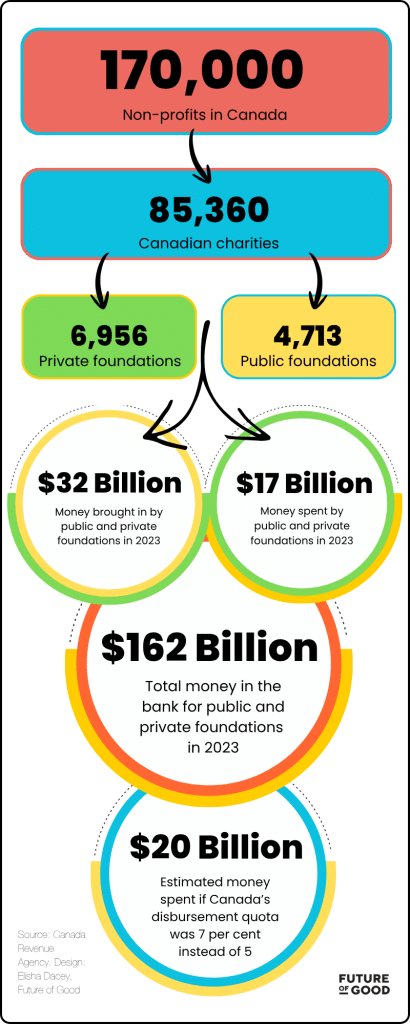
Still, in 2027, the federal government will evaluate its plan for the amount of money philanthropic foundations must disburse to charitable organizations. In 2022, it was increased from 3.5 to five per cent.
There are 11,000 foundations in Canada which have between $162 billion and $200 billion in assets and are generating as much as 12 per cent interest.
If the government were to increase the mandate from five per cent to seven, or even higher, it would allow these foundations to continue growing their investments and sustaining the legacy of their founders, while simultaneously financing more non-profits to the tune of $3.24 to $4 billion.
In Mule’s opinion, the only way this will happen is if charities push for it, hard.
“Nothing came about for those communities unless they advocated for themselves,” he said.
“There’s some clout that comes with (having) charitable status, so why not make use of that to communicate to the state that these are the real needs that are happening on the front lines and this is what we need. It’s that voice that’s important.”
Katherine Scott, researcher at the Canadian Centre for Policy Alternatives, agreed. “Years of advocacy of non-profit sector leaders and (there are) all those groups saying ‘What gives? How is it that we’re so silent on this massive issue?’” she said.
An influx of up to $4 billion annually won’t fix all the issues facing the sector, but it will make them easier to address, she said.
Still, more solutions need to be found, said Paloma Raggo, a philanthropy scholar.
“It’s really hard to know who’s doing what, where,” she said.
This goes doubly for grant funding, Raggo added.
It’s easier for larger organizations that “have more resource structures. You’re more established, but it doesn’t mean that you’re necessarily better at what you’re doing.”
Increasing the mandated spending requirements for foundations could partially rectify this problem and create more stable funding across the country, she said.
Rabia Kedr, the national director of Disability Without Poverty, has a brighter eye on the future.
“I’m always hopeful, otherwise I wouldn’t do this work. I’d hide under a rock,” she said. “I’ve gotten to meet incredible people, hear their journeys, see how they’re involved, empower their involvement.”
Although it’s hard to know what impact her work has in the community, she holds on to the moments when someone sends her an email or tells her in person how they’ve been affected.
“There’s a lot more work to be done. We’ve realized the depth of systems change that needs to happen… But it also reinforced our shared Canadian values. We want to talk to people about the issues. Nobody wants to see anybody struggling. Nobody wants to see people with disabilities living in poverty.
“There will be a new day, and a better day for everybody,” she said.
Your job. Your mission. Your news.
With your support, the sector you're building gets the journalism it deserves, and you get a tax receipt.

Author

Related Articles

Show your cards: Quebec entrepreneur urges young customers to vote in the upcoming elections
Historically, youth aged 18-34 have the lowest voter turnout in provincial elections, according to Elections Canada.
Deadline looms for non-profits, charities to report ‘foreign principals’ to Ottawa
Charities, non-profits and institutions must now register any arrangements with foreign principals working to effect government behaviour

Explainer: The divergent fix-it paths of Ontario and B.C.’s condo oversupply problem
Both provinces have too many tiny, shoebox condos, but both are taking different approaches to fixing it.
