The failed coordination of Canada’s social good sector
Decades of underfunding have left Canada’s community sector exhausted, fragmented, and structurally unable to coordinate — even as movements across Canada show what’s possible when strategic advocacy is sustained.
Why It Matters
Canada’s non-profit sector delivers essential services while operating in a system that structurally discourages collaboration, leadership development, and long‑term advocacy. Without reform to funding models and government–sector relationships, even the most powerful grassroots movements will struggle to secure durable policy change.

This is the first of a three-part series exploring the relationship between Canada’s charities and the governments that ignore them. This series was funded thanks to a generous donation to our Claim-A-Story initiative, which allows our readers to help directly fund news stories that Future of Good is working on. Find the second story here, and read the third story here.
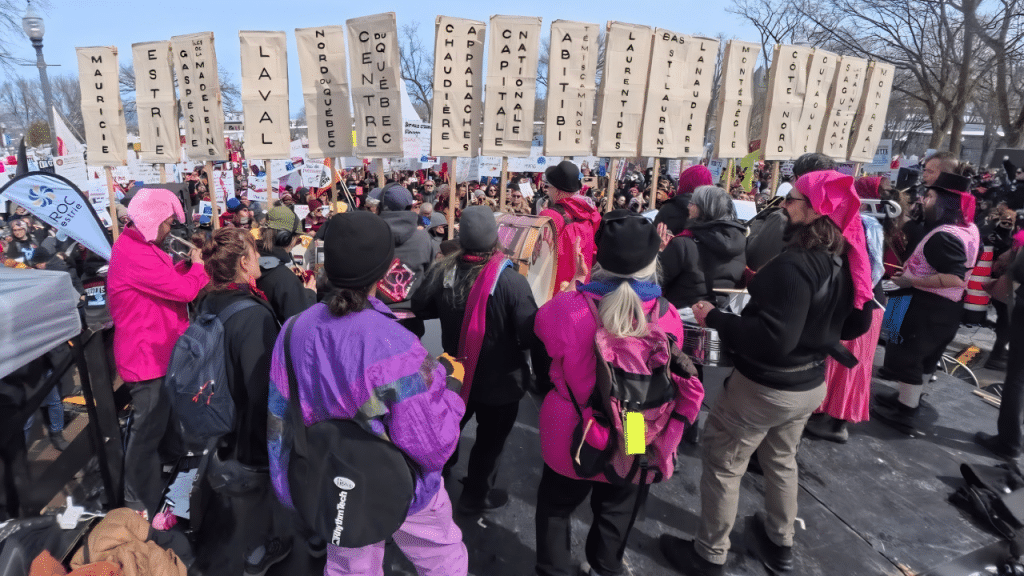
Ten thousand workers from the community sector stood in front of Quebec’s National Assembly on April 2. Decades of underfunding have led to mass burnout, low wages, and a reliance upon cheap labour to compensate for underfunded social services, they said.
As workers essential to the country’s social safety net struggle to get by, they’re often ignored and underfunded by both provincial and federal governments.
Mathieu Gélinas works in Shawinigan, Que. He and Caroline Chartier, co-spokespeople for the movement “Le Communautaire à boutte” (roughly translated as “The Community Sector is Fed Up”), discussed the struggles they were facing: no money, burned-out staff, and an endless cycle of applying for grants and worrying that they’ll run out of money.
From that first conversation, they started organizing Quebec’s community sector, and eventually it turned into a two-week-long strike. Their demands were for immediate financial aid.
“We’ve been working on this movement for a year now… Among grassroots groups who expressed anger at the underfunding and the lack of resources to deliver our essential services,” said Gélinas.
He and Chartier discovered the sector was too busy applying for grants and trying to survive to work together.
The problem of a lack of cooperation between non-profits has always been present. Although many discussions and conferences have taken place with this as the central focus, collaboration is rare and surprisingly difficult.
“We don’t organize as well as we should, and that remains an ongoing kind of topic of conversation,” said Lisa MacDonald, editor of Hilborn Charity E-News.
“The whole sector revolves around a scarcity mindset that all dollars should be going to the charity in question… 90 cents on the dollar should be going to that cause,” she said about the industry.
Because of the mindset that all collected funds should go to the work, there’s no room for investing in leadership or paying a living wage.
MacDonald said she believes a lack of leadership in the sector is leading to less collaboration.
“My concern is that we have not sufficiently trained our leadership to lead and make the kind of changes (we require),” she said.
“A lot of people talk about the fact that they fall into working in philanthropy… They kind of fall into it but don’t necessarily have any training on how to be a leader… Not everyone is a leader.”
In MacDonald’s view, because the non-profit world is passion-driven, it often lacks sufficient training or education to be as effective as possible.
Joy Smith thinks there’s also too much criticism in the sector, lobbed between organizations.
“You know, people need to learn to work together instead of criticizing,” Joy Smith, founder of the Joy Smith Foundation and former Conservative MP, said.
“There is a normal competition happening because people are fighting for organizational survival,” said Paloma Raggo, a professor at Carleton University and researcher in philanthropy.
“What prevents organizations from collaborating is that they’re punished for it… they’re punished because they have to compete to survive.”
Organizations that are struggling to survive are less likely to work strategically together around a larger issue, she said.
Smith described scenarios that were commonplace: two NGOs competing for the same funding within their sector, but the money was awarded to one of them and not the other.
She recalled how upset one was, but said the problem wasn’t that one was awarded grants over the other; it’s simply that there was no clarity about why it happened.
“I think the solution to this is for funders to explain why the funding was given to another NGO,” she said, adding that sometimes a funder will switch who they’re funding in an effort to help other groups.
Sector squabbles
This funding problem exists with both foundations and government funding, said Katherine Scott, researcher at the Canadian Centre for Policy Alternatives.
Funding models are designed to cause this infighting, and the model is fundamentally unable to be resolved, she said, because “the way in which the government funds ensures precarity.”
Canada’s current model is top-down and contract-driven, in which the government sets priorities and invites the sector to compete for funds that are often restrictive, short-term and do not cover full costs. In this way, non-profits are often treated as contractors rather than partners, according to the Canada Grants Database funding guide.
Ideally, the work of the non-profit sector should be what is a “coproduction approach,” said Nick Mule, professor at York University.
In this model, governments and NGOs jointly design and deliver social policy, rather than the government setting direction from above.
The approach would mean NGOs work closely with the public sector and both are considered equal stakeholders, he said.
Instead of one-off consultations, it would involve ongoing, structured collaboration between civil servants and sector leaders.
“And so, with civil servants, with bureaucrats, meeting on a regular basis, sharing the work back and forth, what’s happening on the government side, what’s happening in the sector side, and how can they support one another.”
With constant collaboration, the government could adopt a decentralized approach involving those stakeholders to better liaise with hundreds of thousands of practitioners already on the front lines and use their real-time knowledge to meet emerging needs.
It’s a model that has worked, to varying degrees of success, in Western and non-Western countries to improve the efficiency and efficacy of public services, according to a 2016 study.
This type of approach requires trust between the government and the third sector, Mule said, but over the decades, little has been developed.
Thus, the sector remains in the lurch.
When co-operative advocacy worked
However, successful attempts at pushing the government to make large policy changes have worked before.
For example, in 2008, there was a breakthrough on the Registered Disability Savings Plan thanks to sector organization and advocacy.
“The RDSP movement was organized around the former conservative government of Stephen Harper, and then-finance minister, the late Jim Flaherty,” said Rabia Kedhr, the national director of Disability Without Poverty (DWP).
Flaherty, who had a child with a disability, supported their proposals, said Kedhr.
B.C. disability advocate Al Edmanski was instrumental in lobbying the federal Conservatives under Harper to introduce the RDSP, which gave parents or guardians of a disabled child or people with disabilities a new way to save with no tax on money earned through those savings.
Afterwards, said Kedhr, he helped DWP get established and stepped back to strictly advise and guide them.
To do it, they had to build trust with people within the government, she added.
DWP continued their work, lobbying Trudeau’s government during their first mandate to pass the Accessible Canada Act, which established a legal framework designed to identify, remove, and prevent accessibility barriers within federal jurisdiction. The Trudeau government’s 2020 throne speech also talked about financial security for people with disabilities.
The community saw their opportunity, said Kedhr.
“Now we need[ed] to mobilize to make sure that it’s a promise that’s not forgotten.”
However, when Trudeau called a snap election in 2021, it cut much of the progress the community had made under the Trudeau government, he added.
Instead of quitting, they “mobilised again. We brought together artists, entertainers, famous Canadians with disabilities to also help influence and engage people. We issued an open letter signed by 200 prominent Canadians calling on the federal government to bring forward the legislation to end disability poverty,” Kedhr said.
They launched guerrilla marketing campaigns, created tools for disabled people to speak with politicians, which helped hold the Trudeau government to account, he said.
DWP organized a campaign in which 70,000 postcards circulated across the country, calling on former finance minister Chrystia Freeland to create a fund to help lift the disabled community out of poverty.
In 2023, the Canada Disability Benefit was created. The benefit provides up to $200 per month to people with disabilities.
Despite their success in advocating for the benefit, the amount was much less than desired, said Kedhr.
“Of course, an inadequate benefit was budgeted and delivered,” Kedhr said.
The money barely helps with a week or two of groceries for most people, never mind special accommodations that need to be installed in someone’s home, he said.
Patty Hajdu, the federal government’s current jobs minister, said the current amount is intended as a supplement.
“Provincial benefits are far below the poverty line to begin with,” Kedhr said. Adding $200 monthly on top of that doesn’t move the dial for most people with disabilities.
After 20 years of pushing, Kedhr said the group will continue to advocate for the community.
So why aren’t non-profits working together in a more coordinated effort? Quite simply, it’s the structure of finances, said Raggo.
“Us academics feel from studying the sector that resources are definitely the core of the problem. You’ll see that they’re asking for even more funding. Ideally the same level funding (as the increases in costs), that’s the big challenge a lot of the non-profits face across Canada,” said Raggo.
Correction: An earlier version of this story misspelled Hilborn, Lisa MacDonald’s name and misattributed a statistic to her. This has been updated.
To fully grasp the problem with resources in the sector and the competitive, uncollaborative direction, the financial structures of the non-profit industry must be dissected: Where does its funding come from, and how much money is truly flowing through the third sector? Watch for the second story in this series on Wednesday.
Your job. Your mission. Your news.
With your support, the sector you're building gets the journalism it deserves, and you get a tax receipt.

Author

Related Articles

Show your cards: Quebec entrepreneur urges young customers to vote in the upcoming elections
Historically, youth aged 18-34 have the lowest voter turnout in provincial elections, according to Elections Canada.

Deadline looms for non-profits, charities to report ‘foreign principals’ to Ottawa
Charities, non-profits and institutions must now register any arrangements with foreign principals working to effect government behaviour

Explainer: The divergent fix-it paths of Ontario and B.C.’s condo oversupply problem
Both provinces have too many tiny, shoebox condos, but both are taking different approaches to fixing it.
