Disbursement quota change released extra $711 million into charitable sector: Imagine Canada
New research into the impact of the disbursement quota changes has found that 1,190 foundations, primarily private, were affected. According to Imagine Canada’s principal researcher David Lasby, these foundations would previously have been “disbursing below the levels required by the new quota.”
Why It Matters
The impact of the disbursement quota (DQ) policy change has been challenging to measure: there have been changes to how organizations report to the CRA, existing issues with incomplete and/or missing data, and the calculation for the DQ itself requires data from the 24 months prior to a given fiscal period. Sector experts say that ongoing research is required to continue presenting a full picture of disbursements.

A federal policy change to the disbursement quota (DQ) appears to have led to more than $700 million in new funding over the last two calendar years, according to Canada’s largest charity advocates.
The DQ, which refers to the new amounts that charities and foundations must spend on charitable activities and grants, is reported as part of the the Registered Charity Information Form (T3010).
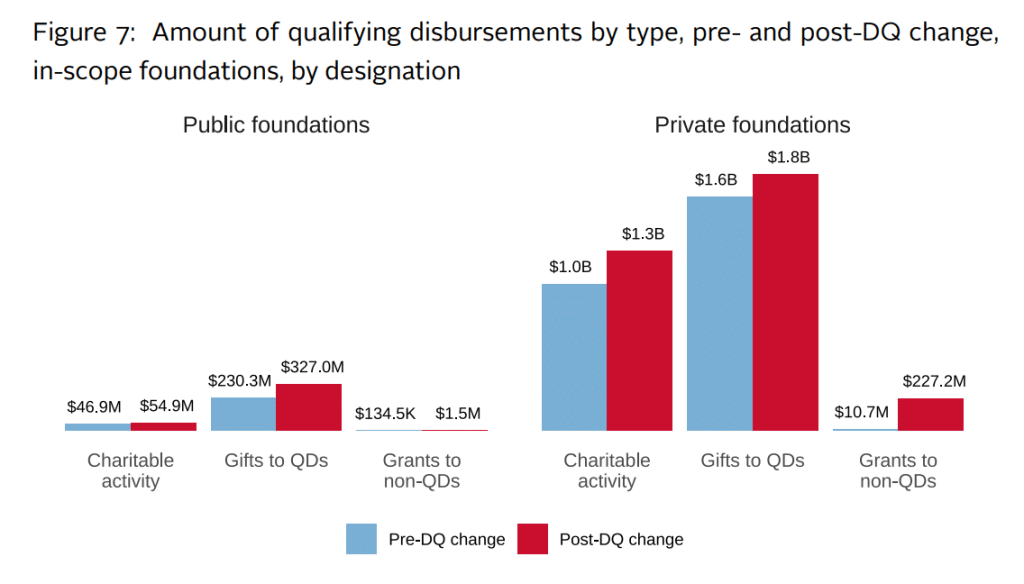
According to David Lasby, principal researcher at Imagine Canada, this was mostly driven by private foundations making disbursement increases: of the $711 million, private foundations accounted for $605 million.
“This is actually somewhat lower than might be expected,” he added, as private foundations account for the majority of non-charitable property held by all the foundations impacted by the DQ policy change.
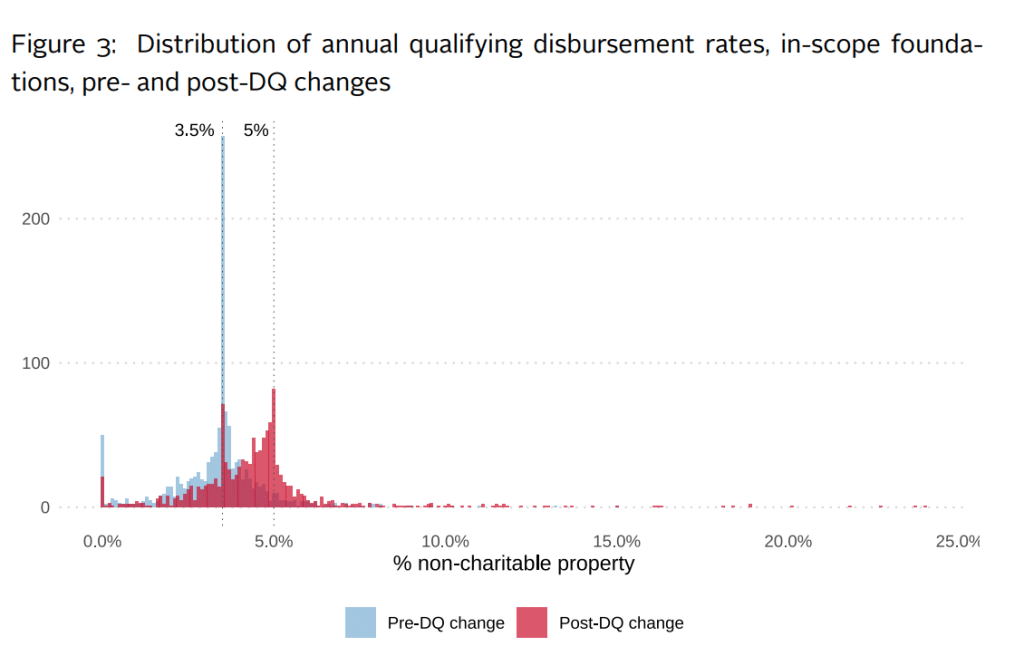
The change refers to an announcement made in Budget 2022, wherein a charity or foundation with assets exceeding $1 million would be required to make disbursements that totalled 3.5 per cent of the first $1 million held ($35,000), and 5 per cent of any assets above $1 million.
The change, which went into effect in January 2023, is intended to reduce the gap between the growth of investment assets held by foundations and charitable spending released to communities.
Imagine Canada’s analysis – released on Wednesday with a specific focus on the policy’s impact on foundations – shows that there were 2,920 foundations with more than $1 million in assets and property that are not used for charitable activity, thereby qualifying for inclusion in the disbursement quota.
Of those, 1,190 were considered “in-scope” for Imagine Canada’s research about the impact of the DQ change, as prior to the policy change, they would have been “disbursing below the levels required by the new quota.”
Lasby and the Imagine Canada team plan to continue to add to this research as further T3010 forms are filed in subsequent years. He added that it is challenging to ascertain the exact impact of the policy change based on only two years of data.
“It’s going to take more time for this to fully play out.”
Philanthropic Foundations of Canada (PFC) welcomed the findings, and its president and CEO, Jean-Marc Mangin, echoed the need for ongoing data.
“A year from now, we’ll be in a much better place to answer some of these questions.”
Foundations “appear to be taking time”
Charities and foundations are required to calculate their own disbursement quotas and report them on their annual T3010 forms. They are also required to report total expenditures on charitable activities, grants to qualified donees, and grants to non-qualified donees.
The total of these three values, when compared with the organization’s disbursement quota, will show whether it is in excess or short of its DQ for a given fiscal period.
Of particular note in Imagine Canada’s research was the rise in giving to non-qualified donees from private foundations, said Mangin, adding that the number could reflect new giving, or a reclassification of existing granting partnerships.
Foundations “can draw on disbursement quota excesses from the five previous fiscal periods to help it meet a shortfall,” according to CRA guidance.
“If no excesses are available to draw on, the charity can try to spend enough the following year to create an excess that it can carryback to cover the shortfall.”
The CRA also says that “continuous shortfalls may lead to a revocation of a charity’s registration.”
One of the key findings from Imagine Canada’s research was that more than half of the foundations that would have been impacted by the DQ change failed to meet their new DQ in the first year of reporting.
“Many foundations appear to be taking time to increase their disbursements to their new effective rate, apparently intending to use excess disbursements in future years to cover current shortfalls,” Lasby wrote.
The required increase also “followed a period with relatively poor investment performance, which likely explains some part of why so many foundations did not meet the new requirement.”
Overall, 80 per cent of foundations in-scope for this research increased their disbursement rate in 2023 and 2024, with private foundations increasing by 1.5 per cent and public foundations by 2 per cent.
According to data collected by PFC in the lead up to the policy change, “foundations have a strong record of responding responsibly to regulatory requirements over time, generally exceeding minimum requirements, adjusting to policy changes as intended, and increasing disbursements during times of need.”
PFC cited data from years prior to the DQ change: “between 2018 and 2020, 63 to 75 percent of foundations granted more than the disbursement quota requirement, and the average payout from 2010 to 2018 was 0.7 per cent higher than required by the rate.”
Lasby warned that additional data is required to fully understand the impact of the DQ policy change, especially on foundations’ investment portfolios, investment returns, and transactions related to property not used in charitable activities.
“Things that we see as gaps are really along the lines of: Why might there be challenges of dispersing at this level? What do foundations investment portfolios look like?,” Lasby said.
“What is a reasonable assumption for what asset growth should be? What is a reasonable risk-adjusted turn for a well-investment foundation that has been responsible with its money?”
“Our position from the start is that this is more than the disbursement quota,” Mangin said.
Further insight is also required on endowments and foundations’ incentives to increase impact investing, he said, adding that PFC members and external partners of the organization are part of a coalition to explore this further.
PFC conducts an investment survey each year to better understand where investment portfolios are, their composition, and where impact investment is flowing to.
A federal review of the disbursement quota is due to take place in 2027.
Your job. Your mission. Your news.
With your support, the sector you're building gets the journalism it deserves, and you get a tax receipt.

Author

Related Articles

Protecting rural housing: Saltbox Fund founder on the power of lending circles
KJ Conyers-Steede is piloting a peer-to-peer community financing model that can be scaled and replicated across rural Canada.

How philanthropy can uplift affordable housing
A new affinity group hosted by Philanthropic Foundations of Canada (PFC) will bring together foundations with deep expertise in funding housing, as well as those that might be new to the space.

$65K raised for BC Children’s Hospital in support of Heated Rivalry star’s comments
A birthday fundraiser for actor Hudson Williams brought in $65,000 for BC Children’s Hospital.
