
Mastercard Foundation makes historic $500 million commitment to Indigenous education. Will it be Indigenous-led?
Mastercard Foundation’s pledge is likely the largest-ever private philanthropic commitment to support Indigenous communities in Canadian history.
Why It Matters
Less than 1 percent of all philanthropic donations in Canada support Indigenous charities. A new donation commitment of $500 million could provide a dramatic boost to the capacity of a cohort of Indigenous initiatives across the country.

Mastercard Foundation’s office, located at 250 Yonge St. in Toronto in Sept. 2021 (Google Images)
This journalism is made possible by the Future of Good editorial fellowship covering the social impact world’s rapidly changing funding models, supported by Future of Good, Community Foundations of Canada, and United Way Centraide Canada. See our editorial ethics and standards here.
On Tuesday, the Mastercard Foundation, Canada’s only ‘mega foundation’, pledged $500 million to support Indigenous education, employment and entrepreneurship initiatives across the country.
The funding, offered through the foundation’s “EleV” program, aims to support 100,000 Indigenous young people with their education and career goals, according to a foundation press release.
While the Mastercard Foundation, with assets of nearly $40 billion, focuses its work predominantly on youth education and employment initiatives on the African continent, this initiative is focused squarely in Canada.
Donations will flow to support more than 45 Indigenous-led organizations across the country in addition to Canadian post-secondary institutions that are “working in deep, sustained partnerships with Indigenous communities,” according to the foundation press release.
“The Mastercard Foundation seeks a world where everyone has the opportunity to learn and prosper,” said Reeta Roy, CEO of the Mastercard Foundation, in the release. “Our EleV program is a commitment to work as partners with Indigenous young people and communities to transform education and employment systems based on their visions and values, in ways that revitalize their languages and cultures.”
Sharon Redsky, a fundraising consultant and researcher says the donation commitment is a “great step forward” for the foundation and will offer much-needed support to Indigenous-led organizations that have been under-resourced by settler-led foundations in Canada.
This year, Redsky co-authored a report, which analyzed all donations made by foundations and charities to other charities of over $30,000 dollars in 2019, the last year for which near-complete information is available. Though Indigenous people comprise about 4.9 percent of the population, Redsky and her team found that just 0.7 percent of all donations went to Indigenous organizations in 2019 — $60 million of a total of $9.6 billion.
Indigenous education, too, says Redsky, has been “neglected.” The federal government, she says, does not provide adequate financial support for education for Indigenous communities, forcing nations to make near-impossible decisions, including about which students to prioritize for tuition funding for post-secondary.
Redsky says Mastercard Foundation’s pledge “raises the bar,” in Canadian settler philanthropy, demonstrating to other institutional philanthropists that multi-digit contributions to support Indigenous-led work are possible.
Shereen Munshi, partnerships and strategic communications manager for The Circle on Philanthropy, an Indigenous-led philanthropic initiative, said by email, she, too, is hopeful this action encourages other settler-led foundations to “give abundantly to Indigenous-led organizations, and give directly to communities and nations.”
Munshi added that she is also hopeful the Mastercard Foundation will focus their resources on initiatives Indigenous people want to see funded: “It is crucial that the funds are directed toward educational endeavours that are identified as a priority by and for Indigenous peoples — not only for supporting post-secondary and other Western focused learning environments. This includes funds dedicated to land, language and culturally focused healing.”
Jess Bolduc, executive director of the 4Rs Youth Movement, an Indigenous-led non-profit, too, agrees, saying by email, she hopes Mastercard Foundation supports projects focused on the “resurgence of Indigenous education, pedagogies, institutions, and economic infrastructure so that Indigenous youth have choice and can determine what path they would like to choose.”
“Otherwise,” she says, “we risk only creating pathways where Indigenous youth’s success [or] impact is being defined solely [by] how they are able to navigate colonial spaces and capitalist systems.”
Future of Good asked the foundation for an interview to inquire about the sorts of projects that will be funded, but staff were not able to arrange one by press time. The foundation’s press release did not specify which sorts of educational or career programs will be eligible for funding, however, the foundation’s website lists 16 organizations that have already received funding through the “EleV” stream.
Among Indigenous-led organizations, Inuit Tapiriit Kanatami, a national Inuit organization, has been funded to explore the potential development of an Inuit university. Indigenous Clean Energy, a non-profit organization, too, has gotten support to power career-building experiences for Indigenous young people in the clean energy field. The Seven Generations Education Institute, an Indigenous-led post secondary institution, has also received foundation dollars to, among other projects, embed Anishinaabe teachings, worldview and language in their programs.
Mastercard Foundation has also offered funds to several post-secondary institutions through the “EleV” funding stream, including the University of Manitoba, the University of Lethbridge, and Yukon University.
Beyond what gets funded, one Indigenous leader who spoke with Future of Good also offered her hopes for how the foundation engages with Indigenous people.
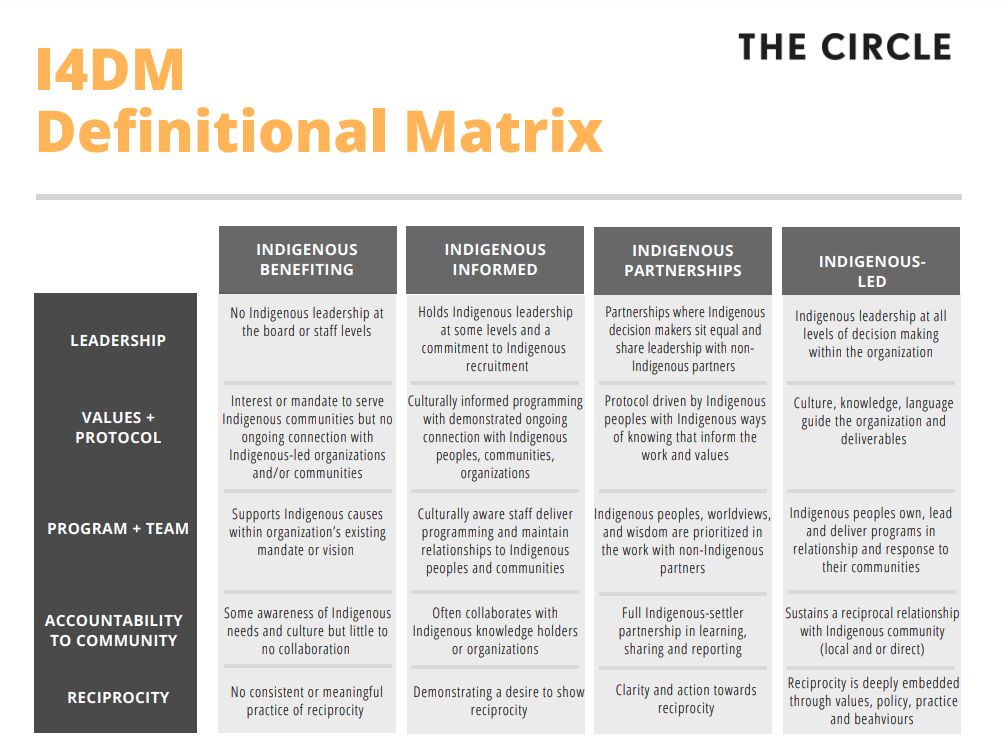 The Circle on Philanthropy’s “I4DM matrix” tool identifies approaches that an organization would need to take to be considered “Indigenous-led,” including that Indigenous people hold leadership roles within all levels of the organization where decisions are made. (The Circle)
Will Mastercard let Indigenous people lead?
Like her colleagues, Victoria Grant, co-creator of the Indigenous Peoples Resilience Fund, welcomed Mastercard Foundation’s announcement, but stresses she hopes “EleV” is led by Indigenous people.
“I think the money is great…If you put $500 million into 100,000 youth, I think that has the potential to make a huge difference,” says Grant. “I just really hope it is Indigenous-led…and that the values come from the communities themselves.”
Indigenous-led, as defined by The Circle on Philanthropy, is about who is calling the shots — but also the approach and relationships between funder and fundee.
According to the organization, an institution is “Indigenous-led” if: Indigenous people are involved at all levels of the organization’s decision-making; Indigenous values and protocols guide the organization and its deliverables; an organization’s programs are designed by and responsive to Indigenous communities; and if an organization is accountable to Indigenous communities and maintains reciprocal relationships with them.
When it comes to funding decision-making, available documents suggest it is up to Mastercard Foundation’s staff to identify local partners with whom the foundation could partner. In previous “EleV” funding, the foundation did not announce a call for grant applications, but rather, but relied instead on identifying, and building relationships with potential partners.
As with all foundations, any recommendations provided by staff would be up to the foundation’s board to approve. While the foundation has some Indigenous staff who lead relationship-building with partner organizations across the country, the board does not appear to currently include any First Nations, Inuit or Métis members.
The foundation is, however, a member of the Circle on Philanthropy; and a signatory to the organization’s “declaration of action” for the philanthropic community which includes a commitment to act by “building relationships with Aborigional peoples.” The foundation’s EleV program strategy also says the foundation works closely with Indigenous-led or informed partners in each region and that they are guided by a value of supporting Indigenous self-determination.
The list of funded projects, too, suggest the foundation is open to resourcing a range of different activities, including resourcing organizational capacity building. This may indicate that the foundation’s fundees play a leading role in shaping the objectives of the financial partnership.
Munshi, a Circle staff member, says she commends the organization on its large monetary commitment, but says “money alone is not enough” — noting that government, too, has a role to play; and that these efforts “must be accompanied by continued changes to education legislation that enables Indigenous-led education efforts in their own communities.”
Moreover, she says she’s orienting toward the commitment with the long-term in mind.
“The impact of these funds will not be measured in years and should be considered in multi-generational terms. We look forward to witnessing the ways in which Indigenous wisdom and solutions will be amplified as a result of this action.”
Related Articles

$65K raised for BC Children’s Hospital in support of Heated Rivalry star’s comments
A birthday fundraiser for actor Hudson Williams brought in $65,000 for BC Children’s Hospital.

‘Winnipeg Declaration’ calls on faith leaders to transform empty church land into affordable housing
A national call to action by Releven is asking leaders to repurpose their underutilized faith-based spaces and commit to solving homelessness by signing the Winnipeg Declaration.
Fighting predatory lending: West Coast credit unions join philanthropic effort
The DUCA Impact Lab has so far partnered with Ontario credit unions Kindred and Your Neighbourhood to fund its Escalator Loan program, which provides loans to people stuck in the payday loan cycle. Now, Vancity and Coast Capital will also be providing funding.