The systemic truth about Canada’s railways, and the Asian community that built them
Thi Dao here, long-time friend of Future of Good’s.
As a settler on the beautiful, unceded territory of the Syilx and Okanagan people, I recently had the privilege of speaking at a panel kicking off Asian Heritage Month, which is observed in May. The theme was “Heritage as Social Capital,” but the conversation quickly pushed deeper into how our sector handles systemic, historical truths.
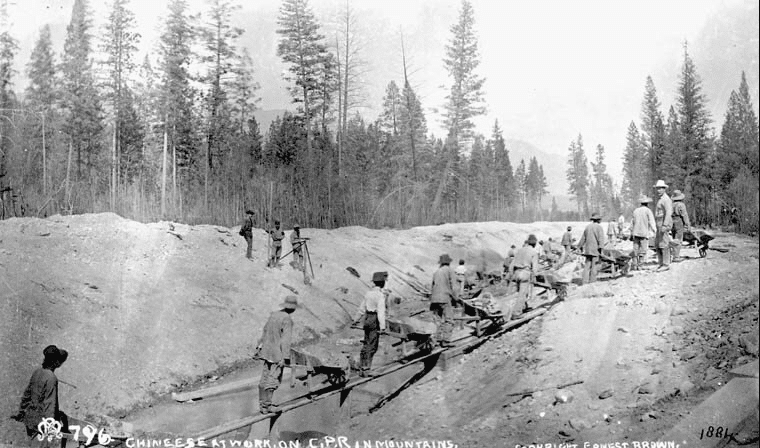
The most poignant moment for me was hearing from Shui Lee (李瑞棟), a fifth-generation Chinese-Canadian. He shared the legacy of his great-grandfather, who arrived in 1914 to build the Canadian Pacific Railway.
His wife and children could not come because the Canadian government’s discriminatory policies – such as the Chinese Exclusion Act and the Head Tax – imposed staggering financial penalties and outright bans designed to keep Chinese families from putting down roots. This forced his family, like thousands of others, to endure decades of painful, state-enforced separation.
According to Lee, between 1881 and 1926, about 17,000 Chinese labourers endured gruelling, unsafe conditions to build the railway, with about 4,000 losing their lives to workplace accidents, winter exposure, and illness. Shui pointed out to me that this translates to an undercount of 1 to 3 deaths per mile of track laid through the mountains. Beyond the dangerous physical labour, these workers faced deep-seated systemic, extreme racism and exploitation.
When B.C. issued its official legislative apology in 2014 for historical wrongs, Shui Lee—who was instrumental in securing that apology—noted that while financial compensation was offered, he turned it down. The goal wasn’t a transactional payout; it was a permanent, systemic acknowledgement of truth.
As a second-generation Asian-Canadian, that hit home. It reminded me that our presence in today’s social purpose spaces is the direct continuation of a long legacy of labour and grit.
If we want to transform systems, we cannot just “spotlight” solutions or tick a heritage month box once a year. We need connective tissue – ones that continue the lifelong work of those who quietly built the foundations of this province and this land.
Because truly resilient systems are built on relational capital — the foundational trust that bridges grassroots movements, cross-sector partnerships, and policy. And I think it’s time to be loud about it.
Moving forward, my goal is to ensure we are actively connecting investors, policymakers, and community leaders through this relationships-first lens. Let’s honour the stories that haven’t always made it into the official record, and remember that radical change takes form in more than just one month of the year.
I’m looking forward to more coffee chats across B.C. this season to discuss how we can build this deeper relational infrastructure together.
In solidarity,
Thi Dao
B.C. Regional Representative, Future of Good
P.S. Is your B.C. organization doing something in the social impact space that we don’t know about? Email me at [email protected].
Resource Ecosystem: Commemorating Asian Heritage
To help you deepen your relationship with Canadian history, support community joy, and access actionable toolkits for Asian Heritage Month, here is a curated list of history, art, and community-led solutions thriving amidst systemic barriers.
1. Cultural & Historical Anchors
- The Sunshine Valley Tashme Museum & Research Centre (Sunshine Valley, B.C.) This heritage site located on Canada’s largest Japanese-Canadian internment camp preserves the lived experiences of state-enforced displacement. To deepen its relational infrastructure, the museum just celebrated the grand opening of its brand-new Tashme Research & Archive Centre and the fully restored historic Tashme Kindergarten Schoolhouse on May 3, 2026.
- The Chinatown Storytelling Centre (Vancouver, B.C.) A state-of-the-art space dedicated to the foundational trust, community grit, and lived experiences of the trailblazers who built Vancouver’s historic Chinatown. It moves past static exhibits to honour the active, generational stories that didn’t always make it into official records.
2. Literature & Tools for Deeper Reckoning
- The Redress Project & Learning Resources (National Association of Japanese Canadians) Various toolkits for social purpose organizations looking to understand how institutional apologies can move away from symbolic, transactional gestures and toward true systemic equity and permanent truth-telling.
- Coquitlam Heritage: The Legacy of Chinese Railroad Workers (Coquitlam, B.C.) An invaluable historical archive detailing the systemic exploitation, wage gaps, and gruelling conditions endured by Chinese labourers building the Canadian Pacific Railway. This serves as a vital tool for understanding the roots of institutional racism in B.C.
- Yi Yi (Dir. Edward Yang, 2000) A cinematic masterpiece that explores the invisible connective tissue of family, generational divides, and modern alienation. By examining life through a tender, holistic lens, the film challenges Western, transactional ways of looking at human relationships and worth.
- Iron Road (CBC Mini-Series, 2009) A gripping historical drama that chronicles the dangerous, untold story of Chinese labourers who constructed the Canadian Pacific Railway through the Rocky Mountains in the 1880s. It visually captures the stark contrast between the exploitation of human labour and the immense wealth it generated for the province.
3. Feel Good’s: Radical Joy & Storytelling Amidst the Noise
- Living Hyphen: An intentional community and publishing platform that explores what it means to live in between cultures. Through their magazine, podcast, and cultural programming, they encourage courageous, tender storytelling that resists the pressure to conform to mainstream norms.
- The Tashme Project: The Living Archives Graphic Novel (Japanese Canadian Legacies, 2026) Julie Tamiko Manning and Matt Miwa, two Japanese-Canadian creators, turned hundreds of hours of interviews of their families’ stories into a one-act verbatim play back in 2009, tracing the oral histories of 20 Nisei who were at Tashme internment camp as children. You can access the beautiful graphic novel of this play online, illustrated this month, by local Canadian-Japanese artists.
- Cold Tea Collective: A media platform highlighting real, nuanced stories of the Asian-Canadian diaspora. By intentionally focusing on wellness, creative entrepreneurship, and generational healing rather than just trauma narratives, they redefine what it means to build modern social capital.
- South Asian Women’s Community Centre (SAWCC): A vital grassroots blueprint for relational capital in action. This community-led organization focuses on building safe spaces, cross-cultural solidarity, and strategic infrastructure to support South Asian women and families facing systemic barriers.
- Elimin8Hate: An advocacy arm of the Vancouver Film Festival that not only does crucial, front-line anti-racism advocacy, but also actively funds Asian-Canadian artistic grants, comedy showcases, and media representation workshops. They serve as a powerful reminder that true systemic resistance is deeply rooted in cultural joy, creativity, and collective healing.
Your job. Your mission. Your news.
With your support, the sector you're building gets the journalism it deserves, and you get a tax receipt.

Author

Related Articles


Dolly Parton’s greatest, most remarkable gift
Clever, kind and witty, she used her fame and her fortune to bless everyone else.