Community Land Trusts explained: Five answers to your pressing questions
Whether you’re a funder or a service provider, land trusts are a must-know
Why It Matters
Canada’s housing crisis spurs new interest in community land trusts. But, the size of the sector and relative obscurity of the land trust structure compared to other non-profit housing models means many interested Canadians don’t understand them well enough.

A previous gathering hosted by the Community Land Trust Summit, presented by the CNCLT.
Community Land Trusts are increasingly being touted as one of the solutions to Canada’s current housing crisis.
Articles and white papers have popped up in recent months, expounding on its democratic qualities and radical departure from the for-profit real estate market.
The first Community Land Trusts (CLTs) in Canada were incorporated in the ‘70s and ‘80s, but the sector remains small. The first national census of land trusts found 41 active CLTs earlier this year, but 11 were formed after 2020, and five were still unincorporated. Despite a flurry of academic research and media attention, funders, service providers, and other housing sector social impact organizations remain unfamiliar with the model.
Here, we walk you through the basics and offer resources to deepen your knowledge of this burgeoning new sector.
-
WHAT IS A COMMUNITY LAND TRUST?
A CLT is essentially an incorporated non-profit that owns land or housing assets and manages them in a unique, democratic way, according to its particular objectives. Although most CLTs are framed as a way to secure affordable urban housing, they can also be established to provide long-term cultural services or sustainably maintain natural environments with ecological, commercial, or cultural significance — the very first CLT was established in 1960s Georgia, U.S., by a group of Black farmers looking to secure land for agriculture.
The residents or users of a CLT make up its membership. These members manage their housing assets in different ways. They often try to cede some control to the community they’re based in, such as electing non-members from the neighbourhood to serve on the board of directors. They may also include external experts on their board. This more expansive board structure is one of the key ways many CLTs differ from other housing non-profits.
That said, a CLT can impose a more traditional structure on top of its democratic foundation. The 2023 national CLT survey revealed that housing units owned or managed by the sector were split between zero-equity co-operative housing, rental units, and resale-restricted homeownership units.
-
HOW FAST IS THE SECTOR GROWING?
The advocacy group Canadian Network of Community Land Trusts held its first conference for the sector from Oct. 19 to 22 in Toronto. Director Nat Pace said it showed a healthy, growing interest in CLTs.
“We have about 10,000 units of housing that are held by the CLT sector right now in Canada, but even in the next year, there’s another couple thousand that are anticipated to come through,” they said, citing survey data.
Of the 41 CLTs the survey identified, 16 were in Ontario. Nova Scotia and British Columbia came next with six and five CLTs apiece. Alberta, Quebec and the Yukon were the only other provinces and territories with CLTs, although one in Saskatchewan didn’t respond to the survey.
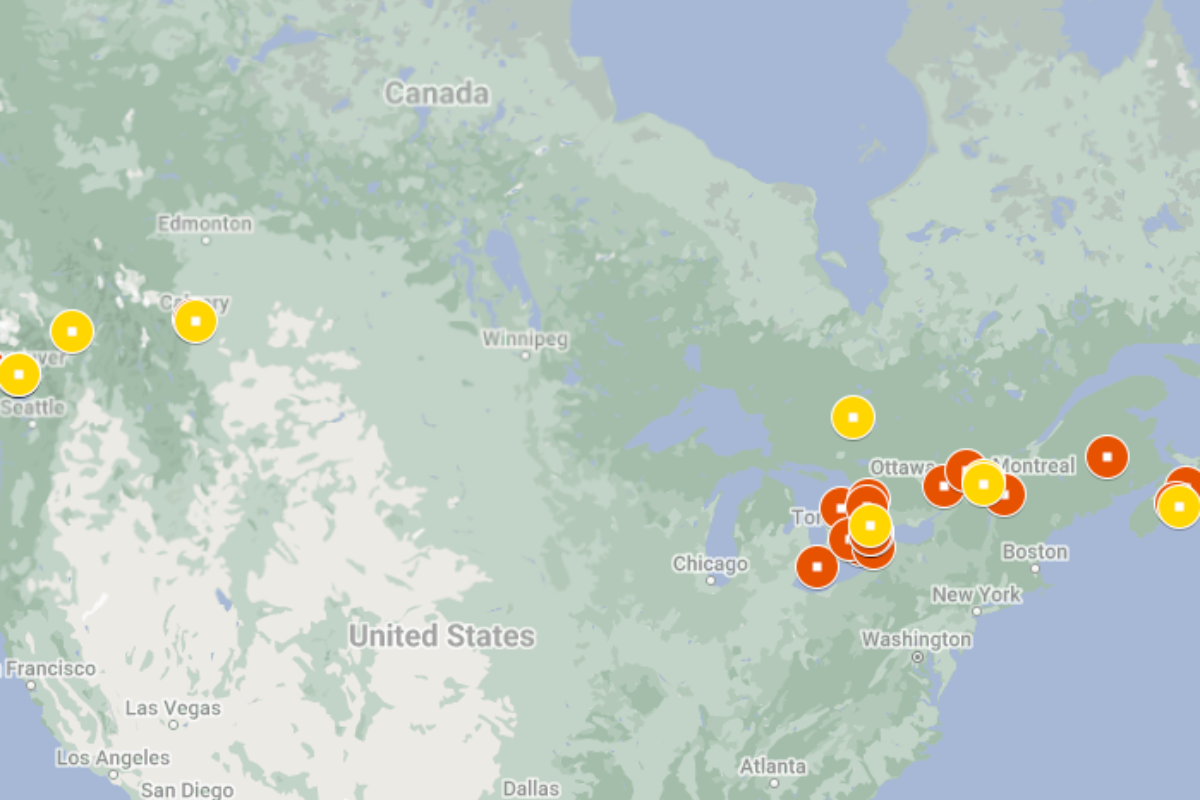
A screen grab of community land trusts represented on a Google Map in Canada. Canadian CED Network image.
-
HOW CAN CLTs HAVE SOCIAL IMPACT?
A CLT’s unique board structure is one of the critical ways non-members within a CLT’s service area can influence its operations. Although 20 CLTs provided the census with their board structure, 70 per cent reserved at least one seat for these community members, and 45 per cent committed one-third or more of all seats.
Many CLTs focus on acquiring affordable housing for marginalized groups, such as the Vancouver-based Aboriginal Land Trust run by the Lu’ma Native Housing Society or the Upper Hammonds Plains CLT in a historic Black Nova Scotian community outside Halifax.
Board hiring is also working towards diversity. Among the 24 CLTs who provided board demographics to the census, racialized people held 28 per cent of seats and women and gender-diverse people had 59 per cent.
-
HOW DO CLTs ACQUIRE LAND AND GROW THEIR PORTFOLIOS?
In their pre-acquisition planning, CLTs may be supported by grants or donations. They can make their first real estate purchase through the traditional bid process or by philanthropic gifts, but these are rare. CLTs are more likely to purchase land at below-market rates from governments or obtain long-term leases on government-owned land. For example, in April 2022, the City of Toronto transferred 81 single-family homes and small buildings from their non-profit affordable housing provider to the Parkdale Neighbourhood Land Trust.
In the long term, CLTs can sustain themselves through tax rebates, fee exemptions, lease fees and operating subsidies. There is also a growing interest in using social finance instruments that reinforce the democratic values of the CLT structure, like community bonds.
-
WHAT ARE THE BARRIERS FACED BY THE SECTOR?
The national census found that 67 per cent of CLTs still establishing their portfolio found a lack of stakeholder awareness about their model to be a barrier to that first acquisition. Nearly half also said insufficient funding for social services related to housing was a barrier, compared to just 17 per cent of CLTs with real estate portfolios. These established CLTs were more likely to report a lack of government funding as a barrier to acquisition.
Part of the issue is that Canada lacks a concrete definition of the minimum requirements for a CLT, Pace says. Some CLTs are created by grassroots organizing, and others by government mandate. Some CLTs reserve board seats for non-members in the community, while others don’t because they supplement their legal framework with a co-op structure to maintain housing units, which have their own board requirements.
Canada Mortgage and Housing Corporation, the federal affordable housing investment body, circulated a survey to CLT sector leaders asking for their preferred definition, Pace says. However, they had already been holding meetings with the members of their CLT network to find an appropriate description.
“Hopefully [the definition] comes from us, but it’s going to have to get the go-ahead from [the government],” they said.
Editor’s note: A previous version of this article incorrectly stated the five current land trusts were incorporated. In fact, 36 are incorporated and five are unincorporated.
Your job. Your mission. Your news.
With your support, the sector you're building gets the journalism it deserves, and you get a tax receipt.

Related Articles

Partnered Partnered content The dirt on cleaner farms: Regenerative agriculture reshaping Canada’s farming future
Farmers see higher profits and healthier soil when moving to regenerative practices, but face financial and policy barriers to making the transition.

Partnered Partnered content Les microcours ont pour but d’aider les Canadiens à acquérir des compétences professionnelles sans frais
Dans le cadre de l’ambition de RBC de doter les gens des aptitudes nécessaires pour réussir, nous aidons les Canadiens à s’adapter à l’évolution du marché du travail en leur offrant gratuitement des microcours et des outils de perfectionnement.

Partnered Partnered content Microcourses aim to help equip Canadians with job-ready skills at no cost
As part of RBC’s ambition to equip people with the skills for a thriving future, the financial institution is helping Canadians adapt to the changing job market with microcourses and upskilling tools at no cost.
