Few politicians are talking about Canada’s disability benefit: advocates want to change that
An estimated 73 per cent of people with an intellectual disability live below the poverty line.
Why It Matters
About eight million Canadians live with a disability, and yet accessibility has barely blipped on the radar during the federal election campaign. Advocates are fighting to change that.
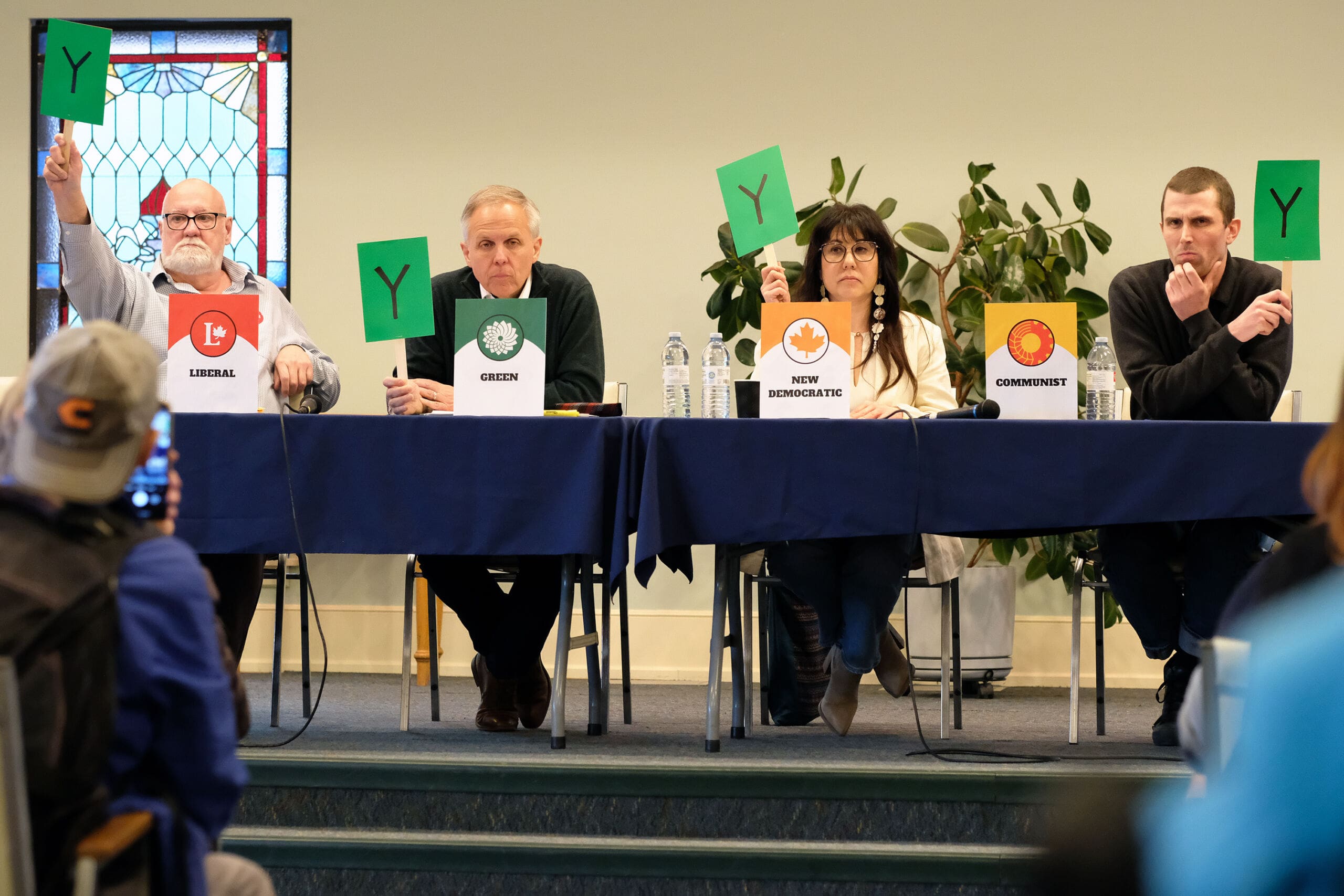
Ian MacIntyre of the Liberal Party, Gerry Gervais of the Green Party, Leah Gazan of the NDP and Cam Scott of the Communist Party take part in an election debate about accessibility at Winnipeg’s First Unitarian Universalist Church on April 8, 2025. (Shannon VanRaes/Future of Good)
Income remains the number one issue for many in Canada’s disability community, but despite increased economic uncertainty, the issue has received little, if any, attention during the first half of the federal election campaign.
“We need to talk about long-term issues, about systemic issues,” said Octavia MacIsaac, a regular speaker at Winnipeg’s First Unitarian Universalist Church, which hosted a recent all-candidates debate focused on accessibility.
“I am safe with housing and stuff, but so many people I know are not. And they have disability benefits, but like hell that’s gonna pay for your rent or like food. It won’t.”
Twenty-seven per cent of Canadians over the age of 15, or eight million people, live with one or more disabilities that impact their daily life, according to Statistics Canada.
That percentage has grown in recent years, partly due to an aging population and an increased prevalence of mental health-related disabilities.
Federal data suggests 28 per cent of people with severe disabilities live in poverty, but reporting by Inclusion Canada estimates 73 per cent of people with an intellectual disability living independently exist below the poverty line.
“I’m particularly disappointed with the Canada Disability Benefit,” said Melissa Graham, executive director of the Manitoba League of Persons with Disabilities, which organized the election debate.
“There was a lot of activism and a lot of community labour that went into the development of that benefit, and it’s nowhere near where we want it to be,” she said.
Some attendees expressed concern that Conservative leader Pierre Poilievre would cancel the benefit altogether if elected on April 28, noting the Conservative Party chose not to participate in the accessibility debate.
Others pointed out that Prime Minister Mark Carney’s new cabinet eliminated the position of Minister of Diversity, Inclusion and Persons with Disabilities.
When asked how his party would improve the Canada Disability Benefit, the Liberal candidate for the riding of Elmwood-Transcona, Ian MacIntyre, pointed to the Disability Advisory Committee, which has advised the Canada Revenue Agency since 2018, and apprenticeship programs, before taking aim at the Conservatives.
“All along the conservatives were saying, yeah, we support it, we support it, we support it until it got to the money. And then, on the budget, no, they voted against it. So that’s where they stand on disability,” MacIntyre said.
Cam Scott, Communist Party candidate for Winnipeg South Centre, said the Canada Disability Benefit should be doubled immediately but eventually replaced by a livable, guaranteed income.
“The entire situation, honestly, when confronted close up, seems careless and arbitrary and really dealing in insulting low sums that obliged people to make truly awful decisions between medical treatments and food,” he said.
The New Democratic Party also supports a guaranteed income for all Canadians, calling the existing benefit limited and restrictive.
“Unless provinces and territories exempt the (Canada Disability Benefit) as income in their calculations of social assistance, the benefit will leave people no further ahead,” said Leah Gazan, NDP incumbent for Winnipeg Centre.
Shortcomings
Inclusion Canada laid out the shortcomings of the Canada Disability Benefit last month, asserting the final regulations don’t meaningfully address poverty despite strong advocacy from the disability community.
“The Canada Disability Benefit was meant to be a game-changer in tackling poverty among persons with disabilities and their families,” said Inclusion Canada CEO Krista Carr.
“Continued reliance on the Disability Tax Credit as the primary eligibility criteria, and a maximum benefit amount of just $200 per month, will prevent thousands of people with disabilities—many of whom are already living in deep poverty—from achieving real financial security.”
Whoever forms Canada’s next federal government, Graham sees a fight on the horizon.
“I think there are still limits and tensions around our voice,” she said. “The Canada Disability Benefit really shows that, and the backlash to what we saw there shows that.”
With so much of the federal election campaign focused on economic concerns stemming from U.S. President Donald Trump’s many trade wars and threats of annexation, Graham said disability issues are getting lost in the discussion.
However, with both the Conservatives and Liberals signalling they would cut expenditures and shrink government if elected, Graham believes now is the time to force the issue.
When austerity is on the table, accessibility and disability supports are often cut, she said, noting that many of the programs political parties are pitching to voters are tied to employment—something many people living with a disability can’t participate in.
“People with a disability that can’t access labour are the first to get cut, the first to feel the tensions leading to terrible consequences.”
Some attendees pointed to the growing number of Canadians choosing medical assistance in dying, linking the trend to poverty and a lack of resources for those living with disabilities. Canada has one of the highest rates of medically assisted death in the world.
“We’re trying to make sure that we get candidates that will speak for us,” MacIsaac said.
“But we cannot stop talking for ourselves either … we have to protest, we have to rally, and we can’t let go.”
Your job. Your mission. Your news.
With your support, the sector you're building gets the journalism it deserves, and you get a tax receipt.

Related Articles

Partnered Partnered content How construction contracts became the blueprint for social change in Manitoba
Manitoba is a leader in social procurement, with decades of partnerships among government, businesses and social enterprises that have shaped a model other communities can learn from.
‘The need is endless’: Food insecurity highest in Canada’s Black, Arab and Indigenous communities
Food insecurity gaps aren’t closing, so community organizations across Canada are trying new ways to help beyond just providing food.
