How do we get people to care about climate change? Push hard, push fast, and don’t stop
Many are deliberately tuning out the news — protecting their mental health, managing eco-anxiety, and shielding themselves from vicarious trauma.
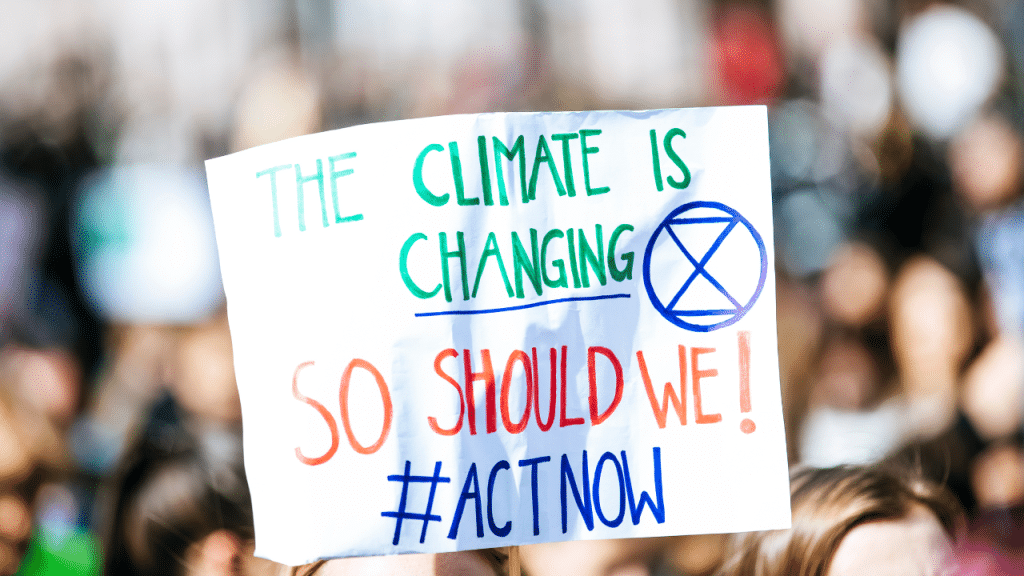
Two weeks ago, a young environmentalist asked me, “What does Future of Good do on climate?” It was a simple question that demanded a complex answer. The climate catastrophe is not just a story, but it’s an overwhelming crisis that is difficult to report on.
Google News initiative estimates that 42 per cent of people are news-avoidant. This stat is more acute with Generation Alpha, who are confronted with this existential problem with seemingly no effective leadership or solutions in sight. The solutions involve complicated systems, science and interconnections.
Gen Alpha are choosing to turn off the news, oftentimes for their own protection: for their mental health, their eco-anxiety, and to ensure that they don’t fall into vicarious trauma.
April 15, I was at an event on Parliament Hill, hosted by several senators and a few MPs on planetary boundaries. The people who are working on this topic are brilliant. You can watch it below.
Dr. Johan Rockström from the Potsdam Institute for Climate shared a lot of science on climate resilience and planetary boundaries, showing that the only certainty is that weather events will increase in frequency and magnitude, undermining the stability of Earth’s entire system.
The ocean is a heat sink that is currently absorbing about 90 per cent of emission-related heat. We’re basically shoving the heat under the carpet, and the planet is starting to lose its resilience. And yet, none of this is news. From a news cycle perspective, it’s happening glacially, while in geological terms, it’s instantaneous.
Dr. Courtney Howard told the crowd about how, as an emergency room physician, the patients triaged to the front of the line are those whose vital signs are nearing the end.
There is a saying, she said, in cardiopulmonary emergency work: Push hard, push fast, and don’t stop.” And this is what we need to do for the planet.
We need to agree on standard indicators informed by planetary boundaries, much as vital signs are informed by human health boundaries.
We then push hard to get them back into acceptable ranges? Where are we pushing fast, and how do we not stop?
Dr. Howard said she has seen firsthand the evacuation of her hospital, Yellowknife’s Stanton Territorial Hospital, to Vancouver as a wildfire caused an emergency evacuation order. The evacuation of a hospital, including patients receiving chemo and dialysis, as well as emergency care and so much more if highly complicated and disruptive, and it is not taken lightly. This evacuation shows how climate precarity and health care are intertwined.
Data or understanding the crisis is not the problem; the problem is a crisis of decision-making and governance, said Dr. Victoria Hearth, a pracademic and author on the leadership required to create a sustainable world.
The economy is meant to be a tool for transforming resources into the things we need, she said, but we’ve treated money as a proxy for wellbeing, yet we know that, above a certain GDP, additional money does not translate into increased wellbeing.
The question now stands: How do we put the right problem at the centre of the room? How do we discuss governance, which includes direction, oversight and accountability? How do we change into a different governance frame?
Catherine McKenna, former MP and federal environment minister, reminded us that Canada is a Petro-state. It’s a part of Canadian identity not frequently discussed.
So how does this turn into a story that engages? How do we create journalism that encourages people to tune in and be excited about the potential for change?
That’s the question I’d like to pose to our audience at Future of Good: what coverage do you need to feel hopeful and motivated about climate change?
Your job. Your mission. Your news.
With your support, the sector you're building gets the journalism it deserves, and you get a tax receipt.

Author