Explainer: What Canada’s new national sovereign wealth fund means for the social sector (and why it’s different than the other one)
The new fund could reshape national investment priorities, and the social sector has a stake in how it’s defined
Why It Matters
In one month, the Carney government launched two funds with similar names: the Build Communities Strong Fund and the Canada Strong Fund. One provides clear investment opportunities to the social sector, and the second is being designed and is open to public consultation. It is important to understand the difference.
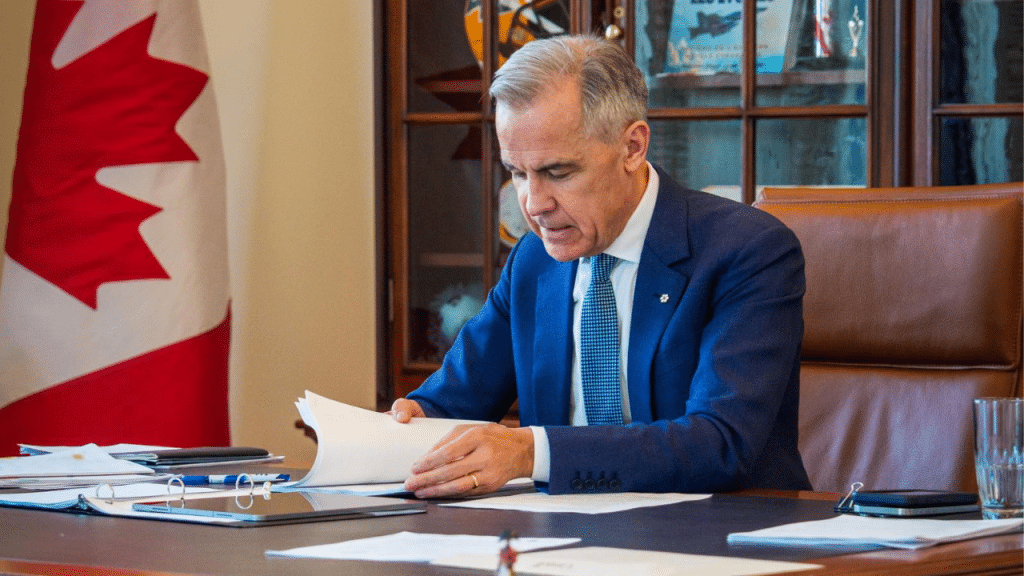
Canada crossed a symbolic threshold on Monday.
Prime Minister Mark Carney unveiled the country’s first national sovereign wealth fund — the Canada Strong Fund — backed by an initial federal commitment of $25 billion over three years.
This fund is a vehicle to co-invest with private capital in projects the government considers essential to the country’s economic future.
It joins a separate but easily confused initiative, the Build Communities Strong Fund, launched earlier this month.
Together, these two programs represent one of the most ambitious federal investment plays in a generation.
For the social sector, understanding the difference between them — and the question mark hovering over both — matters more than the headline.
Two funds, not one
The similar names are confusing, but each program’s purpose is distinct.
The Canada Strong Fund is a true sovereign wealth fund — a state-owned investment vehicle built to generate financial returns.
Rather than drawing on resource royalties like Norway’s famous oil fund, Canada’s will be seeded with public dollars and structured to take equity stakes in major projects alongside private investors – think LNG terminals, pipelines, mines, ports and trade corridors.
Fifteen projects have already been referred to the Major Projects Office for assessment, all in the extraction or heavy infrastructure industries.
The Canada Strong Fund will be run as an independent Crown corporation, insulated from day-to-day political direction, with a mandate to prioritize commercial performance.
Individual Canadians will be able to invest through a forthcoming retail product, with their principal protected — a mechanism still being designed through public consultation, according to the prime minister.
The Build Communities Strong Fund, by contrast, is a grants-and-transfers program — $51 billion over 10 years, flowing through provinces, territories, and municipalities to fund public infrastructure.
Critically, non-profits are explicitly listed as eligible recipients under certain streams, covering projects in health infrastructure, community spaces, climate adaptation, and local transit.
For any organization working in any of those areas, this program speaks directly to them. It is already open for expressions of interest.
The question the government hasn’t answered
Here is what neither fund’s announcement has resolved: what exactly counts as nation-building?
Right now, the answer the Major Projects Office is giving is narrow and extractive — the kind of nation-building that moves commodities to tidewater.
But that definition is not fixed. It is, in fact, actively contested. At the Liberal Party’s national convention in Montreal two weeks ago, delegates voted to adopt a resolution declaring energy efficiency a nation-building priority.
The resolution’s sponsor, MP Éric St-Pierre of Honoré-Mercier, made an explicitly social argument: that energy efficiency reduces the cost of living for the two million Canadian households in energy poverty, employs half a million workers whose wages circulate through local economies, and delivers particular benefits to Indigenous, rural, and northern communities.
That framing — efficiency as equity, not just economics — is a different kind of nation-building logic than LNG Phase 2. And it opens a door.
If the government pursues that resolution and incorporates energy efficiency into the sovereign fund’s investment mandate, the organizations best positioned to deliver on it are not multinational energy companies.
Instead, they are community housing providers undertaking deep retrofits, Indigenous-led energy cooperatives, and non-profit operators of social housing stock that, in many cases, is among the least efficient in the country.
That connection has not yet been made in any official document. The Fund’s mandate is still being written.
What the social sector can do now
The government has committed to a consultation process on the Canada Strong Fund’s mandate and governance over the coming months.
This is not a formality — the Fund is genuinely unfinished, and the definition of what qualifies as a strategic national investment is up for grabs in a way it rarely is.
Social sector organizations, particularly those working at the intersection of housing, energy, and community economic development, have a legitimate and timely case to make: that reducing energy poverty at scale, through community-rooted delivery, is as strategically important to Canada’s resilience as any pipeline.
The Spring Economic Update, to be tabled tomorrow, will offer the next layer of detail. But the real opportunity is the consultation that follows.
Your job. Your mission. Your news.
With your support, the sector you're building gets the journalism it deserves, and you get a tax receipt.

Author

Related Articles

New donation platform to help communities directly pay down mosque debt
Own Your Masjid is a project of boutique marketing agency Process Plus Marketing

Explainer: The divergent fix-it paths of Ontario and B.C.’s condo oversupply problem
Both provinces have too many tiny, shoebox condos, but both are taking different approaches to fixing it.

Elbows up: Spring Impact Capital calls for a giant spreadsheet of available early-stage Canadian capital
The Vancouver impact investor wants to crowd-source a free, national directory
