This article was produced in partnership with CECI.org. You can read our full editorial standards here.
Partnered Partnered content More time, more power: Sahelian women are ‘at the heart of the action’
The RÉELs project seeks to promote women’s empowerment by giving them the tools to succeed
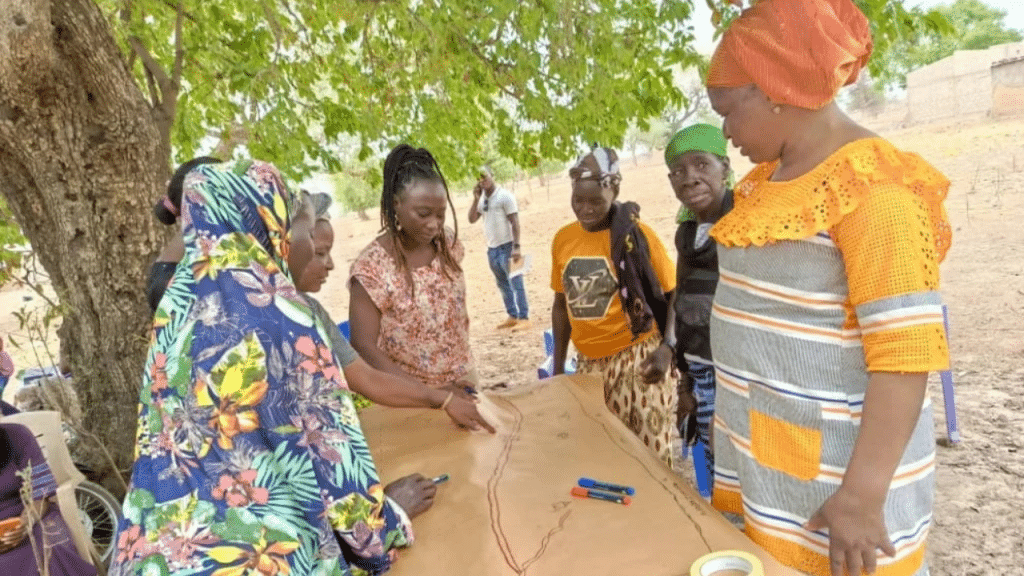
The Ecosystem Resilience and Women’s Leadership in the Sahel (RÉELS) project, led by CECI, has equipped Sahelian communities with solar mills, water points and improved stoves.
These resources are the driving force behind RÉELs’ holistic approach, which improves women’s access to means of production, strengthens their leadership, supports women’s economic organization, enhances local governance, and promotes adaptation to climate change.
To date, this project has touched the lives of more than one million women.
The RÉELs project seeks to reduce women’s vulnerability to climate change by developing their leadership and implementing more sustainable, better-suited agroforestry farming techniques in Burkina Faso, Mali and Niger.
Koumba Anouma, CECI’s Regional Director for Africa, says that the RÉELs project takes a holistic approach to addressing the multiple crises facing the Liptako-Gourma region, including climate change, poverty, and the impacts of forced displacement linked to terrorism.
“We know that women are often among the first to be affected by crises … but at the same time, it’s women who have many resources when it comes to finding solutions,” says the Director.
Ms. Anouma, a Sahelian woman herself, notes that providing tools to promote women’s success has significant ripple effects.
“When women are better organized economically, they participate more in discussions and community decisions, and this truly helps strengthen their leadership, as well as social cohesion in areas where communities are severely weakened by conflict and displacement,” she says.
According to a report examining the impacts of the RÉELs project in the Sio, Socoura, and Dandoli communes, 100% of the women surveyed in these three communes reported that the time they spend on unpaid tasks has decreased since the project began. They are saving between 2.5 and 3.5 hours a day. By reducing women’s workload, they can devote more time to community involvement, training, generating income, and resting.
Of the 104 people surveyed, 70.6 per cent say that social norms about women’s roles and status in their communities have improved with the implementation of pilot initiatives through the RÉELS project.
The impacts of this project are being felt in Kaya, Burkina Faso, where about fifteen women are asserting their independence as members of the Nayineré cooperative. They control every stage of their agricultural production, from sowing to the sale of grain products.
Mariam Soulga, who served as president of the Nayineré cooperative for five years, says that the solar-powered mill provided by the RÉELS project “is a joy.” With this mill, their agricultural production is even more efficient, profitable and hygienic.
Before, the women in the cooperative had to transport their grains to other mills, where their flour risked contamination from other grains milled there.
The solar mill is located next to the cooperative’s processing unit. This allows them to proceed directly with making their couscous, spaghetti, cookies, and baby food, which they then sell at markets and agricultural fairs. Since the mill is solar-powered, they don’t have to worry about electricity bills or the climate impact.
“There are no more residues (from other grains) to remove, and it’s cost-effective. It’s a financial gain, and we save time too. We’re thrilled,” says Ms. Soulga.
This increase in income has contributed not only to economic independence but also to greater confidence. Today, Ms. Soulga says she feels recognized and treated as an equal to men.
“Men are no different from me,” she says. “What men can do, I can do. Men can speak, can make decisions; I, as a member of the association, can speak, I can make decisions.”
The solar mill is ultimately just one aspect of the support provided through the RÉELs project. It also offers training on entrepreneurship, leadership, climate change, gender equality, and gender-based violence, which, according to Ms. Soulga, have enabled her “to be a female leader within her community.”
For Ms. Soulga, internally displaced people are part of her community. Thousands of people have sought refuge in Kaya, located about 100 kilometres from the capital of Burkina Faso, to escape the violence and political instability plaguing the country. To date, the RÉELs project has involved more than 151,000 internally displaced persons (IDPs) in its initiatives, including IDPs trained by members of the Nayineré cooperative.
“These people are now managing to get out of their situation,” says Ms. Soulga. “They’re also able to produce, process products, sell and market them, and earn an income—and that’s a real source of pride for us.”
Within the Nayineré cooperative, inclusion, participation and leadership are at the heart of its governance. There is a rotating presidency. Ms. Soulga has just passed on the title of president to a younger woman who will take over the reins. But her voice will always be heard—the team makes all its decisions collectively.
“Everyone participates. For this to work, everyone must feel included,” says Ms. Soulga. “Within the cooperative, all 15 of us, not a single woman is left behind. We’re all leaders.”
Together, they chose to use a local farming technique called zaï, which involves digging holes to retain water better and using only organic matter to fertilize the soil.
“To make it profitable and beneficial for the fields, we use these agricultural restoration techniques that help combat climate change,” says Ms. Soulga.
The women in the Nayineré cooperative care for their community beyond their farming activities. They organize sanitation days during which they clean health centres and collect trash. They plant trees and monitor them to ensure they grow and thrive during their reforestation efforts. Ms. Soulga sees these activities as part of the responsibilities of a committed citizen.
Ms. Soulga has even bigger plans for her cooperative: if Burkina Faso makes the consumption of local products a priority, this could lead to an expansion of their production.
“If everyone starts buying local, we’ll definitely move beyond being a cooperative to become a union—a large organization,” says Ms. Soulga. “If demand increases, we’ll need to produce more and process more.”
According to Ms. Anouma, initiatives under the RÉELs project, like the solar-powered mill in Kaya, demonstrate that “giving these women the means of production, decision-making spaces,
and climate-resilient solutions benefits the entire community.”
“It boosts income, but it also restores dignity, local governance, and social cohesion for the entire community, so it’s not just about money. And in the Sahel region, in Liptako-Gourma, where Canadian funding is being deployed, it allows us to act where there are immense needs and truly put women at the heart of the action,” she says.
Your job. Your mission. Your news.
With your support, the sector you're building gets the journalism it deserves, and you get a tax receipt.

Related Articles
Caste, corruption, and the collective: Crow’s Theatre’s A Fine Balance confronts India’s enduring inequities with humour and heartbreak
The Giller Prize-winning novel explores the realities of caste violence in India, which has been adapted into a powerful stage production in Toronto.
‘Canada must not go down that road’: More than 250 organizations demand investigation into CBSA after student protesters issued exclusion orders
The students were protesting after being denied post-graduation work permits they say they were eligible for when they enrolled at Portage College.
Half of Filipino immigrants to Canada are overqualified for their jobs: StatCan
‘For the relationship that Canada has with the Philippines, it seems like it’s lopsided.’
