Vancouver tests new app to map accessibility in parks and trails
The pilot program allows app users to identify barriers in city parks to help make outdoor spaces more accessible and inclusive for everyone.
Why It Matters
Access to parks and trails plays an important role in physical health, mental well-being, and community participation. These spaces are often overlooked in accessibility planning, which tends to focus more on indoor buildings and infrastructure.
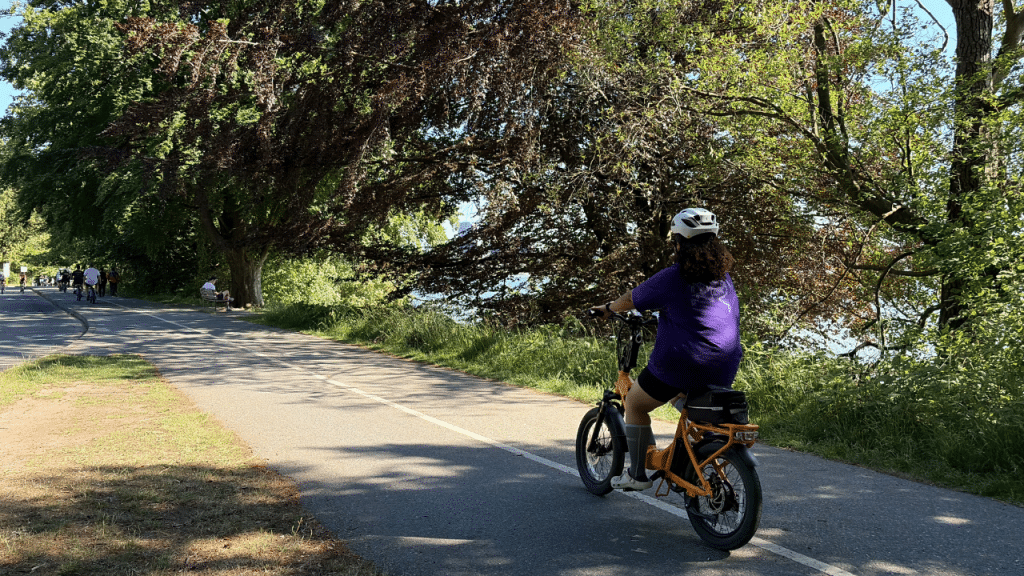
A cyclist uses a recreational trail in Vancouver’s Stanley Park, one of the parks where AccessNow tracking is available. (Abigail Turner/Future of Good)
The Vancouver Park Board has approved a pilot program to track the accessibility of parks and trails.
The initiative is launched through the app AccessNow and is available at four locations, including the internationally recognized Stanley Park.
Users can search, review, and share accessibility information about public outdoor spaces, providing detailed descriptions that help visitors plan their trips in advance.
Similar platforms have been used for buildings and other infrastructure, but applying the technology to parks and trails is unique, according to one advocate.
“I think more of this advocacy and a lot more of the legislative and regulatory requirements that governments and others are trying to meet have related to the built infrastructure like cities or transit systems, and less so to our parks and public spaces,” said Natalie Brown, senior director at Park People.
About eight million Canadians aged 15 and older live with a disability, according to a 2022 Statistics Canada survey.
Of those who have a disability, 56 per cent reported experiencing at least one accessibility barrier in public spaces during the survey year.
“Having public dialogue and talking about this is also good for this kind of social change,” said Brown.
“Through VanPlay, Vancouver’s Parks and Recreation Services Master Plan, we’ve committed to improving accessibility across our parks system, and this work helps move that forward,” said the Vancouver Board of Parks and Recreation in a statement.
“That insight will help guide future improvements and inform where we focus our efforts and investments to make parks more inclusive over time,” they added.
Vancouver is not the first Canadian jurisdiction to use digital tools to improve accessibility information – the city’s new pilot builds on a growing national trend.
In 2021, AccesNow began working with the TransCanada Trail to document access barriers on Canada’s largest trail network. In the following years, several operators made improvements to sections of their trail.
Similar initiatives include Calgary’s Pedesting navigation app, which allows users to identify barriers and plan routes before leaving home and The Atlas, a Canadian crowd-sourcing app that lets users report accessibility barriers.
Advocates say that while these tools can help people navigate barriers, they also improve mental health and community connection.
“In our cities, parks and other publicly accessible open spaces are very critical to wellbeing, not just to people’s physical health,” said Brown.
“We need places, obviously, to get outside and to walk and to connect with nature, but also to [improve] our mental health and our social health. We need spaces to connect to each other.”
Your job. Your mission. Your news.
With your support, the sector you're building gets the journalism it deserves, and you get a tax receipt.

Author

Related Articles

Half of Filipino immigrants to Canada are overqualified for their jobs: StatCan
‘For the relationship that Canada has with the Philippines, it seems like it’s lopsided.’
Partnered Partnered content How construction contracts became the blueprint for social change in Manitoba
Manitoba is a leader in social procurement, with decades of partnerships among government, businesses and social enterprises that have shaped a model other communities can learn from.