Canadian queer communities look for solutions to prevent Trump-style extremist targeting of 2SLGBTQ+ people, migrants
Queer Americans may seek asylum in Canada.
Why It Matters
Donald Trump's anti-2SLGBTQ+ pronouncements and policies risk pushing people back into the closet. But Canada isn't immune, advocates warn.
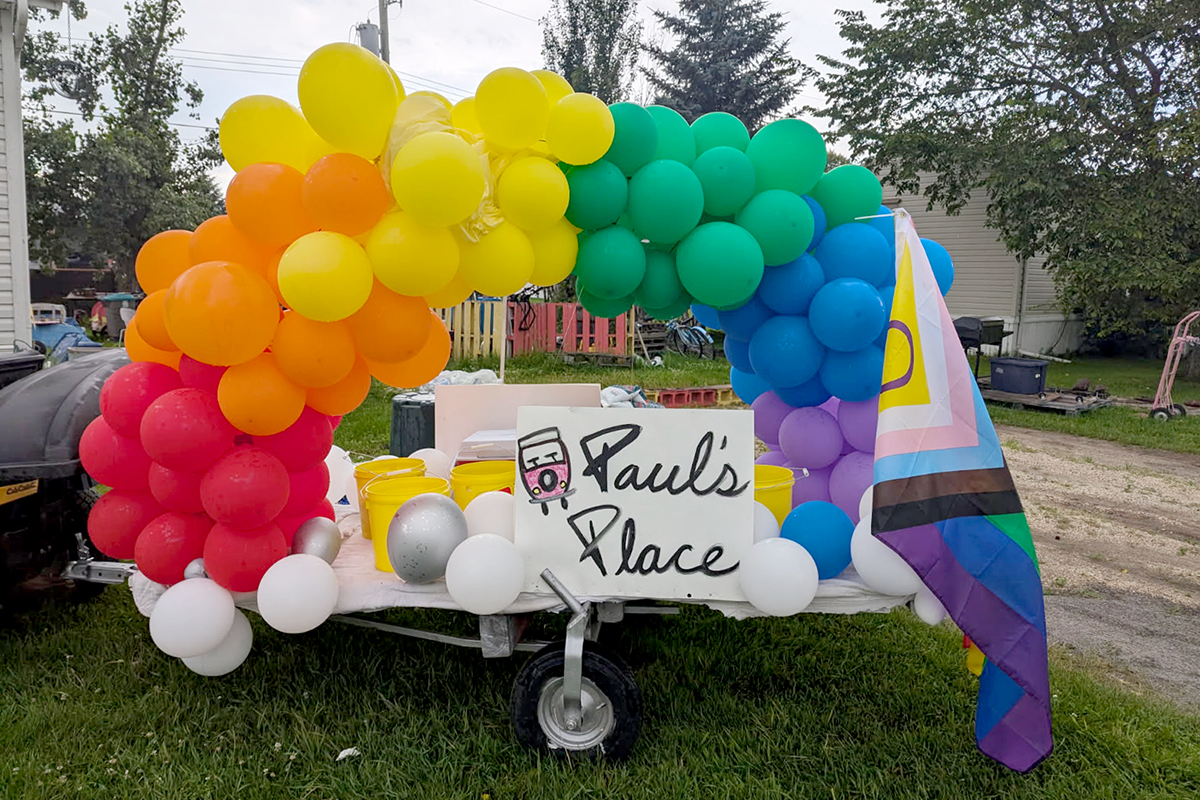
A pride float for Paul’s Place, a drop-in centre in Carman, Man. (Pauline Emerson-Froebe/Submitted)
In 2016, just after Donald Trump’s first electoral victory, Pauline Emerson-Froebe followed through on something many Americans only mused about: she moved to Canada.
“I lived 40-some years down there, I was educated there, my work was there, my wife’s work was there, everything we had was there,” Emerson-Froebe said from her home in Carman, Man., about 80 km southwest of Winnipeg.
“But we talked about it the morning after the election, and we decided Canada was the right choice.”
Her fears at the time—that the Trump administration would target 2SLGBTQ+ people and communities—were quickly borne out.
Just hours after the former reality TV personality was sworn into office in 2017, all mentions of 2SLGBTQ+ people and rights were stripped from White House websites.
Over the next four years, the American President, along with his vice president Mike Pence, would relentlessly attack sexual minorities, rolling back civil rights and protections in healthcare, education, government and the military.
Alphonso David, Human Rights Campaign president at the time, described Trump’s first government as “the most virulently anti-LGBTQ administration in decades.”
Now, Trump is doubling down, leaving 2SLGBTQ+ organizations and advocates in Canada trying to understand what this means for queer communities in both countries, and how to prevent it from happening here.
“It’s heartbreaking to watch,” Emerson-Froebe said.
“The pressure to go back in the closet is getting tighter and tighter down there.”
Hours after being sworn in for the second time, Trump signed an executive order erasing the existence of trans, non-binary and intersex citizens from federal websites.
In the days that followed, he defunded gender-affirming care for youth, then rescinded 78 of his predecessors’ executive orders—including Lyndon B. Johnson’s 1965 affirmative action order, prohibiting federal contractors from discriminating on the basis of race, colour, religion, sex, sexual orientation, gender identity, or national origin.
Trans women have also been banned from women’s sports, and diversity, equity and inclusion initiatives are now illegal in any government-supported setting.
Canada not immune to rhetoric
Canada is not immune to the hateful rhetoric that fueled Trump’s election, experts say, but will likely draw migrants looking for safety nonetheless, even as Ottawa works to curtail immigration drastically.
“There’s a huge panic right now,” said Aleks Dughman-Manzur, co-executive director of programming and advocacy at Rainbow Refugee and a past president of the Canadian Council for Refugees.
Hundreds of queer Americans, as well as asylum seekers from other countries, have reached out to Rainbow Refugee in recent weeks, looking for information about coming to Canada, they said, adding some 2SLGBTQ+ Americans will head north for safety, either as economic migrants or refugees.
“We’re also deeply concerned about the undocumented people and refugees who are in the U.S. currently who may want to come to Canada for safety because they will be at risk,” Dughman-Manzur said.
Trump’s anti-trans and anti-migrant policies mean people detained by the U.S. Immigration and Customs Enforcement Agency, better known by its acronym ICE, will be segregated based on biological sex at birth.
“That means a lot of women, trans women of colour and migrants in the U.S. are going be placed in male detention centers, which put them at really high risk of all sorts of violence,” Dughman-Manzur said.
Desperate migrants may also turn to human smugglers, they said, leaving them vulnerable to crime, violence and even death.
Canada trims the welcome mat
All this comes at a time when Canada has cut immigration targets and, by extension, reduced funding to many newcomer and refugee-serving organizations.
Last October, after months of heated, public discussion, Ottawa announced it would significantly reduce the number of immigrants entering Canada, setting a target of 365,000 permanent residents for 2027—a reduction of 135,000 from current levels.
The federal government also plans to decrease the total number of non-permanent residents by about 445,000 this year, followed by an additional 445,000 in 2026.
Two categories under the Private Sponsorship of Refugees Program have also been paused.
Tonya Callaghan, a professor and academic director for LGBTQ2S+ equity, inclusion and intersectionality at the University of Calgary, said folks in the queer community have often turned to private sponsorship to bring at-risk people to Canada.
It’s unclear how this pause on some private sponsorships will impact that.
Without sponsorship—and hemmed in by the restrictions of the Safe Third Country Agreement—some people may turn to irregular border crossings to claim asylum in Canada, she said.
People like Seidu Mohammed, who walked across the Canada-U.S. border and into Manitoba in 2016, desperate to avoid deportation to Ghana, where same-sex relationships between men are illegal.
He lost all his fingers to frostbite in the process.
Discrimination at home
“People from other parts of the world who are LGBTQ-identified and looking to escape their difficult country through the refugee route would probably still choose Canada over the U.S. But, you know, there are pockets within Canada that are not safe either,” Callaghan said.
She pointed to anti-trans legislation passed by the Alberta legislature late last year, limiting access to gender-affirming healthcare, banning trans people from competing in women’s sports divisions and requiring parental consent for name or pronoun changes in school settings.
New Brunswick imposed similar legislation in 2023, although Premier Susan Holt repealed it when the provincial Liberals formed government in 2024.
At the same time, Saskatchewan used Canada’s Charter of Rights and Freedom’s notwithstanding clause to pass legislation targeting trans youth.
“We are absolutely not immune to these forces that we see in the United States. And that’s why who you have in power is so, so important,” said Callaghan.
“Because, when you have a figure like Donald Trump saying the things that he does …it just emboldens people who already harbour those hateful beliefs: misogynist beliefs, racist beliefs, sexist beliefs, homophobic, transphobic and ableist beliefs to act.”
“It makes things extremely dangerous,” she said.
Trump rose to power through pointed fear-mongering, and trans people, in particular, have become the president’s primary focus, said Callaghan.
“It is extremely depressing and worrisome.”
There is also widespread concern Canada’s next federal election, expected to be called early this spring, will see political leaders pivot toward so-called wedge issues like diversity, equity and inclusion.
Human rights organizations have raised the alarm over comments made by Conservative Party leader Pierre Poilievre, stating trans women have no place in women’s bathrooms, changing rooms, shelters, sporting competitions and other places—comments very similar to those made by Trump and his supporters.
“Not only does this shameful rhetoric put trans and gender-diverse people at further risk; it obscures the realities of gender-based violence in Canada,” said Elishma Khokhar, a gender rights campaigner.
“Amnesty International Canada wholeheartedly condemns any attempt to scapegoat members of the 2SLGBTQQIA+ community to score political points. We call on all political leaders to end the spread of harmful disinformation.”
Like Trump, Poilievre also denies the existence of any gender beyond “man and woman.”
His comments on the issue have drawn praise from some conservative American pundits.
However, with the emergence of new, external threats to Canada’s economy and sovereignty, there is some hope that federal politics will now pivot towards addressing tangible geopolitical concerns and away from what American sociologist James Davison Hunter calls “culture war.”
Building bridges, not walls
As a trans person and lawyer born to Palestinian parents in Chile, Dughman-Manzur said they will work to build bridges with whoever leads Canada’s next federal government.
“No matter what government comes into power in Canada, the concern is always that there’s going to be a continuation of the erosion of the rights for refugee protection and also for the rights of trans and non-binary people,” said Dughman-Manzur.
“We are willing to have conversations across the board with anyone who is in government to try to advocate and make the case for our communities. We’re willing to work across the political spectrum.”
They noted it was the Conservative government of Stephen Harper that launched a pilot program aimed specifically at assisting LBGTQ asylum seekers in 2011.
“We are very pleased to be working with the Rainbow Refugee Committee to help refugees who are in need of protection, particularly those who are persecuted because of their sexual orientation,” Canada’s minister of citizenship and immigration said at the time.
That pilot project evolved into the Rainbow Refugee Assistance Partnership in 2020 under the current Liberal government.
While it’s tempting to focus on problems tied to structural power at times of political change and uncertainly, Callaghan said she takes heart from “the beautiful microphysics of power bubbling up from the bottom.”
Repressive regimes build strong resistance movements, said Callaghan.
“They’re not going to be quiet and silent; they’re gonna be like, oh, no, no, no … you’re not gonna do that to us. Here’s how we’re going to rally and protest against this.”
Dughman-Manzur remains hopeful, even in dark times.
“As a Latin American, I am very much embedded in what solidarity means,” they said.
“So, I do have hope in human nature and believe that we will somehow come together to understand that my liberation is linked to everyone else’s liberation and that we are here to liberate each other and not to oppress each other.”
Back in Southern Manitoba, Emerson-Froebe said the decision to relocate to a small farming town in the province’s bible belt wasn’t undertaken without trepidation.
However, the president of Pembina Valley Pride and driving force behind Paul’s Place, a queer drop-in space, said that 98 per cent of the people she’s met have been “nothing but lovely and accepting.”
“Canada is not a perfect place,” she said. “But in our experience, it’s better … we don’t feel like we have to watch our back so much.”
Yet Emerson-Froebe cautions that rights are also fragile, adding that American ideologies and political trends often make their way north.
“So we’re sort of just on guard, knowing that that may happen … keeping an eye on things and trying to be there for each other and not let anyone fall into the shadows.”
Callaghan shares in that idea of precarity.
“I’ve been researching this since 2004, and what I see is a pendulum swinging constantly back and forth, left to right, left to right, left to right,” she said.
“There are some people who believe in progress, that we’re constantly progressing and everything’s getting better all the time. I personally don’t believe that … it’s a constant battle.”
For those looking to support 2SLGBTQ+ people and communities, Callaghan said now is the time to reach out to their gay, lesbian, trans and gender-diverse friends and let them know that they’re wanted and appreciated.
She said small acts, like taking someone out for coffee or challenging misinformation repeated by friends or family, can be very meaningful.
Emerson-Froebe agrees.
“Allies, this is one of the times when you need to turn the title into a verb,” she said. “Check in on your queer friends. Check in on all friends from marginalized communities.”
Your job. Your mission. Your news.
With your support, the sector you're building gets the journalism it deserves, and you get a tax receipt.

Related Articles
‘The need is endless’: Food insecurity highest in Canada’s Black, Arab and Indigenous communities
Food insecurity gaps aren’t closing, so community organizations across Canada are trying new ways to help beyond just providing food.
Controversial Palestine exhibit opens at Canadian Museum for Human Rights
The exhibit, called Palestine Uprooted: Nakba Past and Present, drew criticism even before it opened at the national museum in Winnipeg.
Vancouver tests new app to map accessibility in parks and trails
The pilot program allows app users to identify barriers in city parks to help make outdoor spaces more accessible and inclusive for everyone.
