Cooking up opportunity: Co-ops, worker-led business models helping newcomers thrive
Flavours of Hope and Culture Links Co-op are reshaping newcomer experiences through food, translation, and worker-owned models
Why It Matters
A s Canada welcomes hundreds of thousands of newcomers annually, grassroots organizations like Flavours of Hope and Culture Links provide vital pathways to belonging, economic independence, and cultural pride. These initiatives don’t just launch businesses—they build resilient communities, challenge systemic barriers, and redefine what inclusive entrepreneurship looks like.

Finding a taste of home can be difficult when you move to Canada, but Flavours of Hope has a delicious way to help. (Flavours of Hope/Supplied photo)
When you move into a country as large and diverse as Canada, it can be difficult to find a taste of the familiar.
Trixie Ling was born in Taipei and has called many places home, including Taiwan, Singapore, and the U.S. before setting down roots in Vancouver. But it was here, where she launched Flavours of Hope, an organization helping newcomer women establish and run food businesses in the city.
“It’s so isolating when you move to a new country by yourself and you don’t know anyone,” Ling said.
“What we’re trying to do through our food business program is really helping women to integrate and flourish, to be a leader, to be able to be proud of their own culture.”
It’s a labour of love stemming from her own immigration experience, paired with her passion for bringing people together over food, stories, and entrepreneurship, she said.
While Canada aims to bring in about 400,000 new permanent residents in 2025, it can be difficult for newcomers to find their path and community in the country’s most populous, highest cost-of-living cities where many first settle.
What began as a project to gather women from different cultures at food events in 2018 blossomed into a non-profit that’s helped launch 20 businesses owned by newcomers from Chile, Venezuela, Peru, Colombia, Mexico, Morocco, Syria, and Egypt nearly seven years later, with cohorts of five new businesses annually.
“It became an empowering pathway for [newcomer women] to be able to make money doing something that they love, doing something that brings them joy and actually brings them a connection to home,” Ling said.
Flavours of Hope, in addition to marketing and other crucial food business skills, provides workshops and events on topics including anti-racism, decolonization, and cross-cultural communication so newcomers feel more supported facing challenges, especially as sentiment toward immigration shifts.
In 2024, a poll revealed that 58 percent of Canadians believed the country accepts too many immigrants.
“I couldn’t help my mom because I was just a kid,” Ling said, explaining she witnessed her mom struggle in isolation without community care and resources.
“But I’ve worked with so many immigrant women along the way … and I always see food as a way for women to be able to build their own connections and friendships, and also many of the women I work with want to earn money to support their family.”
Alongside the fresh empanadas, pozole, and Jamaican patties that come out of the organization, Ling said she is proud of creating opportunities for newcomers to find purposeful work that allows them to “be their own boss.”
She added that helping the women in her community builds momentum, spreading far past the business owners.
“A big part of helping women build the food business [is that] it becomes their family business, and the whole family is involved,” said Ling.
“So many of these women that we support, the whole family is involved, whether they’re involved in the kitchen production, selling at markets … and actually bringing their family closer together.”
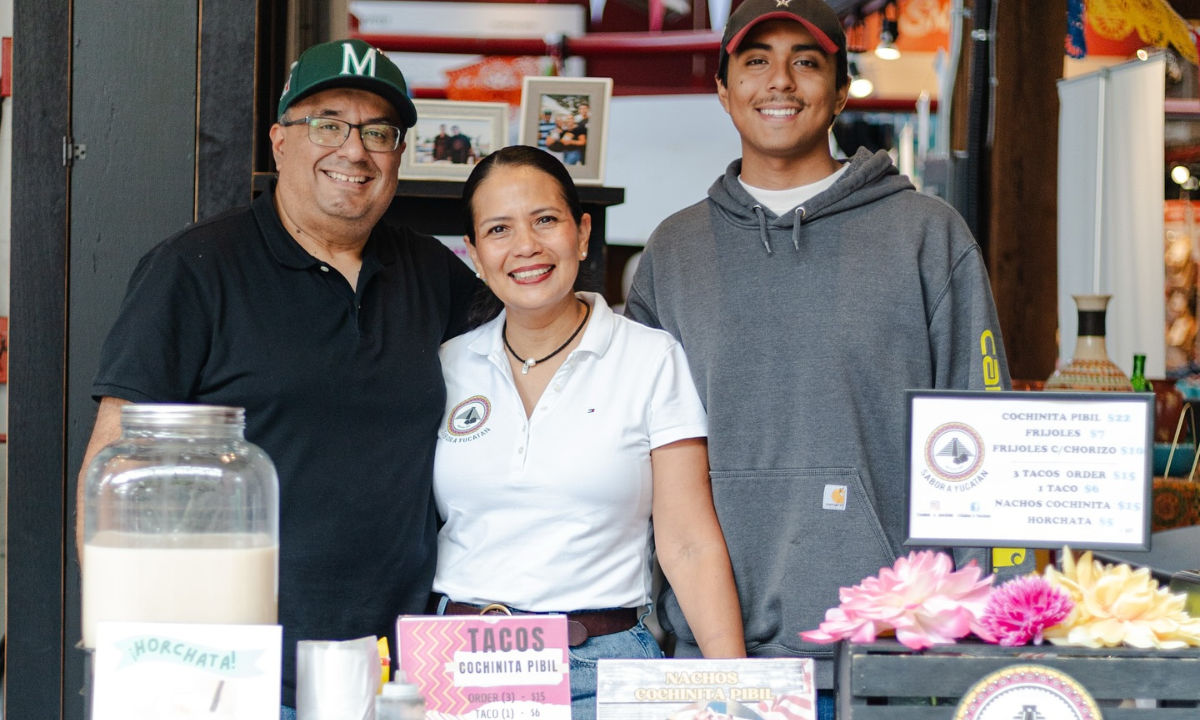
Trixie Ling, middle, working at a pop-up cafe at Granville Island. (Flavours of Hope/Supplied Photo)
Recently, Flavours of Hope set up a pop-up cafe at the bustling Granville Island where several of the food business cohort share business space and responsibilities.
Ling worked at the cafe’s counter on Chilean Independence Day selling empanadas from Ruka Cocina on Sept. 18.
“Chilean people came out just to get her empanada and they were so happy and joyful, just the fact that they can find something that reminds them of home,” Ling said.
“It’s such a hard industry, the food business. The profit margin is so tight,” she added. “Building a community is so key. For any business, to succeed, to flourish, to grow, you need a sense of community.”
While Flavours of Hope is directly helping newcomers establish small businesses, there are others working behind the scenes to help newcomers overcome hurdles and establish better models for workers.
Culture Links is one, a newcomer-owned co-operative providing translation services.
“Culture links has been, for everyone on our team, their first job in Canada,” said Culture Links’ Co-Founder and Executive Director Iva Jankovic, who was born in Serbia and raised in Vancouver.
Speaking Serbian, Spanish, and English, Iva is familiar with both the newcomer and the Canadian experience, which she brings to her work developing co-operatives which she calls, “structurally radical.”
Jankovic said she helped found the group when she realized there was a gap in the kinds of ongoing translation resources and mentorship services she needed for the organizations she was managing.
“We had gotten some grant funding to start a program, which was about making co-operative development materials more accessible for newcomers,” Jankovic said.
“I quickly realized that existing translation services were insufficient for the needs of a program such as ours.”
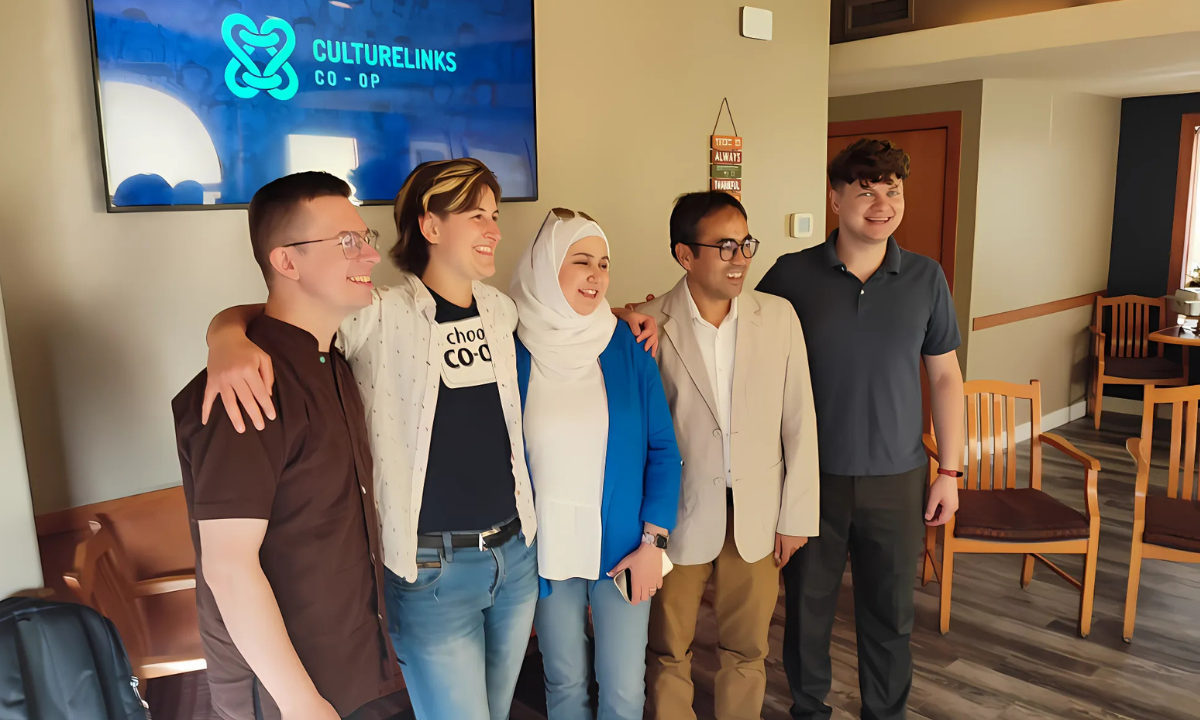
Staff at Culture Links Co-op pose for a photo. (Culture Links/Supplied photo)
Culture Links’ six-person team now provides translation services in Arabic, Ukrainian, Mandarin, Farsi, and more, tailoring services to customer needs.
For example, when they translated food business workshops for Flavours of Hope, they translated Arabic and Spanish live in the Zoom chat, instead of interrupting the speakers.
“It’s brought together people with really diverse experiences, and also everyone, myself included, are from immigrant backgrounds, and most are actually from refugee backgrounds,” Jankovic said.
“The way that it’s created a safe space for people, and seeing them flourish in Canada has been really cool to witness.”
As a worker co-operative, Culture Links pays individual interpreters more (vastly different from other translation work often done by newcomers), and workers have a stake in the company.
“There’s also the advantage of ownership,” Jankovic said.
“Instead of [the company] being owned by a couple of shareholders, it’s owned by the people that actually are involved and that are directly working in the co-op on a daily basis.”
Culture Links is not the only co-operative that’s working; they are part of Solid State, based in Surrey, B.C., which calls itself a “co-operative of co-operatives” committed to supporting one another.
Solid State provides resources to 32 new and growing worker co-operatives so far, including The Cleaning Coop, which pushes against the exploitation of janitorial workers, often racialized women, with a worker-led model. Their goal is to launch up to a dozen co-ops annually, all owned and operated by racialized or migrant worker-owners.
Co-ops are working across Canada, too. In 2022, there were 5,616 co-operatives in Canada generating $66.19 billion, holding $50.5 billion in assets, employing 102,038 people, and paying $2.86 billion in wages.
“The co-op sector for a long time has been kind of aging and mostly seen as a thing of the past, or a thing that only older and whiter folks are part of,” Jankovic said.
“I’ve really seen that change in the past couple of years. Now there’s a whole resurgence of the co-op model being applied in all these creative ways and in different communities.”
Your job. Your mission. Your news.
With your support, the sector you're building gets the journalism it deserves, and you get a tax receipt.

Related Articles

Half of Filipino immigrants to Canada are overqualified for their jobs: StatCan
‘For the relationship that Canada has with the Philippines, it seems like it’s lopsided.’

Partnered Partnered content How construction contracts became the blueprint for social change in Manitoba
Manitoba is a leader in social procurement, with decades of partnerships among government, businesses and social enterprises that have shaped a model other communities can learn from.