Humanitarian organizations push for ceasefire in Gaza amid “horrifying” civilian casualties
More than 9,200 Gazans and 1,400 Israelis have been killed since Oct. 7.
Why It Matters
The Canadian government has announced millions in humanitarian aid for Gaza, Israel and the West Bank, but without a ceasefire, aid agencies won’t be able to deliver it.
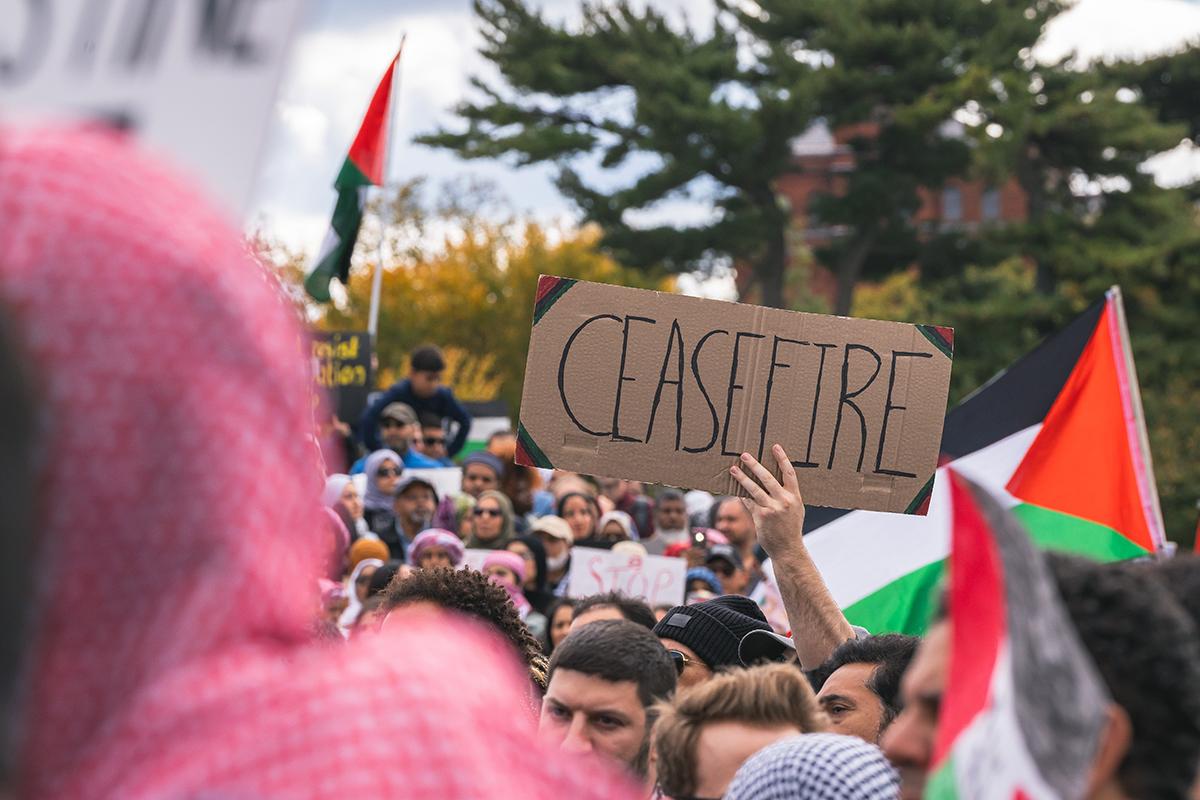
People call for a ceasefire in Washington, DC. Photo: Gayatri Malhotra
Humanitarian aid agencies are calling on the Canadian government to push for an immediate ceasefire in Gaza, where nearly 9,300 people, including more than 3,700 children, have been killed by Israeli airstrikes in recent weeks.
Humanitarian Coalition, whose members include Oxfam Canada, Save the Children Canada, World Vision Canada, Islamic Relief and others, described the bombardment of civilians as “horrifying.”
“The taking of hostages, civilian hostages in particular and especially children … has to be denounced,” said Humanitarian Coalition’s executive director, Richard Morgan.
“But equally, we have to denounce the strikes in Gaza that have overwhelmingly led to civilian casualties, have struck civilian infrastructure, and are depriving many people in Gaza of the basic essentials that we all need to live.”
“It’s for that reason that we’ve been calling for a ceasefire.”
Canada’s Minister of International Development Ahmed Hussen has announced $60 million in humanitarian aid for “Israel, the West Bank and Gaza,” allocating funds to the World Health Organization, the World Food Programme, the Palestine Red Crescent via the Canadian Red Cross, UNICEF and the United Nations Relief and Works Agency for Palestine Refugees in the Near East so far.
The federal government will also match all donations made to Humanitarian Coalition until Nov. 12.
But without a ceasefire, it’s unclear how Canadian aid will reach those who need it most.
Gaza’s borders were sealed on Oct. 9, two days after the militant wing of Hamas breached a concrete wall surrounding the 41-kilometre-long strip of land — home to Palestinian families displaced by ethnic cleansing during the creation and expansion of Israel — killing 1,400 Israelis and taking more than 220 hostages.
Morgan said about 80 per cent of Gazans relied on humanitarian aid before the current escalation in violence but that only a trickle of supplies has entered the territory, home to 2.3 million people and eight refugee camps, in recent weeks. Gaza has been subject to an Israeli land, air and sea blockade since 2007.
“Our members already had prepositioned stockpiles of essentials, ready-to-eat food, water hygiene kits and so on. So, they’ve been busy distributing those as best they can,” Morgan said, adding coalition members are still delivering some cash-based programming despite working in an active conflict zone.
“We’ve been fortunate that so far, our member agencies are not reporting any casualties directly among their team members,” Morgan said. “But everyone has lost somebody in terms of family or friends.”
The United Nations Relief and Works Agency reports that more than 70 of its staff members working in Gaza have now been killed.
“I reiterate my strong appeal for an immediate humanitarian ceasefire, together with the unconditional release of hostages and the delivery of relief at a level corresponding to the dramatic needs of the people in Gaza, where a humanitarian catastrophe is unfolding in front of our eyes,” said UN secretary-general António Guterres in a recent statement.
Canadian officials, including Prime Minster Justin Trudeau, have called for “humanitarian pauses” but have stopped short of calling for a ceasefire. Canada also abstained from voting on a UN General Assembly emergency resolution calling for an “immediate, durable and sustained humanitarian truce” in Gaza.
Only when Israel stops bombing Gaza, and Hamas and Islamic Jihad stop firing rockets into Israel, can humanitarian assistance begin to flow adequately, said Morgan. He also expressed concern about recent bombings in the West Bank, which has 19 official and four unofficial refugee camps. More than 130 Palestinians have been killed in the occupied territory since Oct. 7.
Without a ceasefire, Morgan said a further humanitarian catastrophe looms on the horizon in Gaza, triggered by tightly crowded people in shelters lacking water and sanitation facilities.
“You’ve got shelters that were designed for between 300 or 3,000 people that now actually have 20,000 to 25,000 people in them, with maybe four toilets; it’s completely unsanitary,” he said.
“You can imagine the risk for the spread of cholera, or even for that matter, something as simple as diarrhea, which is so harmful, particularly among children under the age of five.”
Medical relief agencies, like Doctors Without Borders, have also drawn attention to the crisis facing healthcare facilities in Gaza, which are running out of supplies as they continue to care for the roughly 20,000 civilians injured since the beginning of the siege and bombardment.
“We need a ceasefire now. Water, food, fuel, medical supplies and humanitarian aid in Gaza need to be urgently restored,” said the organization’s international president, Dr. Christos Christou.
“We are ready to increase our aid capacity in Gaza. We have teams on standby ready to send medical supplies and to enter Gaza to support the emergency medical response as soon as the situation allows it.”
One Humanitarian Coalition member has six tonnes of medical supplies waiting on the Egyptian side of the Rafah border crossing. Still, so far, the only coalition aid that’s been allowed in has been bottled water.
The UN agency for Palestinian refugees said 15 of Gaza’s 35 hospitals are no longer functioning, largely due to a lack of fuel needed to power their generators. Hunger is also a growing concern in the Gaza Strip, Morgan said, which has been without electricity for nearly four weeks.
Independent Jewish Voices was among the first Canadian organizations to demand a ceasefire. “Canada must call for a ceasefire, condemn Israeli apartheid and work towards a peaceful resolution that upholds the rights to life and freedom of both Palestinians and Israelis,” the grassroots organization said in a statement posted to its website.
Hundreds of U.S. institutional funders, individual donors and philanthropy professionals have also signed an open letter calling for a ceasefire and an end to “the decades of systematic violence, military occupation and displacement that all Palestinians, especially in Gaza, have experienced at the hands of the Israeli government.”
In what some in the development sector described as a break with traditional practices, the International Committee of the Red Cross has also issued public statements calling out the “limitless destruction of Gaza” and demanding a cessation of hostilities.
“I am shocked by the intolerable level of human suffering and urge the parties to the conflict to de-escalate now. The tragic loss of so many civilian lives is deplorable,” said Mirjana Spoljaric, president of the International Committee of the Red Cross.
“This is a catastrophic failing that the world must not tolerate.”
Your job. Your mission. Your news.
With your support, the sector you're building gets the journalism it deserves, and you get a tax receipt.

Related Articles

Partnered Partnered content How construction contracts became the blueprint for social change in Manitoba
Manitoba is a leader in social procurement, with decades of partnerships among government, businesses and social enterprises that have shaped a model other communities can learn from.
‘The need is endless’: Food insecurity highest in Canada’s Black, Arab and Indigenous communities
Food insecurity gaps aren’t closing, so community organizations across Canada are trying new ways to help beyond just providing food.
