Philanthropy experiment: 12 strangers; £100,000; four weeks. How did they give it away?
The Wealth Shared philanthropic experiment participants included a teaching assistant, a tax collector and a retiree.
Why It Matters
In making giving decisions, affluent benefactors tend to rely on their judgement or the advice of paid staff and advisors. But what if there's a better, fairer way?
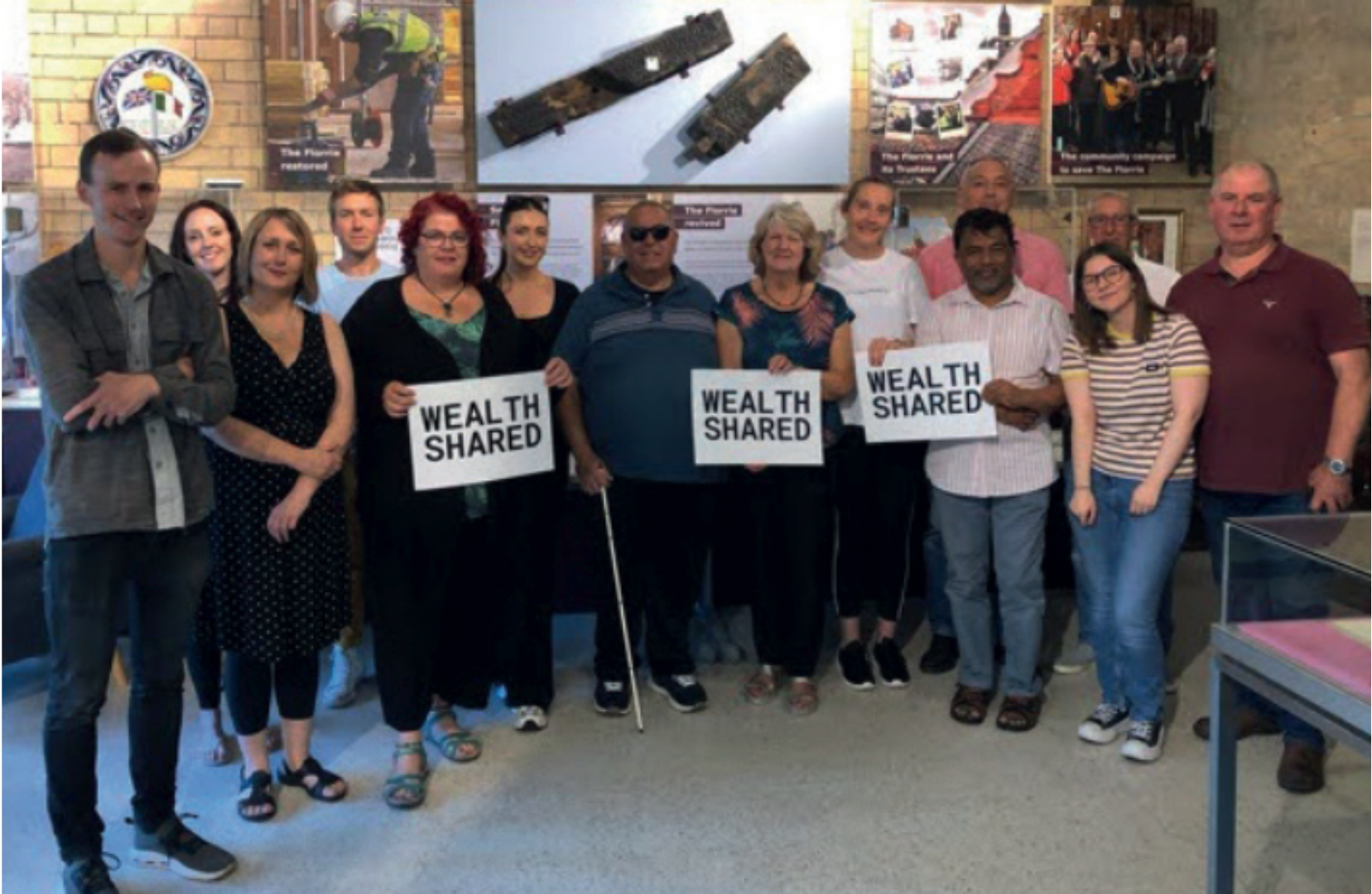
David Clarke (left) stands with the facilitator and participants of Wealth Shared, a philanthropy experiment where 12 strangers collectively decided how to donate £100,000 of Clarke’s wealth. (Supplied Photo / Wealth Shared)
It sounds like the start of a joke: 12 strangers walk into a community centre and are asked to give away £100,000. But this was no jest.
After his mother died, 33-year-old UK researcher David Clarke decided to donate a portion of his inheritance. But rather than set up a foundation or a donor-advised fund, he devised a novel philanthropic experiment called Wealth Shared.
Clarke sent letters to 600 of his neighbours in Liverpool, inviting their participation in a group process to give away £100,000 ($171,000) of his wealth to charity.
About 40 responded, and a dozen people were randomly selected, including a teacher’s assistant, a tax collector and a retiree.
The rules of the process were simple.
The group had four two-hour meetings over a month to decide.
Funds couldn’t be used for personal enrichment, and the group could select no more than four recipients.
Last summer, motivated by rising poverty and living costs, the group picked four trusted, local Liverpool charities focused on poverty reduction to receive £25,000.
The group includes a community centre, a children’s charity, a network of local schools, and an anchor social service hub.
But while the result was simple, the process was anything but.
Citizens engage in “rigorous” process: Clarke
Over eight hours of discussion, the group explored many of the same thorny questions that occupy the minds of high-paid consultants and philanthropic sector staff, according to a report about the experiment.
In conversations guided by a paid facilitator, the group considered how to best ensure the funds had a long-lasting impact and whether their dollars were better spent locally or abroad.
They worried about ensuring recipient charities spent the money as intended and mused about how much due diligence they should do on their prospective beneficiaries.
They also wondered about giving the money to support local schools and reflected on the relationship between philanthropy and state-funded social services.
Before the third meeting, participants took the initiative to research several prospective recipients and presented those materials to the group.
Based on those presentations, they wondered whether an injection of funds was more helpful for more prominent, well-established organizations or smaller start-up operations.
During the fourth meeting, the group unanimously voted to support four groups discussed in previous meetings.
This process showed that a group of people empowered to make a decision together undertake a “rigorous decision-making process,” Clarke said.
Participatory grantmaking: A growing movement
Clarke says the decision to redistribute some of his inheritance was based on the growing “wealth gap” in the United Kingdom, where the wealthiest fifth of the population owns 63 per cent of the country’s wealth, according to the Fairness Foundation.
In Canada, the wealth gap is even wider. In the third quarter of 2023, 67 per cent of the country’s wealth was owned by the richest fifth of Canadians, according to Statistics Canada.
In addition, Clarke said the experiment was motivated by the growing participatory grantmaking movement.
Over the last two decades, many foundations have empowered community members and prospective beneficiaries to decide how to divide charitable funds.
In December, for instance, the Foundation for Black Communities, a Canadian community foundation, asked local residents and community organizations to serve as the grant applicant reviewers on a $9 million fund for Black communities — one of the most extensive such experiments in Canadian history.
Clarke is also not alone among individual philanthropists in turning to neighbours for philanthropic decision-making.
In January, Austrian heiress Marlene Engelhorn announced she plans to invite 50 citizens to determine how her €25 million ($36.3 million) inheritance should be redistributed.
Clarke is hopeful other philanthropists will consider this approach for the sake of democracy and their wellbeing.
He said that pressure is one of the biggest challenges of giving away a lot of money. When people find out you have funds to distribute, they ask for support.
“This is a way of putting that responsibility in the hands of other people, but in a way that I think is quite healthy,” he said.
Did the process work?
Clarke said it’s not up to him to decide whether or not the process was a success — after all, the whole point was to give the power over to a group of neighbours to make the decision.
But the process was “emotionally rich” — even more so than he had expected.
“It felt like people cared about each other and their community and wanted to do something good,” he said. “I feel proud of this project.”
According to a report about the experiment, participants also reported a sense of satisfaction, pride, and positivity about participating.
Some of the organizations that received the funds said that because neighbours had decided on the grants, it offered an extra morale boost said the report.
In addition to the £100,000 pot, Clarke spent £6,200 on the experiment, £2,200 in payments to participants (£200 each), £3,200 to specialist contributors, and £800 to rent the community centre and offer refreshments.
Your job. Your mission. Your news.
With your support, the sector you're building gets the journalism it deserves, and you get a tax receipt.

Related Articles
Inspirit Foundation’s 100% impact portfolio outperforms benchmark over 10-year period
Inspirit Foundation became the only Canadian foundation to successfully transition 100 per cent of its assets to impact investment in 2022. Since the foundation first made the commitment in 2016, its portfolio has made higher returns than a traditional portfolio would.

Explainer: Modelled after B.C.’s success, Quebec is building its first province-wide rent bank network
Rent banks are one of the few homelessness‑prevention tools that intervene before a crisis, stabilizing tenants at a fraction of the cost of emergency shelters or rehousing
Montreal Sustainable Finance Summit: Inequality makes its way onto companies’ financial risk disclosures
The launch of the TISFD signals that social risk is no longer peripheral to financial stability, but is the next major test of whether markets can adapt to a world in crisis
