New AI tool aims to make Canadian federal politics easier to track
“CanadaGPT” is designed to simplify complex government activity by giving users a clear understanding of what’s happening in Ottawa.
Why It Matters
Tracking political activity can be time-consuming and complicated for the non-profit sector. Using technology to simplify the process could help changemakers make quicker, informed decisions.
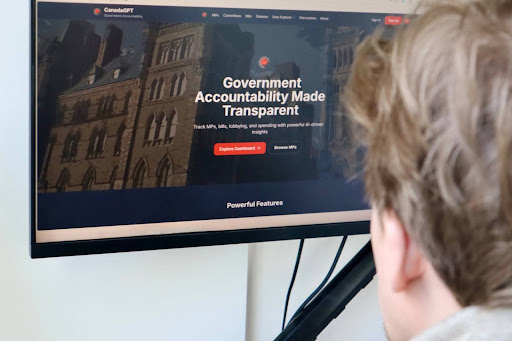
A new AI platform aims to make federal politics more transparent and accessible for Canadians.
“CanadaGPT” connects users to the complete record of Canadian federal parliamentary activity through AI.
The tool allows users to search for every recorded vote, lobbying activity, government contract, donation and Hansard script.
@futureofgood Is this something you’d use? #Canada #Government #Politics #nonprofitsoftiktok ♬ original sound – Future of Good
For the average Canadian, the process can often be time-consuming and confusing, said creator Mathew Dufresne.
“Things like the lobbying database and so forth, if you want to check into that, you have to be some kind of like, Excel wizard or something, to be able to take that data and put it into a form where you can actually do analysis with it,” said Dufresne, the founder of Connexxia.ai, the program behind CanadaGPT.
Dufresne’s passion for politics, paired with his work in the technology sector, led him to create CanadaGPT, which he says is the first of its kind in the country.
“If information was radically available to Canadians, they could ask their own questions and then they could find the answers that are rooted in objective truth and instead of made-up stuff,” he said.
The complexity of Canada’s government can make it hard to dispel misinformation,he added.
However, unlike many AI platforms, CanadaGPT doesn’t offer opinions, said Dufresne.
Instead, it pulls information directly from parliamentary sources, allowing users to make their own conclusions.
“I’m not so much using AI to reason things. I’m using it to help you find things,” Dufrense said.
The tool is accessible to anyone, though he said it could be particularly beneficial for groups working in the social sector.
“Non-profits that would want to use it for research or use it for forwarding their missions…. I’m sure that non-profits would want to get access to this information.”
Tracking
Non-profits are often understaffed and under-resourced, but streamlining the process of tracking policy developments and funding opportunities could make a massive difference for organizations, according to Sam Reusch.
“Anything that makes it easier for groups that represent different interests other than the ones that are typically overrepresented in Ottawa or in Quebec City or wherever, then I think that that’s advantageous,” said Reusch, executive director of Apathy is Boring.
There are millions of recorded Hansard scripts in Canada alone.
“It would take a tremendous amount of effort to go through the entire record of a 15-year politician,” said Reusch.
“If this means that a group can have access to information that previously maybe only a lobbyist with 25 years experience knows how to access, then I think that’s a democratizing force,” she added.
“A tool that would make public engagement easier and more accessible could certainly improve the status quo,” said Simon Lambek, assistant professor of political science at the University of the Fraser Valley.
Lambek researches modern and contemporary political thought and shares that there are many reasons why tracking policymaking can be difficult, from social-economic conditions, misinformation, and oligarchs.
“First, the content itself is often technical and difficult to understand,” he said. “There is often insufficient government transparency and limited media attention to the policy process.”
But even with the platform’s potential advantages, he remains hesitant to integrate AI into politics.
“I am concerned that there are dangers associated with deference to algorithms for policy purposes,” he said.
“Democracy requires that the people, not algorithms or the elites who control them, are in charge.”
Hallucination hesitation
Like other AI platforms, CanadaGPT is not immune to hallucinations.
“The AI’s that exist currently are frequently faulty in their output and present only the most probabilistic rather than the most accurate information,” said Lambek.
However, according to Dufresne, his CanadaGPT platform uses a system called a “GraphRAG”, a technique that significantly reduces the risk of hallucinations, he said.
“The key difference between GraphRAG and conventional AI is what we use the AI for,” said Dufrense.
“Rather than relying on training data or web results to generate an answer, we use AI to formulate a precise database query. The answer comes from the data itself.”
If CanadaGPT’s AI formulates an incorrect query, the database returns an “error” or “no results”, rather than providing a plausible-sounding answer, he said.
“In other words GraphRAG fails safely, it’s far more likely to say, ‘I couldn’t find that,’ instead of making something up.”
While he notes that no AI system is immune to error, he continues to refine his system, he said.
Your job. Your mission. Your news.
With your support, the sector you're building gets the journalism it deserves, and you get a tax receipt.

Author

Related Articles
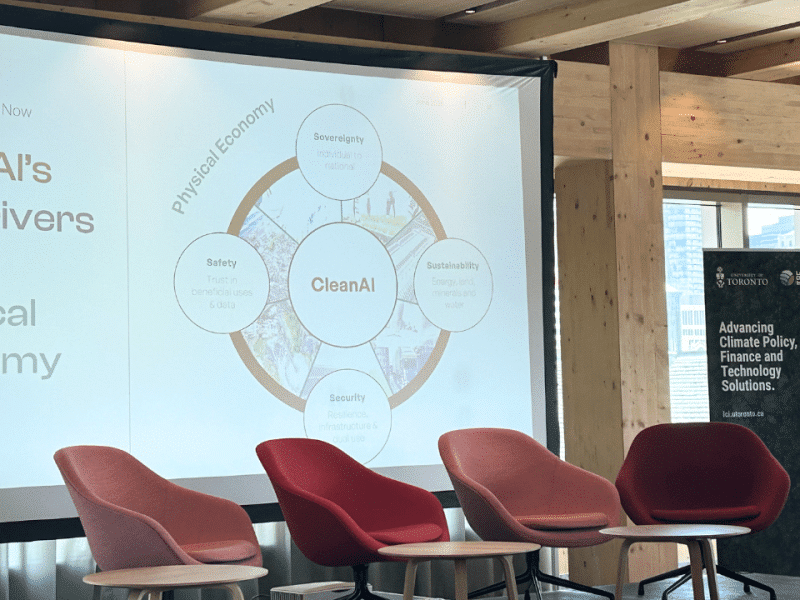
Quarter of all Canadian AI ventures could be categorized as ‘clean AI’: new research
At Toronto Climate Week, the global CleanAI Initiative shared research on the Canadian ecosystem, finding growing investment hubs in Vancouver, the GTA, and Kitchener-Waterloo.

Partnered Partnered content Non-profits are increasingly being targeted for cybercrime. Here’s how your organization can help protect itself
Being cybersecure doesn’t have to be daunting or expensive. A panel of experts discuss ways the non-profit and charitable sector can help protect itself in a constantly changing AI landscape.

Canadian astronaut, entrepreneur donates $15M to Concordia to launch new space school
Montreal’s Concordia University will be the home of the Mark Pathy Space Institute.
