How a digital archive is fighting to save memories of pre-Nakba Palestine
In a story familiar to Indigenous Canadians, an archive has been created to preserve the memories and truths of Palestinians
Why It Matters
Aside from the loss of life during a genocide, the loss of identity and culture is one of the most damaging things invaders can do to a society. But technology is making it easier to prevent that loss, even when resources are scarce.
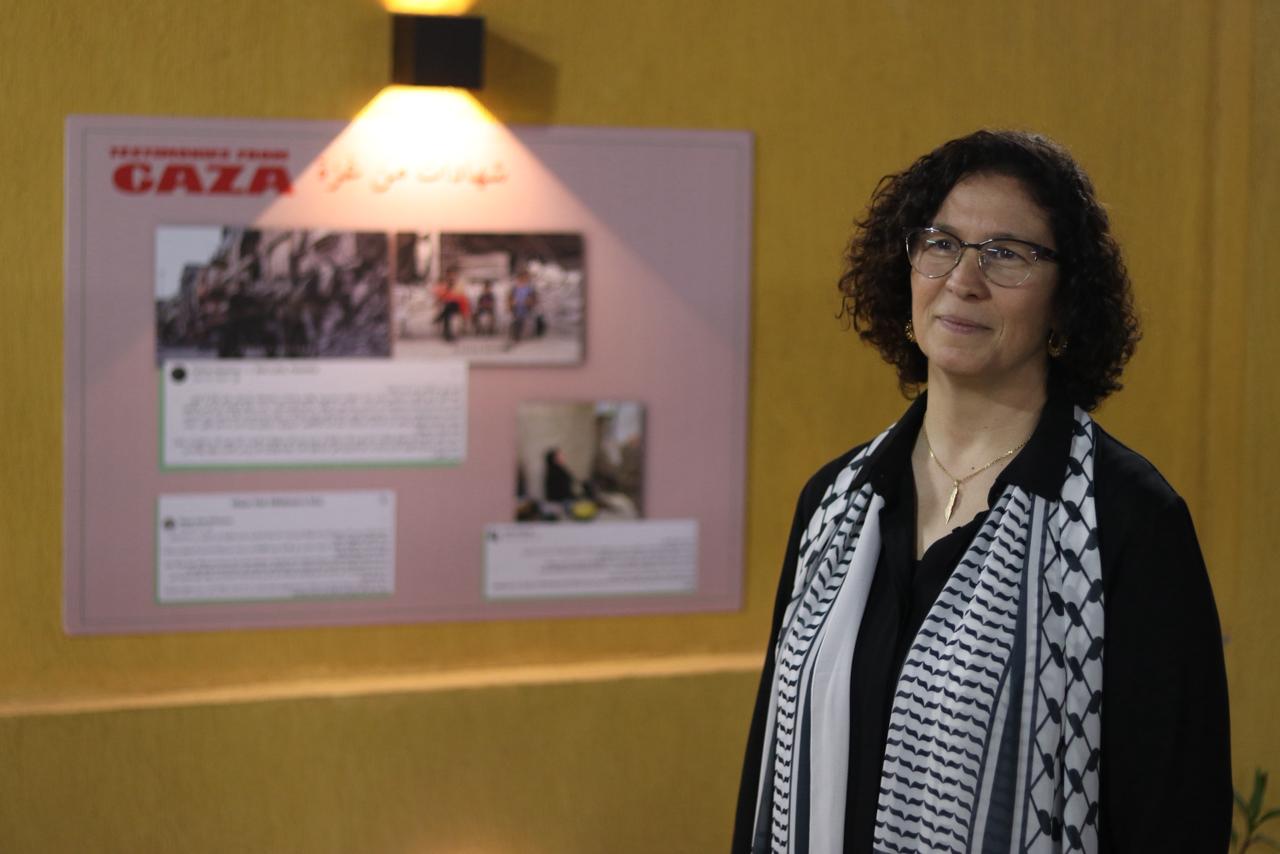
Samar Dwidar at the Palestinian Stories Cairo exhibition, Cairo, 2019. (Samar Dwidar/Supplied.)
By Nadia Mabrouk
It all began in 2018 with a question.
Samar Dwidar, an Egyptian-Palestinian who held Egyptian citizenship through her father, wondered whether the children of Palestinian mothers – now part of a third generation born in exile – carried Palestine in their lives in the same way she did. And how, she asked, is identity truly formed?
She remembered the stories her Palestinian mother told; how they stayed with her, deeply entrenched in memory, keeping the image of Palestine vividly alive. But did all second- and third-generation Palestinians have that same luxury?
She wondered whether, after more than 70 years in exile, these stories were now at risk. Time, after all, has a way of erasing.
These questions led her, in 2018, to begin a research study focusing on women like her mother, Palestinian women who had married non-Palestinians, and how they preserved Palestine in the hearts and minds of their children.
As Dwidar explored her family’s history, she saw how easily Palestinian stories could slip away. With so much of the past scattered or destroyed, preserving memory had become “a necessity,” she said.
That was what finally culminated in Palestinian Stories, a digital archive created to hold not just her family’s history but also the stories of others who feared theirs might vanish too.
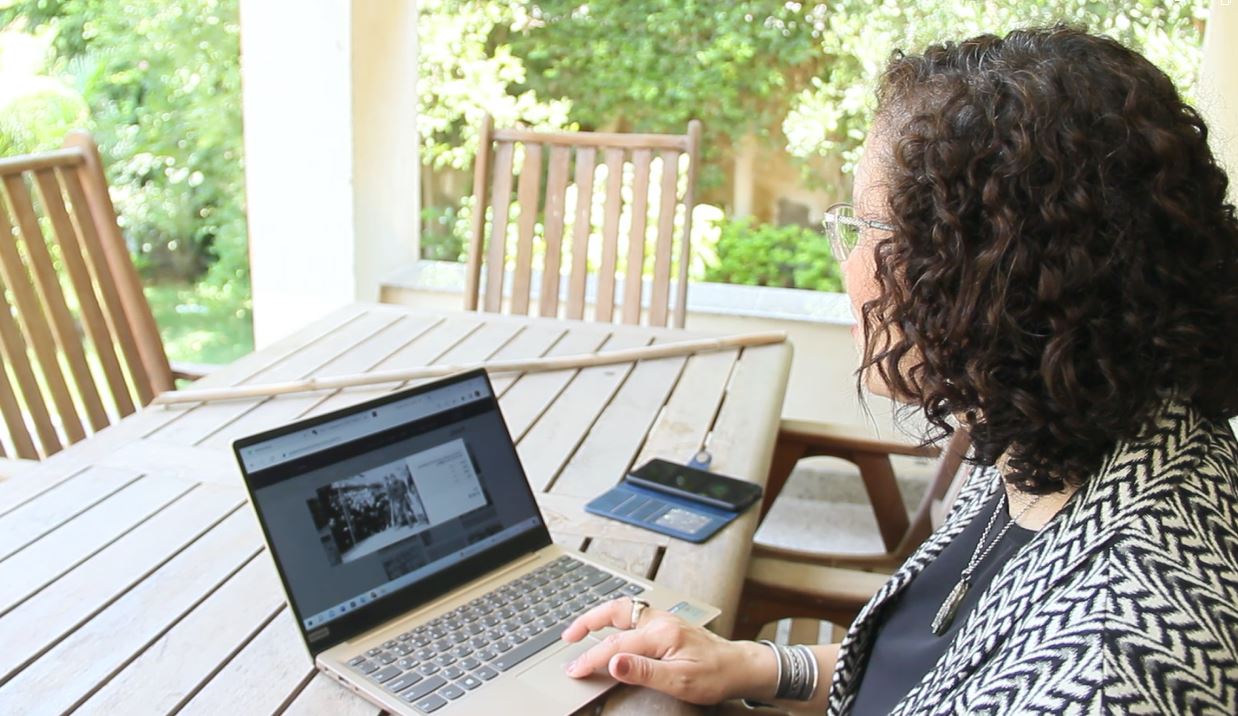
Samar Dwidar browses the Palestinian Stories website in Cairo, Egypt. (Samar Dwidar/Supplied)
The archive now houses not only her own family’s history but also features archival material from 20 families, a significant expansion from the single collection it launched just two years ago.
It also includes a special section dedicated to Gaza during wartime, alongside essays and features in Arabic, English, and other languages. Exhibitions based on the archive have already been held in Egypt, Turkey, and the UK, where one museum has incorporated several letters into its permanent collection.
“Initially, the plan was to publish a research paper through a regional think tank,” she said. “But these questions would unexpectedly grow and give birth to a platform that, hopefully, preserves the stories of Palestinian families before the Nakba, and long after the Gaza wars.”
How it began
But before the website, before the archive, and before any exhibitions, there was the research. Back in 2018, after interviewing a dozen Palestinian women living in Egypt, Lebanon, Jordan, Tunisia, and Saudi Arabia, Dwidar uncovered stories of women who, much like her mother, had fiercely preserved their Palestinian identity and passed it on to their children.
Moved by what she heard, she decided to take a different path. Rather than publish a paper, she would write a novel based on their testimonies. That was her first major shift.
“As I began planning the novel,” Dwidar recalled, “I realized I needed to understand their lives both within Palestine and in the years following the Nakba.”
It was around that time that she turned to her mother for help. Instead of answers, her mother handed her a letter that would change the course of the project for a second time.
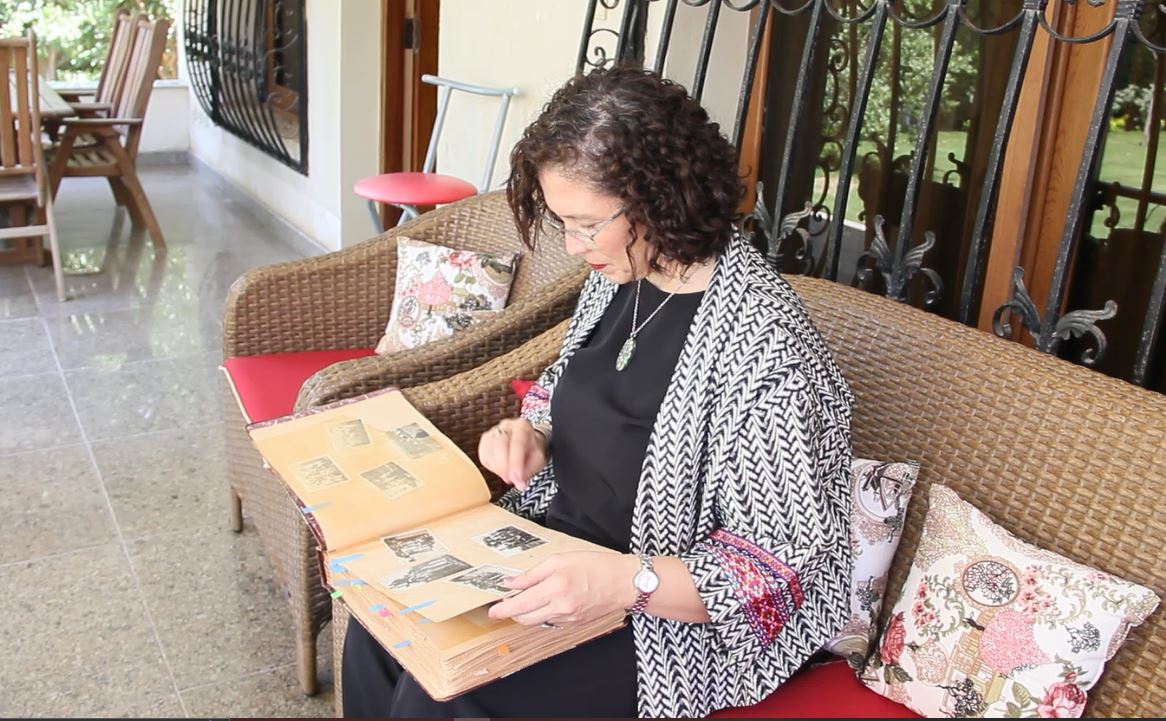
Samar Dwidar browses through her family photographs and scrapbooks. (Samar Dwidar/Supplied)
Dated May 10, 1948, it had been written by her mother’s cousin to her grandfather, Ali Shaath, who was outside Palestine at the time. It described the family’s flight from Jerusalem to Gaza, the confusion of the journey, the thirst, and the relatives lost along the way.
The letter pulled her straight into the Nakba. But when she asked her mother for it again a few months later, she didn’t get the letter. Instead, her mother handed her a box. Inside were more than 350 documents and two photo albums belonging to her grandfather.
“I was born in Cairo in 1969,” Dwidar said. “My grandfather died in 1967, so we never met. But reading his letters, I feel like I know him. His writing was vivid, full of life…it felt like I was walking through Palestine beside him. It was as if the letters found their way to me for a reason.”
That sense of responsibility weighed heavily. Dwidar knew the letters could not be returned to a box. Others needed to read them.
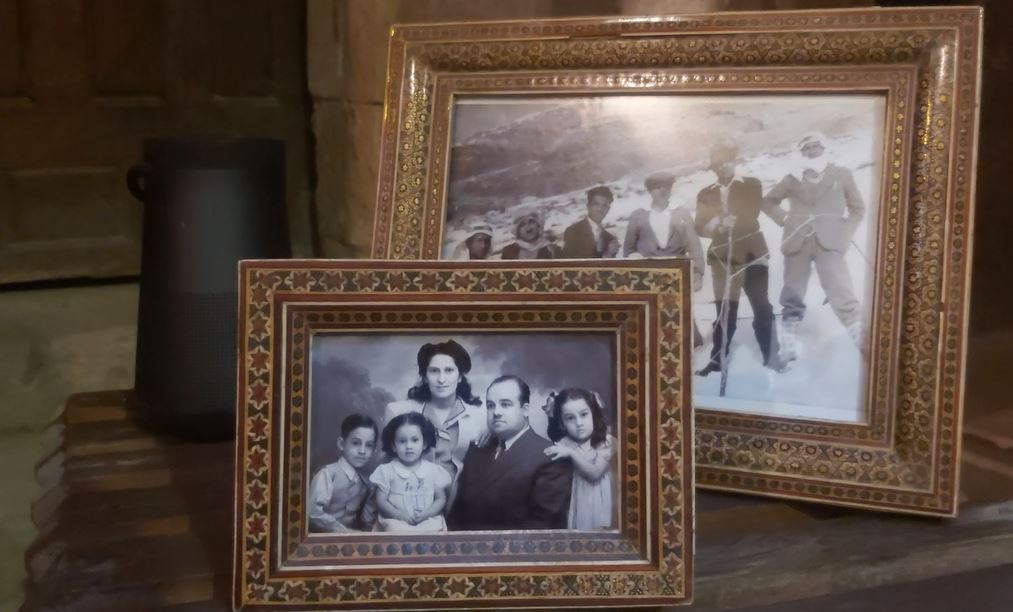
Framed portraits of Dwidar’s family at the Cairo exhibition in 2019. (Samar Dwidar/Supplied)
In 2019, she exhibited them publicly, first in the Palestinian Museum in the United States, and then in the Palestinian Museum and Culture Centre in the UK, where five letters were translated into English and displayed. After that last exhibit, curators requested the letters become part of the museum’s permanent collection.
Then the COVID-19 pandemic arrived. Lockdowns gave her the time to fully immerse herself in the archive. With the help of a friend, she undertook the painstaking task of cataloging the letters, studying archival practices from the UK’s National Archives, and consulting with experts in preservation and digital archiving. The process involved high-resolution photography, creating physical copies, and storing the originals in acid-free archival folders.
Every document was logged with metadata: date, location, sender and recipient, and a brief synopsis.
By the end of the pandemic lockdown, her family’s archive was complete. But as she dug deeper and spoke with archivists and digital historians, she realized it couldn’t end there. That insight became the foundation for Palestinian Stories, or Hikayat Falastiniya, which launched in 2023.
The site allows families to upload their own documents and photographs and determine their visibility, whether they are viewable to the public or restricted to family members.
“In the media,” she said, “Palestinians are too often depicted as either heroes or terrorists. What’s lost is the human being…their dreams, their fears, their achievements and failures. That’s what this archive is for.”
Testimonies from Gaza
Just months after Hikayat Falastiniya launched in 2023, war broke out in Gaza once again. Dwidar, along with a team of volunteers, began working to document what she describes as “the ongoing genocide.”
“During the Nakba, Palestinians had neither the tools nor the awareness to document what was happening to them,” she said.
“Now, we have both. We have no excuse not to archive.”
Within ten days of the conflict’s start, the team launched a new project within the platform, titled Testimonies from Gaza. It documents personal stories, photographs, and video evidence from inside the besieged strip. But the work has taken a heavy toll on the initiative’s team..
“Most people can choose to look away from the horrors of war,” she said. “Archivists cannot. We have to watch every video, sometimes over and over, to ensure it’s properly documented.”
The effort is vital, not only for remembrance but for accountability.
“Social media may delete these posts. Algorithms can bury them. And the people who give these testimonies, many of them don’t survive. That’s already happened more than once,” she added.
Among those leading the documentation is journalist Liqa’ Al-Saadi, a Palestinian from Khan Younis who relocated to Cairo four years before the war. Together with Dwidar and other volunteers, she helps ensure the stories of Gaza are not lost in the digital tide.
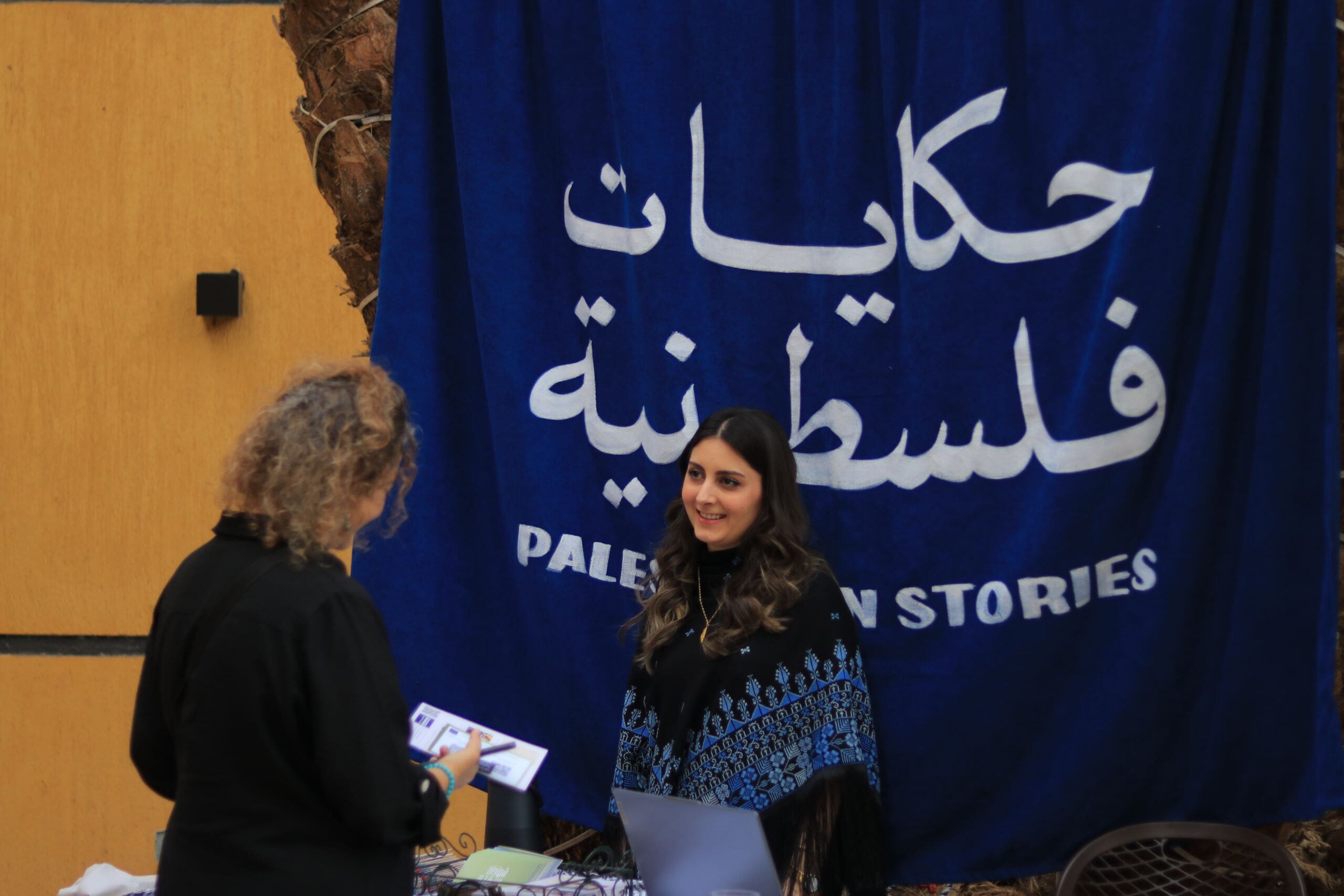
People at the Palestinian Stories Cairo exhibition in 2025. (Samar Dwidar/Supplied)
Al-Saadi lived through the Great March of Return and three wars before relocating to Cairo four years ago. But as the bombs fell on Gaza once again in 2023, she was pulled back emotionally into the trauma she had once physically escaped.
Working on the platform became a kind of reckoning – a way to confront the persistent burden of survivor’s guilt, the psychological wound of asking: Why did I survive when so many others didn’t? Her family remains in Gaza, and each new message, each name in the news, hits close to home.
Al-Saadi not only coordinates volunteers for the project but also engages directly in documentation, which includes interviewing survivors, collecting witness statements, and compiling intimate profiles of the dead.
“It’s emotionally exhausting,” she admitted. “You listen to story after story of murder and torture. You gather details about the martyrs until they become familiar, friends, even. And then you grieve for them.”
The emotional cost is steep. Volunteers often suffer from burnout. The project’s previous coordinator, Ameera Loqma, had to step away entirely, overwhelmed by the psychological toll of handling tragedy on a daily basis.
But Al-Saadi believes the project is essential.
“What’s posted on social media can be deleted or restricted at any time,” she said. “And then there’s the constant doubt, the denial, the distortion.”
She recalls a recent case that drew widespread skepticism: the death of nine children belonging to a Palestinian doctor. Despite clear evidence, many questioned the validity of the story.
“That’s why this archive matters,” she says. “To preserve truth before it disappears.”
Familiar to Canadians
The story is familiar to Canada’s Indigenous peoples.
Indigenous peoples in Canada, who many argue also experienced genocide at the hands of the British, then Canadian governments, fought for years to have their stories acknowledged, recorded and preserved.
Today, the National Centre for Truth and Reconciliation at the University of Manitoba is home to a vast archive relating to the experiences of Indigenous children forced to attend so-called Indian Residential Schools between 1830 and 1996.
Many children died in the institutions.
“We hope the website provides the necessary starting point … and inspiration for all Canadians to learn the truth and start or continue our shared journey for reconciliation,” said Stephanie Scott, the centre’s executive director, when an online version of the archive called Access to Memory was launched in 2021.
The system provides survivors and the public with access to archival material, making it easier to look up schools, dates, statements, and related items such as attendance records, photos, objects, and information about acts of reconciliation.
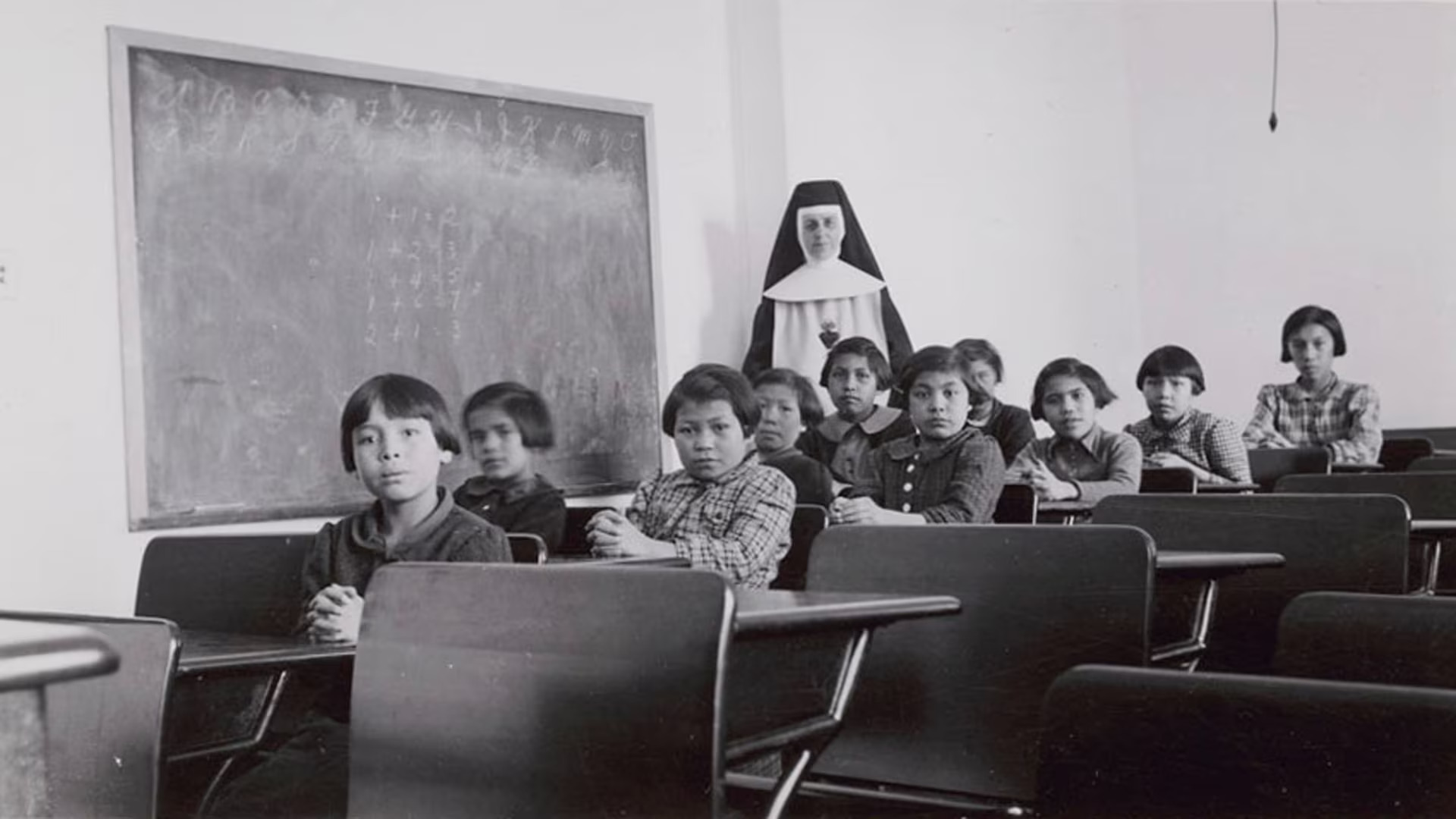
A group of female students and a nun pose in a classroom at Cross Lake Indian Residential School in Cross Lake, Manitoba in February 1940. (Dept. Indian and Northern Affairs/Library and Archives Canada)
Library and Archives Canada has also committed to adopting the United Nations Declaration on the Rights of Indigenous Peoples to ensure records on residential schools are accessible to the public, something that was called for in the Truth and Reconciliation Commission’s 94 Calls to Action.
The federal department has also expanded Project Naming, which aims to identify First Nations, Inuit and Métis Nation Peoples in thousands of archival images.
Those who study the issue say the erasure of Indigenous identities is a crucial component of settler colonialism, one that’s often used to justify occupation and dispossession: someone who doesn’t exist can be neither victim nor survivor.
Writing for Briarpatch Magazine, Lebanese historian and activist Jamila Ghaddar relays that, during the Nakba, Zionist militias “systematically looted, stole, destroyed, and hid Palestinian records and books.”
Later, the Israeli state removed archival material from Lebanon, Syria, Jordan, Iraq, and Egypt.
The organization Librarians and Archivists with Palestine reported that Israeli soldiers destroyed the Central Archives of Gaza City in 2023: 150 years of records were lost.
The Omari Mosque Library, the Al-Israa University Library and the National Museum were also bombed and looted, along with Gaza’s largest public library.
From Gaza, others have joined this digital resistance against forgetting. Salwa Al-Rayyes, whose family home was obliterated during the war, published her family’s surviving archive on Hikayat Falastiniya.
“I found out about the project through a meeting with Samar Dwidar in Cairo,” Al-Rayyes said. “That’s when I knew I needed to preserve what was left of our family’s history.”
Her wedding photos, portraits of her parents, and dozens of official family documents were erased when her home was destroyed.
“It felt like the 28 years I spent in Gaza had been wiped away,” she said.
Determined to salvage what she could, she reached out to relatives across the diaspora. They began scanning and sending back photos, letters, and records, each a fragment of a life interrupted.
“In doing this,” she explained, “I preserved the heritage of my family for the future. When the war ends, I plan to ask more friends to share their archives too. Because many families were entirely erased this time, not even their archives remain.”
This article is published in collaboration with Egab. With files from Shannon VanRaes.
Your job. Your mission. Your news.
With your support, the sector you're building gets the journalism it deserves, and you get a tax receipt.

Related Articles
Caste, corruption, and the collective: Crow’s Theatre’s A Fine Balance confronts India’s enduring inequities with humour and heartbreak
The Giller Prize-winning novel explores the realities of caste violence in India, which has been adapted into a powerful stage production in Toronto.
‘Canada must not go down that road’: More than 250 organizations demand investigation into CBSA after student protesters issued exclusion orders
The students were protesting after being denied post-graduation work permits they say they were eligible for when they enrolled at Portage College.
Half of Filipino immigrants to Canada are overqualified for their jobs: StatCan
‘For the relationship that Canada has with the Philippines, it seems like it’s lopsided.’
